
India received USD 71 billion in foreign direct investment in FY2024-25, making it the fourth-largest FDI destination globally. The EU-India Free Trade Agreement concluded in January 2026 has accelerated European interest in the Indian market to levels not seen since the 2007-08 boom cycle.
Yet for every European company that enters India successfully, at least two abandon their efforts within the first 18 months — typically not because the market was wrong, but because the entry was poorly structured. Market entry consulting exists to compress learning curves, avoid regulatory traps, and convert strategic intent into operational reality.
This guide explains what market entry consulting covers, how different consulting models compare, what a realistic engagement looks like in terms of timeline and cost, and how to select the right advisor for your specific situation. For a focused comparison of India market entry advisory vs. Big Four firms, see our companion analysis.
Why India, Why Now
Three structural forces are converging to make 2026-2028 the most favourable window for European market entry into India in a generation.
The FTA Effect
The EU-India Free Trade Agreement eliminates tariffs on 96.6% of tariff lines over a seven-year implementation period. For industrial goods — the category most relevant to European manufacturers — the majority of tariff reductions take effect within the first three years. A European machinery manufacturer currently paying 7.5-10% import duty will see that reduced to zero, fundamentally altering the competitive equation against Chinese and Japanese suppliers who lack equivalent preferential access.
But tariff reduction alone is insufficient. The FTA introduces rules of origin requirements, conformity assessment provisions, and services liberalisation clauses that create both opportunities and compliance obligations. Companies that understand these mechanisms early will capture first-mover advantage.
India's GDP Trajectory
India's GDP is projected to reach USD 5 trillion by 2027 and USD 7 trillion by 2030, according to IMF estimates. More importantly for European industrial companies, India's manufacturing sector is growing faster than GDP — driven by the Production Linked Incentive (PLI) schemes that have allocated over USD 26 billion across 14 sectors including electronics, pharmaceuticals, automotive components, specialty steel, and advanced chemistry.
This is not speculative growth. Foxconn, Samsung, and Tata have already committed over USD 40 billion in new manufacturing capacity in India between 2024 and 2028. The supply chain ecosystem these investments create generates derived demand for European machinery, components, and technical services.
The China+1 Imperative
The EU Corporate Sustainability Due Diligence Directive (CSDDD) and Carbon Border Adjustment Mechanism (CBAM) are making supply chain origin a compliance issue, not merely a cost consideration. European companies that concentrated manufacturing in China are actively diversifying. India, Vietnam, and Mexico are the three primary alternatives — and India offers the largest domestic market of the three by an order of magnitude.
What Market Entry Consulting Covers
Market entry consulting for India is not a single service — it is a structured engagement that typically spans four phases, each with distinct deliverables.
Phase 1: Market Assessment (4-8 weeks)
The foundational phase answers the question: Is this market viable for your specific product, at your scale, within your risk tolerance?
Deliverables typically include:
- Market sizing: Total addressable market, serviceable available market, and realistic serviceable obtainable market for your product category in India
- Competitive landscape: Identification of domestic competitors, existing importers, and other foreign entrants — with pricing benchmarks
- Regulatory mapping: Identification of all applicable regulations (BIS certification, FSSAI, CDSCO, PESO, or sector-specific requirements) and their implications for your product
- Channel analysis: Distribution models, key intermediaries, and route-to-market options
- Preliminary financial model: Revenue projections, cost structure, and break-even analysis under different entry scenarios
Phase 2: Entry Strategy (4-6 weeks)
With market viability confirmed, this phase defines how you enter.
Key decisions include:
- Legal entity structure: Wholly-owned subsidiary (WOS), joint venture, branch office, liaison office, or project office — each with different implications under the Companies Act 2013 and FEMA (Foreign Exchange Management Act) regulations
- Location selection: India is not one market. Choosing between Mumbai, Delhi-NCR, Bangalore, Chennai, Pune, Hyderabad, or Ahmedabad depends on your sector, customer base, and operational requirements
- Partner identification: If a JV or distribution model is chosen, identification and preliminary vetting of potential partners
- Tax and transfer pricing structure: India's corporate tax regime (effective rate 25.17% for new manufacturing companies), GST implications, and transfer pricing documentation requirements under Section 92 of the Income Tax Act
- IP protection strategy: Trademark and patent registration under Indian law, trade secret protections, and contractual safeguards
Phase 3: Implementation Support (3-6 months)
This is where strategy becomes operational:
- Entity incorporation: Filing with the Registrar of Companies, obtaining PAN, TAN, GST registration, and sector-specific licences
- Bank account opening: A process that routinely takes 4-8 weeks and requires meticulous documentation
- Office/facility setup: Real estate identification, lease negotiation, and fit-out management
- Hiring: Recruitment of initial team (typically a country manager and 2-5 operational staff), employment contracts compliant with Indian labour law
- Regulatory compliance: BIS certification applications, import-export code (IEC) registration, and industry-specific approvals
Phase 4: Post-Entry Support (ongoing)
The first 12-18 months after entry are the highest-risk period. Ongoing support may include:
- Compliance monitoring: Annual filings, GST returns, transfer pricing documentation
- Market development: Customer introduction, trade show participation, government liaison
- Operational troubleshooting: Supply chain issues, customs clearances, labour disputes
- Strategic review: Quarterly assessment of market performance against projections
Consulting Models: Big 4 vs Boutique vs DIY
European companies entering India broadly choose between three consulting models. Each has legitimate use cases — and significant limitations.
The Big 4 and Global Strategy Firms
Firms: Deloitte, EY, PwC, KPMG, McKinsey, BCG, Bain
Best for: Large enterprises (EUR 500M+ revenue) entering India as a strategic market, requiring board-level credibility and comprehensive coverage across tax, legal, HR, and strategy.
Typical engagement: EUR 150,000-500,000+ for a full market entry study and implementation support. Timeline: 6-12 months.
Strengths: Deep bench of specialists, offices across India, ability to handle complex tax structuring and M&A transactions, recognised brand that provides internal stakeholder confidence.
Limitations: Junior consultants often execute the work. Frameworks tend to be generic — the India market entry playbook from a Big 4 firm in Frankfurt looks remarkably similar regardless of whether you manufacture pumps or pharmaceuticals. Limited operational hand-holding. Incentive structure favours large, long engagements rather than efficient execution.
Boutique Advisory Firms
Firms: Tensor Advisory, Tecnova, Kanvic, India Advisory Group, and a handful of others
Best for: Mid-market companies (EUR 10M-500M revenue) that need sector-specific expertise, hands-on execution support, and a partner who understands both European business culture and Indian operational reality.
Typical engagement: EUR 15,000-80,000 depending on scope. Timeline: 3-8 months.
Strengths: Senior practitioners (not junior analysts) do the work. Deep India operational experience. Typically faster and more responsive. Cost structure aligned with mid-market budgets. Many boutique advisors have lived and worked in both Europe and India.
Limitations: Smaller teams mean capacity constraints. May not have in-house tax or legal capability (though most partner with specialist firms). Less useful for complex M&A or restructuring.
The DIY Approach
Best for: Companies with existing India experience (e.g., an Indian-origin founder or executive), very simple entry models (e.g., appointing a single distributor), or companies with internal business development teams that have bandwidth for a 12-18 month learning curve.
Typical cost: Internal time (substantial), travel (EUR 15,000-30,000/year), and legal/accounting fees (EUR 10,000-25,000).
Strengths: Complete control. No advisory fees. Deep organisational learning.
Limitations: Every mistake is first-person. Regulatory missteps can be expensive — a BIS certification rejection, for example, costs 6-12 months and EUR 15,000-30,000 in wasted testing fees. Entity structuring errors can create permanent tax inefficiencies. Without local networks, partner identification relies on trade shows and cold outreach.
What to Expect: Timeline, Deliverables, and Cost
Realistic Timeline
| Phase | Duration | Key Milestone |
|---|---|---|
| Market assessment | 4-8 weeks | Go/no-go decision with data |
| Entry strategy | 4-6 weeks | Board-ready strategy document |
| Entity incorporation | 8-16 weeks | Legal entity operational |
| Initial hiring | 4-8 weeks | Country manager in place |
| First revenue | 6-18 months | Depends on sales cycle |
Total from engagement start to first revenue: 12-24 months for most European industrial companies. Companies selling through distributors can be faster. Companies requiring BIS certification or manufacturing setup should plan for the longer end.
Deliverables You Should Expect
A credible market entry consultant should provide, at minimum:
- Written market assessment report with data sources cited — not a PowerPoint deck with stock photography (see a market intelligence report example for the sections a serious one covers)
- Competitive intelligence based on primary research (interviews, site visits), not just desk research
- Financial model with explicit assumptions that you can stress-test
- Legal entity recommendation with a comparison of alternatives and tax implications
- Implementation roadmap with named responsible parties and realistic timelines
- Regulatory compliance checklist specific to your product category
- Risk register identifying the top 10 risks and mitigation strategies
Cost Benchmarks
| Scope | Boutique Advisory | Big 4 |
|---|---|---|
| Market assessment only | EUR 10,000-25,000 | EUR 50,000-150,000 |
| Full entry strategy | EUR 25,000-50,000 | EUR 100,000-300,000 |
| Implementation support (6 months) | EUR 15,000-40,000 | EUR 80,000-200,000 |
| End-to-end (assessment through operational) | EUR 40,000-80,000 | EUR 200,000-500,000+ |
These ranges reflect European mid-market engagements. Companies entering with manufacturing intent or M&A strategies will fall at the higher end.
How to Choose the Right Consultant: Five Criteria
1. India Operational Experience — Not Just Strategy
Ask whether the advisory team has personally incorporated entities in India, managed BIS certification processes, hired Indian employees, and resolved customs disputes. Strategy slides are abundant. Operational scar tissue is rare.
2. Sector Specificity
India's regulatory environment varies dramatically by sector. A consultant who has guided pharma companies through CDSCO and WHO GMP requirements may have limited relevance for an automotive components manufacturer navigating ARAI homologation. Ask for sector-specific case studies.
3. European Cultural Fluency
The most effective India market entry consultants are bicultural — they understand European decision-making processes (board approvals, compliance requirements, risk committees) and Indian business culture (relationship-driven negotiation, bureaucratic navigation, hierarchical communication). This is not a nice-to-have. Misalignment between European expectations and Indian operational reality is the single most common source of failed market entries.
4. Transparent Pricing and Scope
Beware of consultants who propose open-ended retainers without defined deliverables. Credible firms will provide a fixed-fee proposal with clearly scoped phases, named deliverables, and defined decision gates where you can pause or terminate.
5. Network Quality
India is a relationship-driven market. Your consultant's network — access to government officials, industry associations (CII, FICCI, ASSOCHAM), potential partners, and sector experts — directly affects the speed and quality of your market entry. Ask for specific examples of introductions they have facilitated.
Sector-Specific Considerations
Pharmaceuticals and Medical Devices
India's pharma market (USD 50+ billion, third-largest by volume globally) is heavily regulated. Entry requires navigation of CDSCO (Central Drugs Standard Control Organisation) for drug approvals, BIS for certain device categories, and compliance with the revised Schedule M (India's GMP standard, aligned with WHO GMP since 2024). The PLI scheme for pharmaceuticals (INR 15,000 crore allocation) is creating significant demand for European equipment and APIs.
Key regulatory bodies: CDSCO, BIS, FSSAI (for nutraceuticals), NPPA (pricing)
Automotive and Components
India's automotive market is the third-largest globally. Entry models range from direct export (subject to ARAI/ICAT homologation) to JV manufacturing. The PLI scheme for automotive and advanced chemistry cells has attracted commitments exceeding USD 8 billion. European Tier 1 and Tier 2 suppliers are actively establishing Indian operations.
Key regulatory bodies: ARAI (Automotive Research Association of India), ICAT, BIS
Industrial Machinery
The FTA's tariff elimination on industrial machinery (from 7.5-10% to 0% by year 3) makes this one of the most immediately affected sectors. European CNC, packaging, and processing equipment manufacturers should prepare pricing strategies, distribution agreements, and after-sales service models now.
Key consideration: After-sales service capability is the primary competitive differentiator in India. Indian buyers will choose a marginally inferior product with local service over a superior product supported only from Europe.
Chemicals and Specialty Materials
India's chemicals market (USD 220 billion, fifth-largest globally) is growing at 9-10% annually. Entry requires compliance with the draft Indian Chemical Management and Safety Rules (analogous to EU REACH), BIS certification for certain categories, and careful navigation of anti-dumping duties that India applies aggressively in chemicals.
Key regulatory bodies: DCPC (Department of Chemicals and Petrochemicals), BIS, DGFT
Food Processing
India's food processing sector is growing at 15-20% annually, driven by urbanisation, rising incomes, and the PLI scheme for food processing (INR 10,900 crore). European companies entering this sector must navigate FSSAI (Food Safety and Standards Authority of India) registration and licensing, which applies to all food products, ingredients, and food-contact materials.
Key regulatory bodies: FSSAI, BIS (for food-contact packaging), APEDA (for exports)
Frequently Asked Questions
How long does it take for a European company to start selling in India?
For distribution-based entry without regulatory barriers: 6-12 months. For entry requiring entity incorporation: 9-18 months. For entry requiring BIS certification or manufacturing setup: 12-30 months. These timelines assume competent advisory support; DIY approaches typically take 50-100% longer.
Do I need to set up a legal entity in India?
Not necessarily. If you plan to sell through a distributor, you can export directly without an Indian entity. However, if you want to hire employees, hold inventory, invoice Indian customers in INR, or participate in government tenders, you will need an entity — typically a Private Limited Company incorporated under the Companies Act 2013.
What is the minimum investment required?
India does not have a minimum capital requirement for most types of companies (the INR 1 lakh minimum paid-up capital for private limited companies was removed in 2015). However, realistic budgets for a meaningful market entry range from EUR 50,000 (distribution-only model) to EUR 500,000+ (entity with local team and warehouse).
Can I use my EU CE marking instead of BIS certification?
No. CE marking and BIS certification are separate regulatory systems with no mutual recognition. If your product falls under compulsory BIS certification (approximately 370 product categories as of 2026), you must obtain BIS certification regardless of existing CE marks. The EU-India FTA includes provisions for future mutual recognition of conformity assessment, but implementation timelines are not yet defined.
How is Tensor Advisory different from the Big 4?
Tensor Advisory specialises exclusively in EU-India cross-border consulting for mid-market industrial companies. Our senior practitioners do the work directly — there is no delegation to junior analysts. We combine European business fluency with deep India operational experience, and our pricing reflects mid-market budgets rather than enterprise overhead structures.
What does a typical market entry engagement cost?
A boutique advisory engagement for end-to-end market entry support typically ranges from EUR 40,000-80,000. This covers market assessment, entry strategy, entity incorporation support, and initial operational setup. The Big 4 equivalent typically costs EUR 200,000-500,000+. See the cost benchmarks section above for detailed breakdowns by phase.
Which Indian cities are best for European companies?
It depends on your sector. Mumbai is India's financial capital and best for banking, financial services, and trading operations. Bangalore leads in technology and R&D. Chennai and Pune are automotive hubs. Hyderabad is strong in pharmaceuticals and IT. Delhi-NCR offers proximity to government and North Indian markets. Your consultant should recommend locations based on customer proximity, talent availability, and operational costs.
How do I protect my intellectual property in India?
India is a signatory to major international IP treaties (Paris Convention, TRIPS, Madrid Protocol). Trademark registration is straightforward and should be filed early. Patent protection is available but enforcement can be challenging. Trade secret protection relies primarily on contractual mechanisms (NDAs, employment agreements). A comprehensive IP strategy should be part of your entry plan.
Next Steps
If you are evaluating India market entry and want a structured assessment of the opportunity for your specific product and sector, Tensor Advisory offers a complimentary 30-minute briefing call. No sales pitch — just a candid assessment of whether India makes sense for your business, and if so, what the realistic path looks like.
Tensor Advisory is a cross-border consulting firm specialising in EU-India market entry for European industrial companies. We provide market intelligence, entry strategy, regulatory navigation, and implementation support.
Read the methodology, source date and confidence level before carrying a number into a decision.
What does the FTA change for your product?
Open the Tariff Calculator →Every figure above is dated and source-attributed. Nothing arrives as an unexplained number.
- Sources are listed in the report methodology and verified against the publication date.
- Regulatory outcomes remain subject to entry-into-force dates and line-level classification.
Continue the research
Choose the next evidence step
Use this briefing as context, then choose the format that fits the question you need to answer.
Standard report
Start with a dated baseline
Use a fixed-scope report when you need a sourced answer to a defined market question.
ExploreCustom MIR
Shape the question around your case
Carry this article’s question into one target market, sector, corridor, and decision brief.
ExploreScoping call
Talk through the decision
Bring the corridor, timing, and evidence gap to a call before choosing the right format.
ExploreRelated Intelligence
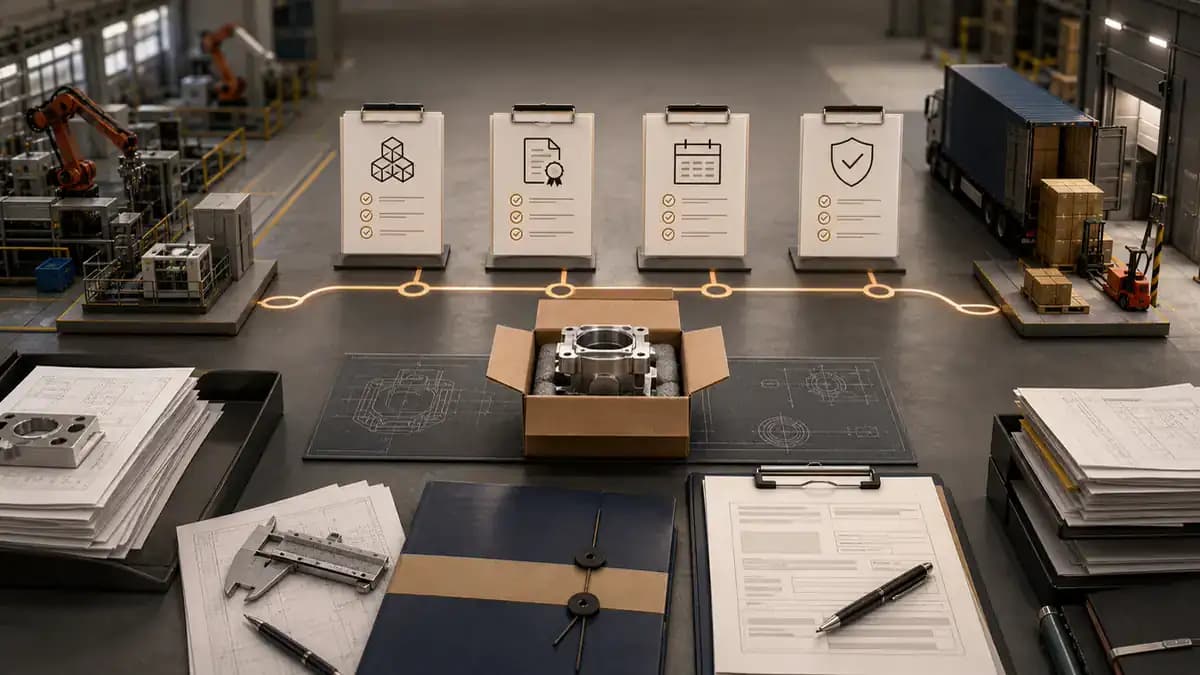
India UK Trade Deal: Manufacturer Action Checklist
India–UK trade deal checklist for manufacturers: verify classification, origin, schedules and implementation before changing price, sourcing or market-entry plans.
Manufacturing in India vs Mexico: Buyer Guide
A sourced India-versus-Mexico manufacturing sequence for Western buyers: market, trade treatment, regulation, suppliers, logistics, and site diligence.
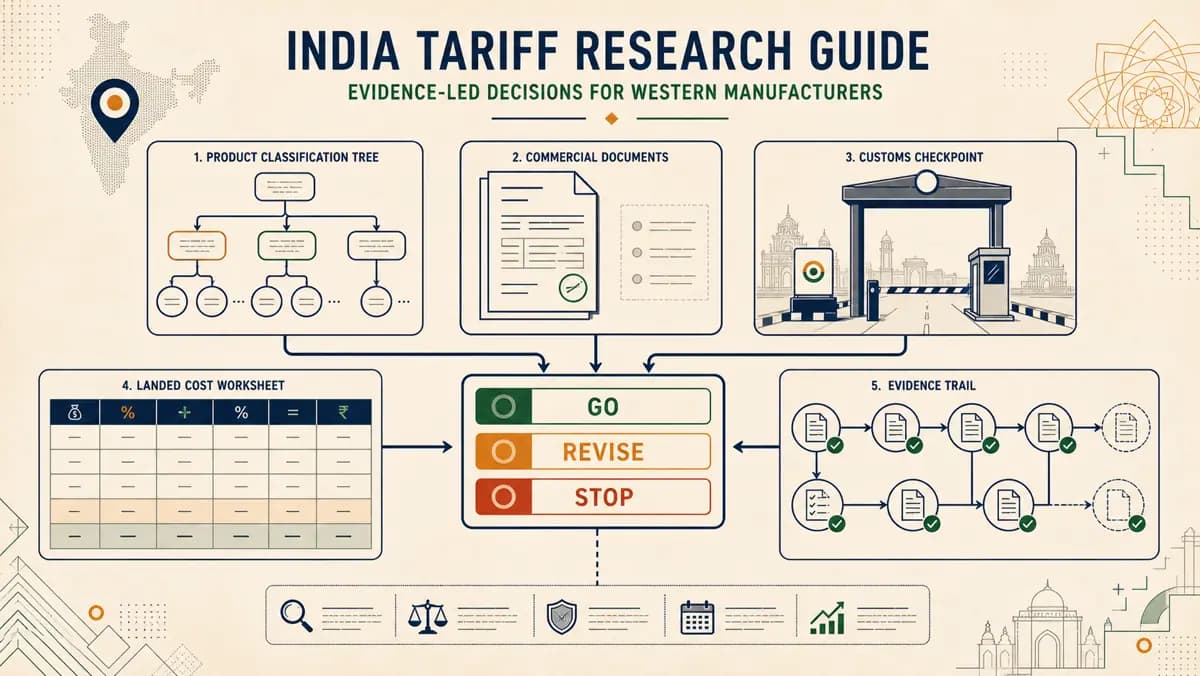
India Tariffs: A Manufacturer's Line-Level Check
Separate India tariff headlines from the line-level import evidence needed before quoting, sourcing or entering the market.