By Tensor Advisory | March 2026
Executive Summary
- On February 28, 2026, India and the EU released the provisional text of their landmark free trade agreement — just one month after concluding negotiations on January 27.
- The agreement spans 20 chapters covering goods, services, digital trade, intellectual property, investment, SME provisions, and dispute resolution.
- Tariff schedules are not yet included — they will follow separately. This means the headline tariff reductions (cars from 110% to 10%, wine from 150% to 20-30%, chemicals from 22% toward zero) are agreed in principle but the detailed product-level schedules are pending.
- The FTA includes a dedicated SME chapter requiring both sides to publish market access guidance and establish SME contact points.
- Ratification timeline: expected signing in early 2027, with full implementation following. This gives European SMEs a 12-18 month window to prepare before the tariff reductions take effect.
- Bilateral merchandise trade already stands at $136.54 billion (2024-25), with a stated target to double it by 2032.
Why This Matters Right Now
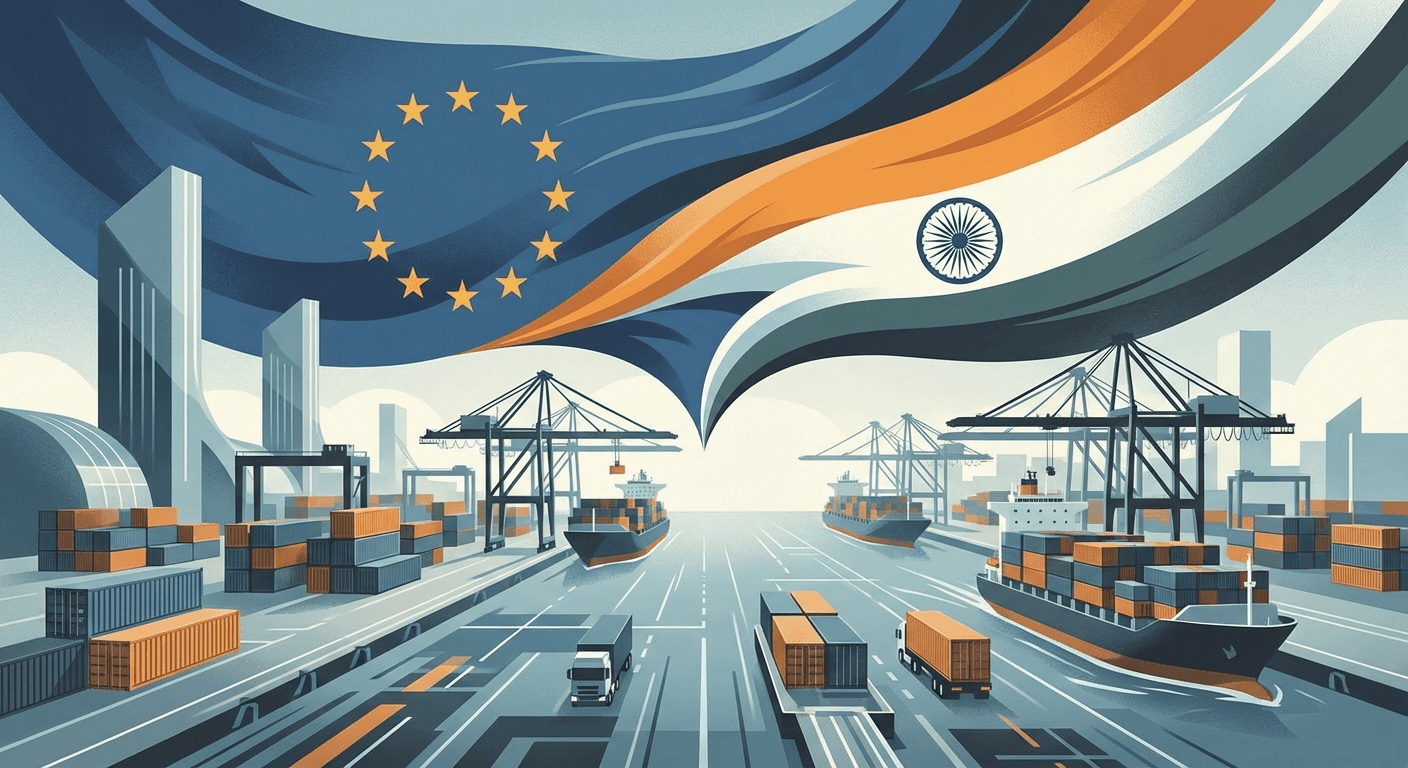
European Commission President Ursula von der Leyen called this the "mother of all deals" — and the numbers back that up. This is the largest bilateral trade agreement either the EU or India has ever signed, covering nearly two billion people and roughly a quarter of global GDP.
But for European SMEs, the significance isn't the headline. It's the timing.
The provisional text is public. The tariff schedules are pending. Ratification will take 12-18 months. That means you have a window right now — while your competitors are still reading press releases — to position your company for what's coming.
What the 20 Chapters Actually Cover
The chapter-by-chapter summary from the European Commission reveals the scope goes far beyond tariff cuts:
Trade in Goods (Chapters 2-5)
- Market Access: India will progressively eliminate or reduce tariffs on 96.6% of EU exports. Key reductions: automobiles (110% → as low as 10% under a quota of 250,000 vehicles), machinery and electrical equipment (up to 44% → reduced), chemicals (22% → reduced), pharmaceuticals (11% → reduced), aircraft and spacecraft (11% → reduced).
- Rules of Origin: Defines when a product qualifies as "originating" and can claim FTA preferences. Critical for manufacturers with complex supply chains.
- Customs and Trade Facilitation: Streamlined border procedures, advance rulings, and electronic documentation.
- Sanitary and Phytosanitary Measures: Alignment on food safety and agricultural standards.
Trade in Services (Chapter 8)
- Enhanced access for European companies in financial services, maritime transport, telecommunications, and professional services.
- Mobility provisions for business professionals — easier movement of key personnel between EU and India.
Digital Trade (Chapter 11)
- Framework to facilitate digital trade and ensure an "open, secure and trustworthy online environment."
- Covers online sales of goods and services.
- Exclusions: audio-visual services and government procurement.
Intellectual Property (Chapter 12)
- Strengthened IP protections including geographical indications — significant for European food, wine, and luxury goods exporters.
Investment (Chapter 9)
- Liberalised investment framework with protections for European investors in India.
SME Chapter (Chapter 16)
- This is the chapter most European SMEs will miss. It requires both India and the EU to:
- Publish comprehensive market access information on a single digital platform
- Establish dedicated SME contact points
- Cooperate on identifying ways for small companies to benefit from the agreement
- This creates an official, government-backed infrastructure for SME market entry that didn't exist before.
Other Notable Chapters
- Competition Policy (Chapter 13): Level playing field provisions
- Subsidies (Chapter 14): Transparency on state subsidies
- Government Procurement (Chapter 10): Market access for public tenders
- Sustainable Development (Chapter 15): Environmental and labour standards
- Dispute Resolution (Chapter 19): Mediation and settlement mechanisms
What's NOT in the Text Yet
- Detailed tariff schedules (product-by-product reduction timelines)
- CBAM (Carbon Border Adjustment Mechanism) specifics — India receives no special exemption, but comparable treatment to other nations is guaranteed
- The five-year review clause means terms can be renegotiated after implementation
The 3 Things European SMEs Should Do Before Ratification
1. Map Your Product Exposure to the Tariff Reductions
Even without the detailed schedules, you know the direction. If you export machinery, chemicals, pharmaceuticals, automotive parts, or food products to India — or want to — your tariff burden is about to drop significantly.
Action: List every product you export (or could export) to India by HS code. Cross-reference against the announced tariff reduction categories. Estimate the price competitiveness gain. This analysis takes a day, and it will tell you whether India moves from "interesting" to "priority" on your market map.
2. Understand the Rules of Origin — Now
The Rules of Origin chapter determines whether your products qualify for FTA tariff preferences. For companies with complex supply chains (components from multiple countries), this is where deals get made or broken.
Action: Review your supply chain for India-bound products. Identify which components are EU-originating vs. third-country. If a key component comes from outside the EU or India, you may not qualify for preferential tariffs — and restructuring supply chains takes time.
3. Register for the SME Contact Points as Soon as They Launch
The SME chapter creates a new official channel between European small businesses and Indian market access resources. This is exactly the kind of infrastructure that helps SMEs navigate India's regulatory complexity — BIS certification, FSSAI compliance, state-level permits, and banking requirements.
Action: Monitor the European Commission's trade website for the launch of SME contact points. Being among the first to use this channel gives you a structural advantage. A practical EU-India FTA action plan for European SMEs can help sequence that preparation.
What This Means for Different Sectors
| Sector | Current Indian Tariff | Expected Direction | Opportunity |
|---|---|---|---|
| Automotive | Up to 110% | Down to ~10% | Massive — India is the world's fastest-growing large auto market |
| Wine & Spirits | Up to 150% | Down to 20-30% | Premium EU wines become price-competitive for India's growing HNI segment |
| Machinery | Up to 44% | Significant reduction | EU capital goods become more competitive vs. Chinese alternatives |
| Chemicals | Up to 22% | Near elimination | Direct cost advantage for EU chemical exporters |
| Pharmaceuticals | 11% | Reduced | API and equipment exports get a margin boost |
| Food & Agriculture | Varies | GI protections + tariff cuts | EU specialty foods get both price and brand protection |
| Professional Services | Restricted | Liberalised access | EU consultancies, law firms, and financial advisors get formal market access |
The Timeline to Watch
| Date | Milestone |
|---|---|
| Jan 27, 2026 | Negotiations concluded at India-EU Summit |
| Feb 28, 2026 | Provisional text released (20 chapters) |
| Q2-Q3 2026 | Legal scrubbing + tariff schedule finalisation |
| Late 2026 | EU Council approval + European Parliament consent |
| Early 2027 | Expected signing |
| 2027-2028 | Phased implementation of tariff reductions |
| 2032 | Target to double bilateral trade from current $136.54B |
The Bottom Line
The EU-India FTA is the biggest trade deal of 2026. The text is public. The direction is clear. And the 12-18 month window before implementation is the best preparation time European SMEs will ever get.
Don't wait for the tariff schedules. Don't wait for ratification. Start mapping your India opportunity now — because 6,000 European companies already operate in India, and every one of them is reading the same text you are. For the wider context, see our complete EU-India FTA guide for Western companies.
Tensor Advisory helps European SMEs navigate India market entry — from regulatory compliance and partner identification to commercial strategy. If you're evaluating India in light of the FTA, book a briefing.
Sources: India-EU FTA Provisional Text (Commerce Ministry), BusinessToday, European Commission Chapter Summary, World Economic Forum, ECIPE Analysis, The Week
Read the methodology, source date and confidence level before carrying a number into a decision.
What does the FTA change for your product?
Open the Tariff Calculator →Every figure above is dated and source-attributed. Nothing arrives as an unexplained number.
- Sources are listed in the report methodology and verified against the publication date.
- Regulatory outcomes remain subject to entry-into-force dates and line-level classification.
Continue the research
Choose the next evidence step
Use this briefing as context, then choose the format that fits the question you need to answer.
Standard report
Start with a dated baseline
Use a fixed-scope report when you need a sourced answer to a defined market question.
ExploreCustom MIR
Shape the question around your case
Carry this article’s question into one target market, sector, corridor, and decision brief.
ExploreScoping call
Talk through the decision
Bring the corridor, timing, and evidence gap to a call before choosing the right format.
ExploreRelated Intelligence

India EU Trade Deal: What Is Binding in September 2026?
A dated implementation-status guide to the India-EU trade deal, the published draft texts, and the checks Western companies should complete before changing a quote.
India UK Trade Deal: Manufacturer Action Checklist
India–UK trade deal checklist for manufacturers: verify classification, origin, schedules and implementation before changing price, sourcing or market-entry plans.
EU-India FTA: European Cars at 10% Tariff — What Tier 2 Suppliers Should Know
EU-India FTA cuts car tariffs from 110% to 10%. Zero-tariff auto components are the real prize. Tier 2 & 3 supplier action plan with timeline, BIS requirements, and first-mover advantages.