By Tensor Advisory | March 2026
Executive Summary
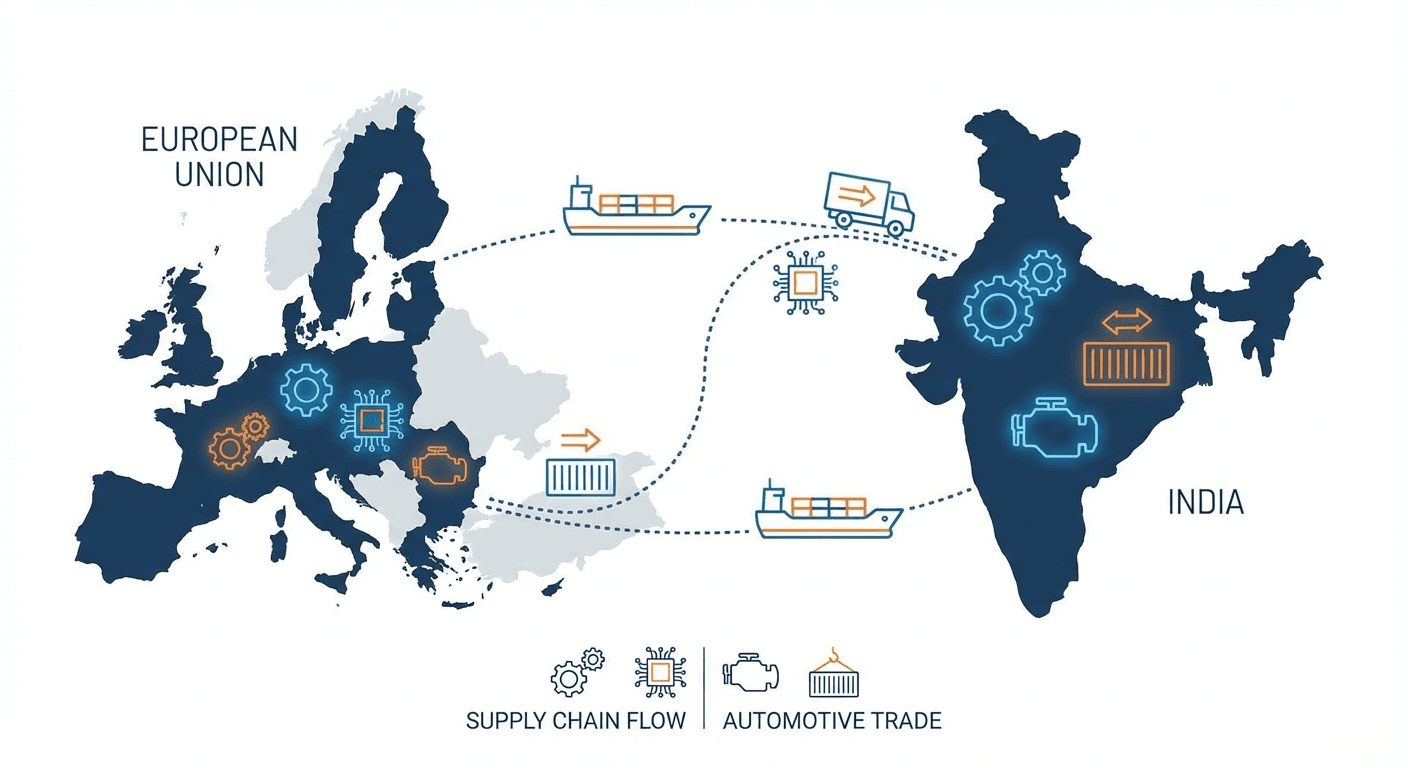
- The EU-India FTA will phase down Indian tariffs on European cars from 110% to 30-35% initially, then to 10% over approximately five years, with car parts eventually reaching zero tariff over 5-10 years.
- A Tariff Rate Quota (TRQ) of 250,000 vehicles per year caps the number of cars eligible for the lowest rate — protecting India's domestic industry while opening a controlled channel for European imports.
- The headline story is about BMW, Mercedes, and Volkswagen. The bigger opportunity is for European Tier 2 and Tier 3 component suppliers who can now price competitively against Chinese alternatives in India's fast-growing auto market.
- Rules of Origin will determine which products qualify for preferential tariffs — companies with complex, multi-country supply chains need to assess compliance now.
- India's auto component market is already worth $74.3 billion (FY 2024-25) and growing. European suppliers who prepare during the 12-18 month ratification window will have a structural advantage.
The Headline: 110% to 10%
When the EU-India FTA was announced on January 27, 2026, the automotive tariff reduction grabbed every headline. India's import duty on European cars — currently among the highest in the world at 110% for vehicles above $40,000 — will drop to as low as 10%.
For a €50,000 BMW 3 Series, that's the difference between a landed cost of €105,000 and €55,000 in India once the full phase-down completes. Initially, duties will drop to 30-35%, with the 10% rate reached over approximately five years. The maths is obvious — even the first-phase cut is transformative.
But the real story isn't about luxury sedans. It's about what happens further down the supply chain. (For the broader FTA context beyond automotive, see our full FTA breakdown for European SMEs.)
The TRQ: 250,000 Vehicles Per Year
India isn't opening the floodgates. The Tariff Rate Quota limits the number of vehicles eligible for the reduced 10% tariff to 250,000 units per year. Beyond that quota, the standard tariff applies.
For context, India is estimated to have imported roughly 40,000 CBU (completely built unit) vehicles in FY 2024-25. Note: the 250,000 quota is split between 160,000 ICE vehicles (tariff cuts from day one) and 90,000 EVs (duty cuts begin from year five). The TRQ of 250,000 is six times current import volume — generous, but capped.
What this means:
- OEMs (BMW, Mercedes, Audi, Porsche, Volkswagen) will compete for quota allocation
- Volume importers will benefit most — expect Volkswagen and Renault to push harder into India's mid-market
- Luxury-only brands (Porsche, Maserati) have plenty of room within the quota
- The quota creates urgency — early movers secure allocation, late entrants may face constraints as volumes grow
Where the Real Opportunity Sits: Components
Here's what the press coverage misses.
Car parts under the FTA will eventually reach zero tariff over a 5-10 year phase-down. Currently, European auto components face duties of 7.5-15% entering India. Those go to zero.
India's auto component industry is worth $78.7 billion (FY 2024-25, up from $74.3 billion in FY 2023-24) and is projected to reach $200 billion by 2030 per McKinsey. India is already the world's third-largest auto market by volume. European companies currently hold a small fraction of this component supply.
Why? Partly because Chinese components are cheaper. Partly because Indian manufacturers have built strong domestic capabilities. But mostly because a 7.5-15% tariff makes European precision components just expensive enough to lose on price, even when they win on quality.
Zero tariff changes that equation.
Sectors where European suppliers have a quality edge:
| Component Category | Current Tariff | FTA Direction | European Advantage |
|---|---|---|---|
| EV battery systems | 15% | → 0% | Cell chemistry, thermal management |
| ADAS sensors & modules | 10-15% | → 0% | Safety certification, reliability |
| Precision machined parts | 7.5-10% | → 0% | Tolerances, metallurgy |
| Powertrain electronics | 10% | → 0% | Integration, durability |
| Suspension systems | 7.5% | → 0% | NVH performance |
| Interior trim (premium) | 10-15% | → 0% | Materials, finish quality |
The European advantage in these categories is real and measurable. What the tariff barrier did was force Indian OEMs to source domestically or from China, even when European components were technically superior. Removing that barrier lets quality compete on a level playing field.
Rules of Origin: The Make-or-Break Detail
The FTA's Rules of Origin chapter determines whether your products qualify for preferential tariffs. This is where many European SME suppliers will get tripped up.
The core question: Does your product qualify as "EU-originating"?
If you manufacture entirely in the EU using EU-sourced materials — you're fine. But most auto component supply chains are more complex:
- A German sensor manufacturer using semiconductors from Taiwan and rare earths from China: Does the final product qualify?
- A French brake system company with assembly in Romania using forgings from Turkey: EU-originating?
- An Italian interior trim supplier using leather from Argentina and textiles from India: Circular dependency?
The provisional FTA text establishes the framework, but the detailed product-specific rules (based on HS codes) are still pending. What we know:
- Sufficient transformation must occur in the EU — the product must be substantially different from its imported inputs
- Value-added thresholds will apply — a minimum percentage of the product's value must be created in the EU
- Cumulation provisions may allow India-sourced inputs to count toward origin — critical for joint ventures and existing India operations
Action for suppliers: Map your supply chain now. For each product you'd export to India, trace every input to its country of origin. Identify where you might fall short of origin requirements. You have 12-18 months to restructure supply chains before the tariff reductions take effect.
What Indian OEMs Actually Want from European Suppliers
Understanding demand is as important as understanding tariffs. Here's what Indian automotive companies are actively seeking from European partners:
1. EV Components — Urgent
India's EV transition is accelerating. Tata Motors, Mahindra, and Hyundai India are all scaling EV production. They need battery management systems, thermal management solutions, power electronics, and charging infrastructure components. European suppliers with EV expertise are in high demand.
2. Safety Systems — Regulatory Push
India's Bharat NCAP (crash safety rating) launched in 2023, and consumer awareness of safety ratings is rising fast. OEMs need ADAS components, airbag systems, and structural reinforcement solutions that meet global standards. European suppliers with NCAP experience have a direct advantage.
3. Localisation Partners — Strategic
Indian OEMs don't just want to import components. They want partners who will localise production in India over time. The FTA makes imported components cheaper in the short term, but the long-term play is JVs and technology transfer. European Tier 2 suppliers willing to set up Indian operations (even small-scale assembly) will win larger, longer contracts.
The Timeline for Auto Sector SMEs
| When | What to Do |
|---|---|
| Now (Mar 2026) | Map your product portfolio against FTA tariff categories. Assess Rules of Origin compliance. |
| Q2 2026 | Watch for detailed tariff schedules (product-level HS code reductions). Attend ACMA (Auto Component Manufacturers Association) events. |
| Q3-Q4 2026 | Begin conversations with Indian OEM procurement teams. The FTA won't be ratified yet, but smart buyers are already planning. |
| Early 2027 | Expected FTA signing. Finalise supply chain adjustments for Rules of Origin compliance. |
| 2027-2028 | Phased tariff reductions begin. First shipments under preferential rates. |
| 2028-2032 | Car parts reach zero tariff. Companies with India presence capture disproportionate share. |
Two-Way Street: Indian Auto Components to Europe
The FTA isn't one-directional. ICRA's analysis highlights that Indian auto component manufacturers will also gain improved access to European markets under the agreement. Tariff rationalisation and preferential access will enhance Indian companies' pricing competitiveness with European OEMs.
This creates partnership opportunities for European SMEs:
- Joint ventures with Indian component makers to serve both markets
- Technology licensing arrangements where European IP meets Indian manufacturing scale
- Co-development of components for India-specific vehicle platforms that can also be exported to Europe
The Bottom Line
The FTA automotive tariff cuts will reshape India's auto component supply chain over the next 5-10 years. The headline story is about luxury cars getting cheaper. The business story is about European precision component suppliers getting a level playing field in the world's third-largest auto market.
The 12-18 month window before implementation is your preparation time. Map your products. Check your origins. Start conversations with Indian buyers. The companies that move during the ratification window — not after it — will capture the early-mover advantage.
FAQ
When will the EU-India FTA automotive tariff cuts take effect?
The FTA was announced on January 27, 2026, but ratification and implementation are expected in early 2027. Tariff reductions will be phased — an initial drop to 30-35% upon implementation, reaching the final 10% rate over approximately five years. The 12-18 month window before implementation is your preparation time.
Does the 250,000 vehicle quota apply to all European cars?
The quota is split: 160,000 for ICE vehicles (tariff cuts from day one) and 90,000 for EVs (duty cuts begin from year five). The quota covers completely built units (CBUs) only — components shipped for local assembly are covered separately under parts tariff schedules.
Do European auto component suppliers need BIS certification to export to India?
It depends on the product category. Safety-critical components (tyres, glass, certain electrical parts) require BIS certification. Many industrial auto components do not. Check the BIS compulsory registration scheme (CRS) list for your specific HS codes before assuming you're exempt.
What is the best India entry mode for a European Tier 2 supplier?
Most start with a distributor arrangement to test market demand, then graduate to a liaison office or wholly owned subsidiary. The right approach depends on your product complexity, after-sales requirements, and willingness to invest.
How much does it cost to set up operations in India as a European auto supplier?
A distributor-only model can be tested for €20,000-50,000. A liaison office costs €50,000-100,000 annually. A full wholly owned subsidiary with manufacturing requires €500,000+ depending on sector and scale. See our India market entry costs analysis for detailed breakdowns.
Tensor Advisory helps European automotive and industrial suppliers evaluate India market entry. From regulatory mapping to partner identification and commercial strategy — we know the ground truth because we operate from here. Book a sector briefing.
Sources: CNBC India-EU FTA Auto Analysis, India Briefing FTA Luxury Auto Impact, Business Standard ICRA Auto Components, BusinessToday FTA Car Tariffs, EU Commission FTA Chapter Summary
Read the methodology, source date and confidence level before carrying a number into a decision.
What does the FTA change for your product?
Open the Tariff Calculator →Every figure above is dated and source-attributed. Nothing arrives as an unexplained number.
- Sources are listed in the report methodology and verified against the publication date.
- Regulatory outcomes remain subject to entry-into-force dates and line-level classification.
Continue the research
Carry the market-entry question forward
Use the sources in this briefing to decide whether you need a defined baseline, a corridor-specific brief, or a scoping conversation.
Standard report
Start with a dated baseline
Use a fixed-scope report when you need a sourced answer to a defined market question.
ExploreCustom MIR
Shape the question around your case
Carry this article’s question into one target market, sector, corridor, and decision brief.
ExploreScoping call
Talk through the decision
Bring the corridor, timing, and evidence gap to a call before choosing the right format.
ExploreRelated Intelligence
EU-India FTA 2026: What European SMEs Must Do Now to Capitalize on New Trade Opportunities
Action plan for European SMEs under the EU-India FTA. Real tariff numbers, timelines, and strategic moves.

India EU Trade Deal: What Is Binding in September 2026?
A dated implementation-status guide to the India-EU trade deal, the published draft texts, and the checks Western companies should complete before changing a quote.
The EU-India FTA Text Is Out. Here's What European SMEs Should Do Right Now.
India and the EU released the provisional FTA text on February 28, 2026. With 20 chapters covering goods, services, digital trade, IP, and a dedicated SME chapter — here's how European SMEs should prepare before ratification.