
Regulatory status checked 12 July 2026. BIS obligations are product- and standard-specific, and Quality Control Orders can be added, amended or deferred. Confirm the exact product against the current BIS compulsory-certification lists and upcoming QCO implementation dates. Timelines and costs below are planning ranges, not official commitments or legal advice.
The Bureau of Indian Standards (BIS) certification is the single most common regulatory barrier European exporters encounter when entering the Indian market. The majority of certification rejections for foreign applicants are attributable to avoidable procedural errors.
This guide provides European exporters with a comprehensive, step-by-step understanding of BIS certification: what it covers, which products require it, how the process works, what it costs, where companies most frequently fail, and how the recently concluded EU-India Free Trade Agreement may reshape the landscape.
What is BIS certification and who needs it?
The Bureau of Indian Standards is India's national standards body, established under the Bureau of Indian Standards Act, 2016. BIS sets product quality and safety standards for goods sold in India — analogous to the CE marking system in the European Union or the BSI Kitemark in the United Kingdom.
BIS certification serves two primary functions:
- Consumer protection: Ensuring that products sold in India meet minimum safety, quality, and performance standards.
- Market regulation: Creating a level playing field between domestic manufacturers and foreign importers.
For European exporters, the critical distinction is this: BIS certification is mandatory for a growing list of product categories. Products covered by compulsory BIS standards cannot be legally imported into, sold, or distributed in India without the BIS Standard Mark (the ISI Mark).
Unlike CE marking, which relies on self-declaration for many product categories, BIS certification requires third-party testing, factory inspections, and ongoing compliance surveillance. This makes it more resource-intensive — but also more predictable once the process is understood.
Which products require BIS certification?
As of early 2026, BIS maintains compulsory certification through approximately 187 Quality Control Orders (QCOs) covering over 700 product categories across multiple sectors. The list has expanded steadily — from 106 categories in 2014 to its current scope — and further additions are anticipated.
Key product categories relevant to European exporters
| Sector | Examples of Covered Products | Relevant BIS Standard |
|---|---|---|
| Electronics & IT | Power adapters, batteries, LED drivers, IT equipment, cables | IS 616, IS 13252, IS 16046 |
| Electrical equipment | Switches, plugs, wiring accessories, circuit breakers | IS 1293, IS 3854 |
| Steel & metals | Structural steel, pipes, wire rods, TMT bars | IS 2062, IS 1239, IS 1786 |
| Chemicals | Certain paints, cleaning agents, industrial chemicals | IS 15489 |
| Mechanical equipment | Cylinders, valves, compressors, certain industrial machinery | IS 3196, IS 7285 |
| Automotive components | Tyres, safety glass, brake linings | IS 15627, IS 2553 |
| Cement & building materials | Portland cement, concrete admixtures | IS 269, IS 9103 |
| Medical devices (select) | Certain implants and devices (under dual BIS/CDSCO oversight) | IS 15748 |
Important note for European exporters: Holding a CE mark does not exempt products from BIS certification. While the underlying technical standards may overlap significantly (many BIS standards are harmonised with ISO/IEC standards), a separate BIS application, testing, and factory audit are required.
The full list of products under compulsory certification is maintained on the BIS website and updated via Gazette of India notifications. We recommend European exporters check the current list before committing to an India export strategy for any product line.
The BIS certification process: step by step
Step 1: Determine the applicable standard
Identify which BIS standard applies to your product. This is not always straightforward — a single product may fall under multiple standards, and the applicable standard may differ from the equivalent EN or ISO standard your product already meets.
Timeline: 1–2 weeks (if conducted properly with regulatory counsel).
Step 2: Appoint an Authorised Indian Representative (AIR)
Foreign manufacturers must appoint an Authorised Indian Representative — a legally registered Indian entity that serves as the liaison with BIS. The AIR is responsible for:
- Submitting the application on behalf of the foreign manufacturer
- Maintaining records and handling correspondence with BIS
- Managing post-certification compliance and surveillance
The quality of your AIR can materially affect your certification timeline. Choose a representative with demonstrated experience in your product category.
Timeline: 2–4 weeks to identify, vet, and formally appoint an AIR.
Step 3: Submit the application
The application is submitted through the BIS online portal (Manak Online) and includes:
- Completed application form (Form VI for foreign manufacturers)
- Product test reports from a BIS-recognised laboratory
- Manufacturing process documentation
- Quality management system documentation (ISO 9001 is expected)
- Factory layout and equipment details
- AIR authorisation letter
- Application fee payment
Timeline: 1–2 weeks for preparation and submission.
Step 4: Product testing
Samples must be tested at a BIS-recognised laboratory. For foreign manufacturers, testing can be conducted at:
- A BIS-recognised lab in India (samples must be shipped)
- An internationally accredited lab that BIS accepts (limited list — verify before testing)
Testing timelines vary significantly by product category. Electronics testing is typically faster (4–8 weeks); steel and construction materials may take longer due to the nature of the tests involved.
Timeline: 4–12 weeks, depending on product category and laboratory backlog.
Step 5: Factory inspection
BIS dispatches an inspection team to the foreign manufacturer's factory. This is a physical, on-site audit that evaluates:
- Manufacturing processes and quality control systems
- Alignment between documented processes and actual practice
- Testing equipment calibration and capability
- Raw material sourcing and incoming inspection procedures
- Record-keeping and traceability systems
For European factories, the inspection is typically conducted by BIS officers travelling from India. Scheduling is subject to BIS resource availability, which introduces the single largest source of unpredictable delay in the process.
Timeline: 4–16 weeks from application approval to actual inspection date. The inspection itself takes 1–3 days.
Step 6: Grant of licence
If the test reports and factory inspection are satisfactory, BIS issues the licence. The licence permits the manufacturer to apply the BIS Standard Mark (ISI Mark) to the certified product and export it to India.
Licences are typically valid for one to two years and require renewal, which includes a fresh factory inspection.
Timeline: 2–4 weeks after successful inspection for licence issuance.
Total timeline: realistic expectations
| Phase | Duration |
|---|---|
| Standard identification + AIR appointment | 3–6 weeks |
| Application preparation and submission | 1–2 weeks |
| Product testing | 4–12 weeks |
| Factory inspection scheduling and execution | 4–16 weeks |
| Licence issuance | 2–4 weeks |
| Total (best case) | 14 weeks (~3.5 months) |
| Total (typical) | 24–32 weeks (~6–8 months) |
| Total (worst case, with resubmissions) | 12–18 months |
The most common cause of extended timelines is the factory inspection scheduling phase. European manufacturers should plan accordingly and not commit to Indian customers or distributors based on best-case estimates.
What does BIS certification cost?
BIS certification costs vary by product category and the number of product variants within a single application. Estimated costs for European exporters:
| Cost Component | Estimated Range |
|---|---|
| Application fee (BIS) | INR 1,000–10,000 (~EUR 11–110) |
| Product testing (per product/standard) | INR 50,000–300,000 (~EUR 550–3,300) |
| Factory inspection (BIS officer travel to Europe) | INR 100,000–300,000 (~EUR 1,100–3,300) |
| AIR fees (annual) | INR 100,000–500,000 (~EUR 1,100–5,500) |
| Consulting/regulatory advisory | INR 100,000–500,000 (~EUR 1,100–5,500) |
| Total per product category (estimated) | EUR 4,000–18,000 |
These figures represent estimated costs per product category based on industry experience. Actual costs vary depending on product complexity and testing requirements. Manufacturers with multiple product lines requiring separate certifications should multiply accordingly. Annual renewal costs are typically 40–60% of the initial certification cost.
Hidden costs to account for: sample shipping to India, internal staff time for documentation preparation, factory readiness improvements (if quality systems need upgrading), and potential re-testing costs if initial samples fail.
The five most common mistakes European exporters make
1. Assuming CE certification provides automatic equivalence
This is the most expensive assumption in India market entry. CE marking and BIS certification are separate regulatory regimes. While technical standards may overlap, the certification process, testing requirements, and ongoing surveillance obligations are distinct. Every year, European companies lose months of market-entry time by assuming their existing certifications will suffice.
2. Choosing an unqualified Authorised Indian Representative
The AIR is not a formality. An inexperienced AIR can misclassify products, submit incomplete applications, and fail to manage the BIS relationship effectively. We have observed cases where a poorly chosen AIR added 6–9 months to the certification timeline.
3. Underestimating the factory inspection
European manufacturers accustomed to self-declaration or desktop audits under CE are sometimes surprised by the rigour of BIS factory inspections. Inspectors evaluate actual manufacturing conditions, not just documentation. Companies that prepare only paperwork without ensuring factory-floor alignment consistently face corrective action requests that delay the licence.
4. Applying for the wrong standard
A single product may be covered by multiple BIS standards, and the applicable standard is not always the one that appears most intuitive from a European classification perspective. Misidentifying the standard means the entire application — including testing — must be redone.
5. Starting the process too late
BIS certification is a 6–8 month process under normal conditions. Companies that begin the process only after signing distribution agreements or making market-entry commitments in India frequently find themselves unable to fulfil those commitments on time. Certification should be initiated at least 12 months before the intended market-entry date.
How the EU-India FTA may streamline BIS certification
The EU-India Free Trade Agreement, concluded on 27 January 2026, contains several provisions that are expected to affect the BIS certification landscape for European exporters:
Mutual recognition of conformity assessment
The FTA includes a framework for mutual recognition of conformity assessment procedures. In practice, this could mean that test results from EU-accredited laboratories may be accepted by BIS without requiring retesting in India. This alone could reduce certification timelines by 4–12 weeks and costs by EUR 550–3,300 per product category.
However, mutual recognition will be implemented on a sector-by-sector basis, and the specific product categories covered will be determined through bilateral technical negotiations that are expected to continue through 2026 and 2027.
Streamlined factory inspection protocols
The agreement envisions a framework where factory inspections conducted by EU-accredited conformity assessment bodies could be accepted by BIS, reducing or eliminating the need for BIS officers to travel to European factories. This would address the single largest bottleneck in the current process.
Harmonisation of standards
Both sides have committed to greater alignment of technical standards, particularly in sectors where international standards (ISO, IEC) already form the basis for both BIS and EN standards. Over time, this could reduce the documentation burden for products already certified to harmonised international standards.
What this means in practice (2026)
The FTA provisions are not yet in effect. Ratification and implementation will take time, and the mutual recognition frameworks will require sector-specific negotiations. European exporters should:
- Not delay BIS certification in anticipation of FTA benefits. The current process remains mandatory.
- Monitor sector-specific developments through BIS notifications and EU trade authority updates.
- Maintain comprehensive documentation of existing EU certifications and test results, so they are prepared to take advantage of mutual recognition provisions as soon as they take effect.
Related Intelligence
Download the Free 2026 India Market Entry Playbook — The complete framework for entering India, from entity structure to compliance.
India Market Entry Strategy for European and American SMEs: The 2026 Playbook — BIS certification in the context of your full market entry plan.
India Market Entry Costs: A Realistic Budget for Western Companies — Where certification fits in the Year 1 budget.
The EU-India FTA: What Western Exporters Need to Do Before Ratification — How the FTA will progressively impact BIS requirements.
India Pharma Equipment Market: Opportunities for Western Manufacturers — Sector-specific certification requirements for pharma equipment.
Frequently Asked Questions
Can I sell in India without BIS certification?
For products on the mandatory list, no. Importing without BIS certification is a customs offence. For products not on the mandatory list, yes — but you will be excluded from government tenders and institutional procurement that specifies BIS-certified products.
Is CE marking recognised in India?
CE marking is not a substitute for BIS certification. India does not recognise European conformity assessments for products that fall under BIS mandatory certification. Some IS standards reference IEC standards (which underpin CE marking), but the certification process is separate.
Can I start the BIS process before establishing an Indian entity?
Yes. The BIS application can be filed by a foreign manufacturer directly. However, you will need an Authorised Indian Representative (AIR) — a registered Indian entity that acts as the liaison between you and BIS. Many compliance consultants offer AIR services.
How often do standards change?
BIS standards are revised periodically. Major revisions typically provide a 6–12 month transition period. Subscribe to BIS notifications for your product categories and build standards monitoring into your compliance function.
Do UK companies benefit from the EU-India FTA provisions on BIS?
No. The UK is no longer an EU member state. A separate UK-India FTA is under negotiation but has not been concluded. UK manufacturers should monitor those negotiations independently and follow the current BIS process without FTA-related expectations.
How do Rules of Origin interact with BIS certification?
They do not. BIS certification is a product safety and quality standard — it applies regardless of the product's origin. Rules of Origin are relevant for preferential tariff treatment under the FTA, which is a separate matter from product certification.
Navigating BIS Certification?
Indian product certification is complex, but you don't have to figure it out alone. Our team has guided dozens of European manufacturers through the BIS process — from documentation to testing lab selection.
Talk to Our Regulatory Team → | Download the India Market Entry Playbook →
Read the methodology, source date and confidence level before carrying a number into a decision.
What does the FTA change for your product?
Open the Tariff Calculator →Every figure above is dated and source-attributed. Nothing arrives as an unexplained number.
- Sources are listed in the report methodology and verified against the publication date.
- Regulatory outcomes remain subject to entry-into-force dates and line-level classification.
Continue the research
Carry the market-entry question forward
Use the sources in this briefing to decide whether you need a defined baseline, a corridor-specific brief, or a scoping conversation.
Standard report
Start with a dated baseline
Use a fixed-scope report when you need a sourced answer to a defined market question.
ExploreCustom MIR
Shape the question around your case
Carry this article’s question into one target market, sector, corridor, and decision brief.
ExploreScoping call
Talk through the decision
Bring the corridor, timing, and evidence gap to a call before choosing the right format.
ExploreRelated Intelligence
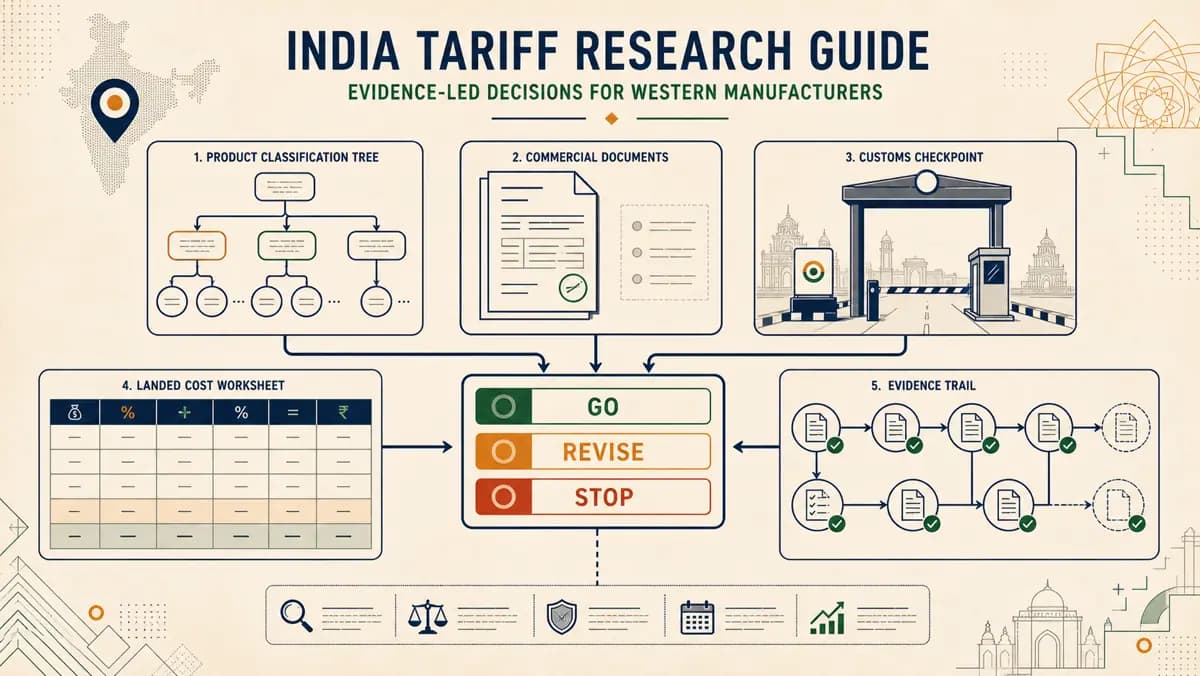
India Tariffs: A Manufacturer's Line-Level Check
Separate India tariff headlines from the line-level import evidence needed before quoting, sourcing or entering the market.
Wholly Owned Subsidiary in India under the Companies Act 2013: A Source Map
A source map for the wholly owned subsidiary India Companies Act 2013 question: Companies Act relationships, FEMA and RBI source tracks, FAQs, and counsel handoff.
India Manufacturing Products: A Buyer Shortlist Frame
A decision frame for Western SMEs shortlisting India manufacturing products using sector signals, export evidence and product-level compliance gates.