
Status checked 12 July 2026. Negotiations concluded on 27 January 2026. The published text remains subject to legal revision and becomes binding only after signature and completion of internal procedures. Product eligibility and effective dates require verification against the final annexes. European Commission: agreement texts and disclaimer. This article is not legal or customs advice.
The EU-India Free Trade Agreement was concluded in January 2026 after 19 years of negotiations. It covers 96.6% of tariff lines and represents the most significant trade facilitation event between Europe and India in history.
But concluded is not ratified. Ratification will take 12–18 months. European exporters who prepare now will capture first-mover advantage when tariff reductions take effect.
What does the EU-India FTA actually cover?
The agreement is comprehensive. Key elements:
Tariff elimination. 96.6% of tariff lines will be eliminated or significantly reduced over a 7-year implementation period. Most industrial goods reach zero tariff by year 3. Sensitive agricultural products have longer phase-out periods.
Services liberalisation. India has committed to opening key service sectors to European firms, including professional services, financial services, and telecommunications. The details are still being finalised.
Investment protection. Separate investment protection agreement under negotiation. Expected to include investor-state dispute settlement (ISDS) mechanisms.
Government procurement. India has agreed to limited opening of government procurement to EU firms. This is historically significant — India has resisted government procurement liberalisation in all previous trade negotiations.
Which sectors benefit most?
Industrial Machinery (current tariff: 7.5–10%)
FTA impact: Tariff eliminated to 0% by year 3.
European manufacturers of CNC machines, packaging equipment, processing lines, and automation systems will see immediate cost competitiveness improvements. A German CNC manufacturer currently paying 7.5% duty on a €200,000 machine saves €15,000 per unit — enough to shift the competitive equation against Chinese and Japanese alternatives.
Medical Devices (current tariff: 10–15%)
FTA impact: Reduced to 0–5% by year 5.
The Indian medical device market is 75–80% import-dependent. European manufacturers of diagnostic imaging, surgical instruments, and patient monitoring equipment will gain significant price advantage over US and Japanese competitors who do not have equivalent FTA benefits.
Food Processing Equipment (current tariff: 7.5%)
FTA impact: Tariff eliminated to 0% by year 2.
India processes only 10% of its food production — the lowest ratio among major economies. The PLI scheme for food processing plus zero tariff creates a structural opportunity for European equipment manufacturers.
Pharmaceutical Equipment (current tariff: 7.5–10%)
FTA impact: Tariff eliminated to 0% by year 3.
India's pharmaceutical industry is the world's third largest by volume. Growth in biosimilars, vaccines, and complex generics is driving demand for European-manufactured filling lines, lyophilisers, and quality control equipment.
What do European companies need to do now?
Before ratification (next 12–18 months)
Audit your supply chain for Rules of Origin compliance. The FTA's preferential tariff rates only apply to goods that meet Rules of Origin criteria. Typically, this requires 40–60% of value to be added within the EU. If your product incorporates significant non-EU components, review the product-specific rules now.
Review your India pricing strategy. The tariff reduction will change your competitive position. Model your pricing at current tariffs, year 1 tariffs, and year 3 tariffs to understand the trajectory.
Identify BIS certification requirements. The FTA does not eliminate the need for BIS certification. Products that require BIS certification today will still require it after the FTA takes effect. Start the certification process now — by the time it is completed (9–14 months), tariff reductions may already be in effect.
Register for ECICS classification. Ensure your products are correctly classified under the Indian Customs Tariff (aligned with HS codes). Incorrect classification can result in wrong tariff rates, customs delays, and penalties.
After ratification
Apply for preferential tariff treatment. This requires a Certificate of Origin issued by an authorised body in your EU member state. The specific requirements will be detailed in the FTA implementation regulations.
Monitor the implementation schedule. Tariff reductions are phased. Track which of your product categories receive immediate reduction versus delayed reduction.
Evaluate manufacturing in India. For products with high shipping costs relative to value, the FTA may make local manufacturing or assembly more attractive than export. The combination of PLI incentives + FTA-reduced input costs can create compelling unit economics.
What will the FTA not do?
It will not eliminate non-tariff barriers. BIS certification, FSSAI registration, CDSCO approval, and other regulatory requirements remain in full force. The FTA includes TBT provisions for future harmonisation, but implementation will take years.
It will not simplify Indian bureaucracy. Entity setup, GST compliance, transfer pricing documentation, and state-level regulatory requirements are domestic policy matters, not trade agreement matters.
It will not guarantee market access. Tariff reduction improves price competitiveness. It does not eliminate the need for market intelligence, distribution strategy, and local market knowledge. Companies that enter India with only a tariff advantage and no market strategy will still struggle.
Related Intelligence
Download the Free 2026 India Market Entry Playbook — The complete framework for entering India, from entity structure to compliance.
India Market Entry Strategy for European and American SMEs: The 2026 Playbook — How the FTA fits into the broader market entry decision.
BIS Certification for European Companies: The Complete 2026 Guide — Non-tariff barriers that the FTA does not eliminate.
India vs. Vietnam vs. Mexico: Market Entry Cost Comparison — How India's FTA advantage compares to Vietnam's EVFTA and Mexico's USMCA access.
India Pharma Equipment Market: Opportunities for Western Manufacturers — Sector-level FTA impact analysis for pharma equipment.
Manufacturing in India vs Mexico: Buyer Guide — How to separate a country screen from product, trade, supplier, logistics, and site diligence.
Frequently Asked Questions
When will the tariff reductions actually start?
After ratification by both the European Parliament and the Indian Parliament. Expected timeline: late 2027. Some tariff reductions take effect immediately upon entry into force; others are phased over 3–7 years.
Do UK companies benefit from the EU-India FTA?
No. The UK is no longer an EU member state. A separate UK-India FTA is under negotiation but has not been concluded. UK manufacturers should monitor those negotiations independently.
Will the FTA affect my existing Indian distributor arrangements?
The tariff reduction changes the economics of import — your products become cheaper at the Indian border. This may affect distributor margins, pricing negotiations, and competitive positioning. Review your distribution agreements in light of the new tariff structure.
How do Rules of Origin work in practice?
Your product must qualify as "originating" in the EU to receive preferential tariff treatment. This typically requires that a minimum percentage of value is added within the EU, or that the product undergoes "substantial transformation" in the EU. Product-specific rules vary — check the FTA annexes for your HS code.
Don't Wait for Ratification — Prepare Now
The companies that position before the FTA takes effect will capture the market. Get a personalized action plan for your products and sector. For the agreement's broader implications, read our complete EU-India FTA guide for Western companies.
Book a Free FTA Strategy Session → | Download the India Market Entry Playbook →
Read the methodology, source date and confidence level before carrying a number into a decision.
What does the FTA change for your product?
Open the Tariff Calculator →Every figure above is dated and source-attributed. Nothing arrives as an unexplained number.
- Sources are listed in the report methodology and verified against the publication date.
- Regulatory outcomes remain subject to entry-into-force dates and line-level classification.
Continue the research
Choose the next evidence step
Use this briefing as context, then choose the format that fits the question you need to answer.
Standard report
Start with a dated baseline
Use a fixed-scope report when you need a sourced answer to a defined market question.
ExploreCustom MIR
Shape the question around your case
Carry this article’s question into one target market, sector, corridor, and decision brief.
ExploreScoping call
Talk through the decision
Bring the corridor, timing, and evidence gap to a call before choosing the right format.
ExploreRelated Intelligence

India EU Trade Deal: What Is Binding in September 2026?
A dated implementation-status guide to the India-EU trade deal, the published draft texts, and the checks Western companies should complete before changing a quote.
The EU-India FTA Text Is Out. Here's What European SMEs Should Do Right Now.
India and the EU released the provisional FTA text on February 28, 2026. With 20 chapters covering goods, services, digital trade, IP, and a dedicated SME chapter — here's how European SMEs should prepare before ratification.
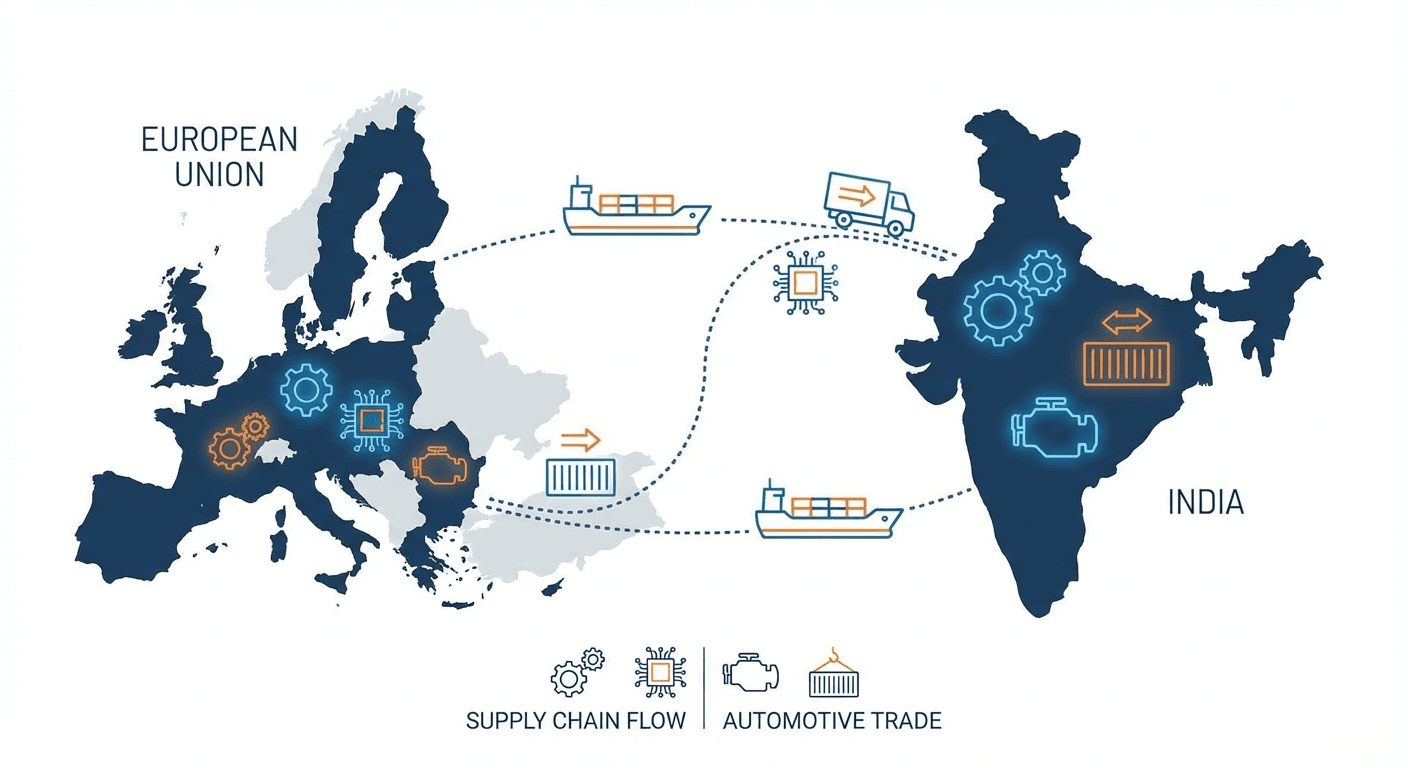
EU-India FTA: European Cars at 10% Tariff — What Tier 2 Suppliers Should Know
EU-India FTA cuts car tariffs from 110% to 10%. Zero-tariff auto components are the real prize. Tier 2 & 3 supplier action plan with timeline, BIS requirements, and first-mover advantages.