
India's pharmaceutical industry is the world's third largest by volume and the largest supplier of generic medicines globally. This industry relies heavily on imported equipment — and European manufacturers hold 35% of India's pharmaceutical machinery imports.
The opportunity is structural, not cyclical. Biosimilar production, vaccine manufacturing capacity expansion, and increasingly stringent quality requirements are driving demand for the precision equipment that European manufacturers excel at producing.
How large is the market?
India's pharmaceutical market reached approximately $55 billion in 2025, growing at 10–12% annually. The equipment segment — machinery for manufacturing, packaging, quality control, and laboratory operations — represents approximately $4–5 billion annually, with imports accounting for 55–60% of the total.
Key segments for European manufacturers:
| Equipment Category | Market Size (India) | Import Share | Growth Rate |
|---|---|---|---|
| Tablet presses and coating | $600–800M | 60% | 8–10% |
| Filling and sealing machines | $400–600M | 65% | 10–12% |
| HPLC and analytical instruments | $300–500M | 70% | 12–15% |
| Lyophilisers / freeze dryers | $200–300M | 75% | 15–18% |
| Water purification systems | $300–400M | 50% | 8–10% |
| Clean room equipment | $200–300M | 55% | 10–12% |
The highest growth segments — lyophilisers and analytical instruments — are precisely where European manufacturers have the strongest competitive advantage.
What is driving demand?
Biosimilar expansion
India is the world's largest biosimilar market by volume. Over 100 biosimilars are approved in India. Manufacturing biosimilars requires precision equipment — aseptic filling lines, lyophilisers, bioreactors — that Indian domestic manufacturers cannot yet produce to the required specifications.
Vaccine manufacturing capacity
Post-COVID capacity expansion continues. The Serum Institute of India, Bharat Biotech, and Biological E are all investing in new manufacturing facilities. Each facility requires €50–200M in equipment, with European manufacturers supplying the majority of critical components.
Quality compliance upgrading
Indian pharma companies targeting EU and US markets must comply with EMA and FDA manufacturing standards. This requires equipment that meets cGMP requirements — and European manufacturers have inherent credibility with EU regulators because their equipment is designed to meet EU standards.
PLI scheme incentives
The Production Linked Incentive scheme for pharmaceuticals provides 3–10% cashback on incremental production. Companies investing in new manufacturing capacity are using PLI incentives to justify capital equipment purchases.
Who are the main competitors?
European competitors (35% import share):
- Germany: Bosch Packaging (now Syntegon), Fette Compacting, IMA, GEA
- Italy: IMA Group, Marchesini
- Switzerland: Bühler, GF Machining
- UK: Malvern Panalytical, Mettler-Toledo (Switzerland/UK)
Asian competitors (40% import share):
- China: Truking Technology, NJP (growing fast on price)
- Japan: Fuji Paudal, Glatt (Japanese operations)
- South Korea: Emerging in automation and controls
Indian domestic (25%):
- Cadmach, ACG Group, Anchor Mark — strong in standard equipment, weak in precision and biosimilar-grade systems
European competitive advantage: Precision, compliance documentation, after-sales support, and regulatory credibility. Chinese competitors compete on price (40–60% cheaper) but lack the regulatory track record and support infrastructure that Indian pharma companies need for EU/US market access.
What are the regulatory requirements?
BIS certification
Pharmaceutical machinery falls under BIS mandatory certification for specific categories (electrical components, pressure vessels). Not all pharma equipment requires BIS — but any equipment with electrical or pressure vessel components likely does. Timeline: 9–14 months.
Import licensing
Pharmaceutical equipment does not require drug import licences (those apply to pharmaceutical products, not manufacturing equipment). Standard import documentation (IEC, customs classification, GST) applies.
Current tariff structure
| HS Code | Description | Current Tariff | Post-FTA Tariff |
|---|---|---|---|
| 8422.30 | Filling, sealing machines | 7.5% | 0% (year 3) |
| 8479.82 | Mixing, grinding, separating | 7.5% | 0% (year 3) |
| 9027.20 | Chromatographs (HPLC) | 10% | 0% (year 3) |
| 8419.39 | Dryers (lyophilisers) | 7.5% | 0% (year 2) |
The EU-India FTA eliminates tariffs on virtually all pharmaceutical equipment within 3 years of entry into force.
What is the recommended entry strategy?
Phase 1: Intelligence (Month 1–2)
Commission a Scout Report covering the specific equipment subcategory. Identify the top 20 potential customers, the competitive landscape, and the realistic regulatory timeline.
Phase 2: Market validation (Month 3–6)
Attend PMEC India (Mumbai, December). Meet potential distributors and end customers. Validate the Scout Report findings with on-the-ground conversations.
Phase 3: Distribution setup (Month 6–12)
Select and contract 2–3 regional distributors. Start BIS certification if required. Register for GST and IEC through a local entity or branch office.
Phase 4: Market development (Month 12–24)
First installations and reference sites. Build service capability (local service engineers or trained distributor technicians). Establish presence in government tender databases (GeM — Government e-Marketplace).
Related Intelligence
Download the Free 2026 India Market Entry Playbook — The complete framework for entering India, from entity structure to compliance.
India Market Entry Strategy for European and American SMEs: The 2026 Playbook — The broader market entry framework for any sector.
BIS Certification for European Companies: The Complete 2026 Guide — Certification requirements that affect pharma equipment imports.
The EU-India FTA: What Western Exporters Need to Do Before Ratification — How tariff reductions will impact pharma equipment pricing.
India Market Entry Costs: A Realistic Budget for Western Companies — Year 1 budget planning for your India entry.
Frequently Asked Questions
Is the Indian pharma equipment market growing or saturating?
Growing. India's pharmaceutical industry is expanding at 10–12% annually, and equipment demand grows slightly faster due to quality upgrading and capacity expansion. The biosimilar segment alone will require $2–3 billion in new equipment investment over the next 5 years.
Can I sell to Indian companies without establishing a local entity?
Yes, through a distributor or agent. However, after-sales service expectations in India require some form of local presence — either a service-capable distributor or your own service team. Indian pharma companies will not purchase equipment that cannot be serviced locally.
How do I compete with Chinese equipment that costs 40–60% less?
On quality, compliance documentation, and total cost of ownership. Indian pharma companies targeting EU and US regulatory approval need equipment with verifiable cGMP compliance. Chinese equipment often meets the technical specifications but lacks the regulatory documentation trail that Indian companies need for facility inspections.
Are there government incentives for pharmaceutical equipment purchases?
Yes. The PLI scheme provides 3–10% cashback on incremental production, which effectively subsidises equipment purchases. Additionally, EPCG (Export Promotion Capital Goods) scheme allows duty-free import of capital goods if the buyer commits to export obligations.
Exploring India's Pharma Equipment Market?
Get a sector-specific Scout Report covering competitive positioning, regulatory pathways, distributor mapping, and pricing strategy for your equipment category in India's pharmaceutical sector.
Get a Sector-Specific Scout Report → | Download the India Market Entry Playbook →
Read the methodology, source date and confidence level before carrying a number into a decision.
What does the FTA change for your product?
Open the Tariff Calculator →Every figure above is dated and source-attributed. Nothing arrives as an unexplained number.
- Sources are listed in the report methodology and verified against the publication date.
- Regulatory outcomes remain subject to entry-into-force dates and line-level classification.
Continue the research
Choose the next evidence step
Use this briefing as context, then choose the format that fits the question you need to answer.
Standard report
Start with a dated baseline
Use a fixed-scope report when you need a sourced answer to a defined market question.
ExploreCustom MIR
Shape the question around your case
Carry this article’s question into one target market, sector, corridor, and decision brief.
ExploreScoping call
Talk through the decision
Bring the corridor, timing, and evidence gap to a call before choosing the right format.
ExploreRelated Intelligence
India Furniture Manufacturers: How to Shortlist and Verify Suppliers
Compare India furniture manufacturer discovery leads and learn how a Western buyer can verify factory status, product evidence, samples, inspections, and claims.
India Manufacturing Products: A Buyer Shortlist Frame
A decision frame for Western SMEs shortlisting India manufacturing products using sector signals, export evidence and product-level compliance gates.
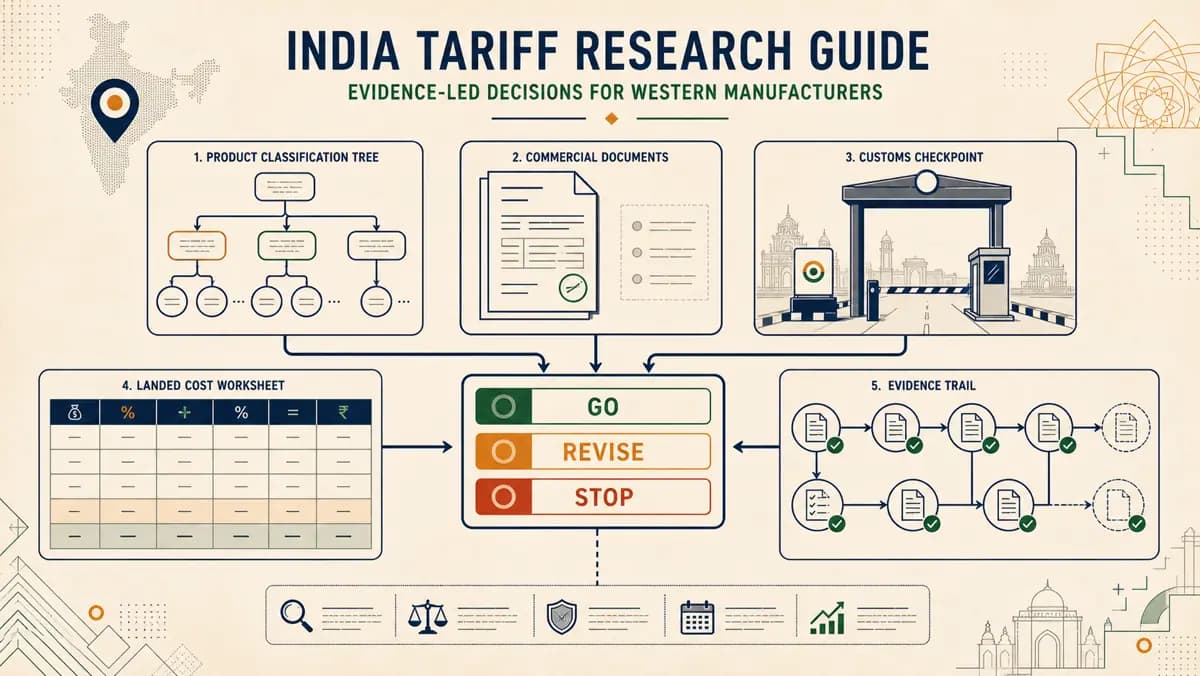
India Tariffs: A Manufacturer's Line-Level Check
Separate India tariff headlines from the line-level import evidence needed before quoting, sourcing or entering the market.