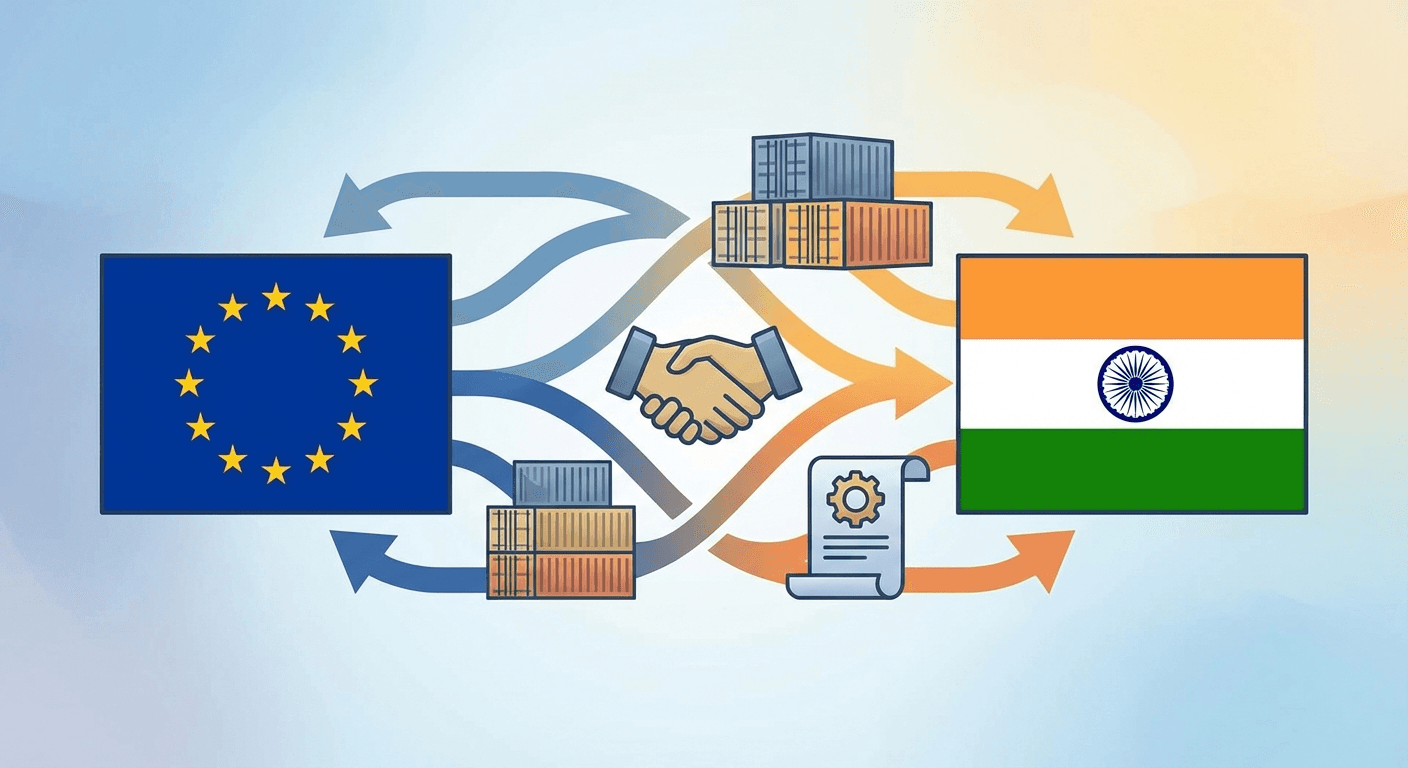
TL;DR
The EU-India Free Trade Agreement, concluded on January 27, 2026 after nearly 18 years of negotiation, creates unprecedented opportunities for European SMEs willing to move fast. The deal covers 96.6% of traded goods by value and is expected to double EU exports to India by 2032, saving businesses €4 billion annually in tariffs. Wine tariffs drop from 150% to 75% immediately (then to 20-30% gradually), car tariffs from 110% to as low as 10%, and machinery duties up to 44% are eliminated entirely. Action required now: The agreement still needs European Parliament consent and Indian ratification before entering into force (expected within ~12 months). Smart companies are preparing NOW — conducting market feasibility, establishing IP protection, and identifying local partners — so they're ready on day one.
EU-India FTA 2026: What European SMEs Must Do Now to Capitalize on New Trade Opportunities
The EU-India Free Trade Agreement, concluded on January 27, 2026, covers 1.8 billion people and represents one of the most significant bilateral trade deals in recent history. For European SMEs, this agreement transforms India from a complex, tariff-heavy market into an accessible growth opportunity — but only for those who prepare now.
The agreement covers tariff elimination or reduction on 96.6% of traded goods by value, streamlines regulatory processes through mutual recognition frameworks, and opens service sectors previously restricted to foreign companies. The deal is expected to enter into force within approximately 12 months of ratification. European businesses that position themselves during this window will capture market share that late entrants may never recover.
What's Actually in the EU-India FTA
Trade Liberalization Scope
The agreement covers goods trade worth over €120 billion annually. India will liberalise 96.6% of tariff lines, while the EU will liberalise 99.3% — creating broadly balanced market access. The deal is expected to save European exporters €4 billion per year once fully implemented.
Key provisions include:
- Goods liberalization: Progressive tariff elimination across manufacturing, chemicals, machinery, and agricultural products
- Services market access: European firms gain entry to telecommunications, financial services, logistics, and professional services
- Digital trade framework: Cross-border data flows, e-commerce provisions, and digital services recognition
- Government procurement: European suppliers can bid on Indian public sector contracts worth €200 billion annually
- Intellectual property protection: Enhanced IP enforcement mechanisms and patent recognition protocols
Regulatory Harmonization
The agreement establishes mutual recognition frameworks for technical standards, reducing compliance costs for European exporters by an estimated 25-30%. Professional qualifications recognition allows European engineers, architects, and consultants to practice in India with streamlined approval processes.
Standards alignment covers:
- Manufacturing quality certifications (ISO, CE marking acceptance)
- Food safety and pharmaceutical approvals
- Automotive emissions and safety standards
- Construction and engineering specifications
Investment Protection
Bilateral investment provisions protect European investments in India through dispute resolution mechanisms and guarantee repatriation of profits. The agreement includes provisions for minority stake acquisitions in sensitive sectors and streamlined approval for majority foreign ownership in non-strategic industries.
Sector-by-Sector Impact Analysis
Manufacturing and Industrial Goods
Current barriers: India's average manufacturing tariff of 18.3% has made European exports uncompetitive against domestic producers and Asian suppliers.
Post-FTA reality: Immediate tariff elimination on 65% of manufacturing categories, with remaining tariffs phased out over 5-7 years. European machinery, chemicals, and precision instruments gain significant cost advantages.
Strategic implications: German and Italian machinery exporters will compete directly with Chinese suppliers on cost. French pharmaceutical companies access India's generic manufacturing base through joint ventures with reduced regulatory friction.
Automotive Sector
Transformation scale: India imports €8.5 billion in automotive components annually. The FTA eliminates 25% tariffs on European auto parts, making European suppliers competitive with Korean and Japanese alternatives.
Electric vehicle opportunity: India's EV transition creates demand for European battery technology, electric drivetrains, and charging infrastructure. European companies gain preferential access to India's €15 billion EV incentive programs.
Services and Digital Economy
Financial services: European banks gain access to India's retail banking market through subsidiary establishment. Insurance companies can increase foreign ownership limits from 49% to 74% in most categories.
Technology services: European software companies benefit from data localization exemptions for cross-border B2B services. Cloud service providers gain market access previously restricted to domestic operators.
Professional services: Engineering, consulting, and legal services firms can establish branches with simplified licensing requirements.
Agriculture and Food Processing
Market access gains: EU agricultural exports worth €4.2 billion annually gain preferential access, with immediate tariff elimination on wine, dairy products, and processed foods.
Quality premium capture: European food brands access India's premium consumer segment, projected to reach 300 million households by 2030.
Implementation Timeline and Critical Dates
Phase 1: Entry into Force (Expected early-mid 2027)
The agreement requires European Parliament consent and Indian ratification. Once both complete, the following takes effect immediately:
- First wave of tariff reductions (e.g., wine from 150% to 75%, machinery duty elimination)
- Services market access for priority sectors
- Mutual recognition frameworks operational
- Investment protection provisions active
Phase 2: Progressive Liberalization (Years 1-7)
- Additional tariff reductions phase in annually
- Wine tariffs continue declining toward 20-30%
- Spirits tariffs reach 40% target
- Government procurement markets open progressively
- Digital trade provisions fully operational
Phase 3: Full Implementation (Years 7-10)
- Remaining sensitive tariffs reach final levels (e.g., gin at 10 years)
- Full services market liberalisation achieved
- Complete regulatory harmonisation in covered sectors
Five Actions European SMEs Must Take Now
1. Conduct Immediate Market Feasibility Analysis
Timeline: Complete before entry into force (expected early-mid 2027)
European SMEs must assess India market potential using FTA-adjusted economics. Traditional market entry models based on high tariff scenarios no longer apply. Companies should:
- Recalculate total cost of market entry with eliminated tariffs
- Analyze competitive landscape changes from preferential access
- Identify regulatory compliance requirements under new mutual recognition agreements
- Assess local partnership requirements for services sectors
Critical insight: Market entry costs will decrease 30-45% for most European manufacturers, fundamentally altering ROI calculations.
2. Establish Intellectual Property Protection Strategy
Timeline: File priority applications as early as possible (2026)
India's enhanced IP enforcement mechanisms under the FTA provide stronger protection, but companies must act before market entry. Priority actions:
- File patent applications in India for core technologies
- Register trademarks across relevant product categories
- Establish trade secret protection protocols for India operations
- Create IP licensing frameworks for potential local partnerships
Risk factor: Delayed IP filing creates vulnerabilities as competitors enter the Indian market simultaneously.
3. Identify and Evaluate Local Partnership Opportunities
Timeline: Partner identification well before entry into force
Despite improved market access, local partnerships remain essential for distribution, regulatory navigation, and market penetration. Strategic partnership evaluation should focus on:
- Distribution network reach and quality
- Regulatory compliance expertise
- Financial stability and growth trajectory
- Cultural alignment and operational compatibility
- Existing relationships with target customer segments
Partnership models: Joint ventures for manufacturing, distribution agreements for market entry, technology licensing for IP monetization, and service alliances for professional services firms.
4. Prepare Certification and Compliance Infrastructure
Timeline: Certification processes initiated in 2026
Mutual recognition agreements simplify but don't eliminate certification requirements. Companies must:
- Understand sector-specific certification requirements under new frameworks
- Establish quality management systems aligned with Indian standards
- Prepare documentation for expedited approval processes
- Train personnel on Indian regulatory compliance requirements
Compliance advantage: Early certification under new mutual recognition frameworks provides competitive advantage over delayed market entrants.
5. Develop India-Specific Go-to-Market Strategy
Timeline: Strategy finalization before entry into force
India market entry requires localized approaches despite regulatory simplification. Strategic considerations include:
- Pricing strategy adjusted for local purchasing power and competitive dynamics
- Product adaptation requirements for Indian market preferences
- Channel strategy optimized for India's diverse distribution landscape
- Customer service and support infrastructure for local market needs
Market intelligence: Detailed market entry costs and budgeting framework provides comprehensive financial planning support for European SMEs.
Key Tariff Changes by Sector
| Sector | Current India Tariff | Post-FTA Tariff | Phase-in | Source |
|---|---|---|---|---|
| Automobiles (cars) | Up to 110% | As low as 10% | Gradual | Reuters, Jan 27 |
| Machinery & Equipment | Up to 44% | 0% | Immediate to Year 3 | EU Commission |
| Wine (premium) | 150% | 75% → 20-30% | Year 1 → gradual | Reuters, Jan 27 |
| Spirits | Up to 150% | 40% | 7 years (gin: 10 years) | Reuters, Jan 27 |
| Pharmaceuticals | 10-15% avg | Reduced/eliminated | Phased | EU Commission |
| Dairy Products | 30-40% avg | Reduced | Phased | EU Commission |
| Textiles (EU→India) | Variable | Reduced | Phased | EU Commission |
| Professional Services | Market restrictions | Liberalised access | Upon entry into force | EU Commission |
Common Mistakes Western Companies Make in India Entry
Understanding typical market entry failures helps European SMEs avoid costly mistakes during FTA implementation.
Mistake 1: Underestimating Regulatory Complexity
Despite FTA simplifications, India's regulatory environment remains complex. Companies often underestimate compliance requirements for labor laws, environmental approvals, and sector-specific regulations not covered by the trade agreement.
Solution approach: Engage local regulatory experts before market entry and budget 15-20% additional time for regulatory compliance versus European standards.
Mistake 2: Inadequate Local Partnership Due Diligence
European companies frequently select local partners based on initial presentations rather than comprehensive due diligence. Poor partnership choices create long-term operational and financial risks.
Due diligence framework: Financial audits, reference checks with existing international partners, assessment of management quality, and evaluation of operational capabilities across all proposed partnership functions.
Mistake 3: Pricing Strategy Misalignment
European companies often apply European pricing models to the Indian market without adjustment for local purchasing power and competitive dynamics. This approach limits market penetration despite tariff advantages.
Pricing optimization: Develop India-specific pricing that captures FTA cost savings while remaining competitive with local and Asian suppliers.
Mistake 4: Cultural and Communication Underinvestment
Business culture differences create operational friction that undermines partnership effectiveness and customer relationships. European companies often underinvest in cultural training and local team development.
Cultural investment: Allocate 10-15% of India market entry budget to cultural training, local team development, and relationship building activities.
Mistake 5: Insufficient Market Research Depth
Surface-level market research leads to product-market fit failures and unrealistic market penetration timelines. Comprehensive market entry frameworks provide detailed guidance for avoiding common research gaps. To see what decision-grade research looks like in practice, review a market intelligence report example before commissioning or producing your own.
Frequently Asked Questions
What is the actual implementation date for the EU-India FTA?
The EU-India Free Trade Agreement was concluded on January 27, 2026. It still requires European Parliament consent and Indian ratification to enter into force — expected within approximately 12 months. Once ratified, initial tariff reductions and services market access provisions become effective immediately.
How does the FTA affect existing European companies already operating in India?
Existing European operations benefit retroactively from tariff eliminations on imports and expanded market access for services. Companies can restructure operations to optimize for new trading conditions, including supply chain adjustments and service line expansions previously restricted.
What sectors remain restricted under the FTA?
National security sectors including defense manufacturing, critical telecommunications infrastructure, and strategic minerals remain subject to foreign investment restrictions. Retail trading, nuclear energy, and certain agricultural land ownership continue to have limitations not affected by the FTA.
Do European SMEs need Indian partners for market entry under the FTA?
Legal requirements for local partnerships are eliminated in most sectors, but practical considerations still favor partnership approaches. Distribution networks, regulatory navigation, and customer relationship building benefit significantly from local partnership, especially for SMEs without existing Asia operations.
How long will tariff phase-outs take for my specific products?
Tariff elimination schedules vary by product category and sensitivity. 72% of products receive immediate duty-free access, with remaining products phasing out over 3-7 years based on sector sensitivity. Detailed FTA impact analysis provides product-specific timelines and market entry implications.
What support is available for European SMEs entering the Indian market?
The EU-India Business Portal provides regulatory guidance, certification support, and partnership facilitation. Member state trade promotion agencies offer India-specific export assistance programs enhanced for FTA implementation. Additionally, specialized advisory services help European companies navigate market entry complexity and optimize FTA benefits.
Strategic Recommendations for Immediate Action
The EU-India FTA creates a narrow window for European SMEs to establish market presence before competitive advantages diminish. Companies that act decisively in 2026 will capture market positions that late entrants may struggle to achieve.
Priority focus areas:
- Market research and feasibility analysis — start now, complete before ratification
- IP protection and regulatory compliance preparation — file in 2026 while there's still time
- Local partnership establishment and go-to-market strategy — be ready to execute on entry into force
European businesses that delay India market entry risk losing first-mover advantages to competitors already positioning for FTA benefits. The agreement transforms India from a challenging, tariff-heavy market into a commercially viable extension of the European trade zone.
Strategic market entry support and comprehensive FTA optimization guidance help European companies maximize benefits while avoiding common market entry pitfalls. Professional advisory services provide the expertise and local market intelligence necessary for successful India market expansion under the new trade framework.
Ready to capitalize on EU-India FTA opportunities? Download our comprehensive India Market Entry Guide 2026 or schedule a strategic consultation to develop your India expansion strategy.
Tensor Advisory specializes in EU-India business strategy and provides comprehensive market entry support for European companies expanding into India's dynamic economy.
Read the methodology, source date and confidence level before carrying a number into a decision.
What does the FTA change for your product?
Open the Tariff Calculator →Every figure above is dated and source-attributed. Nothing arrives as an unexplained number.
- Sources are listed in the report methodology and verified against the publication date.
- Regulatory outcomes remain subject to entry-into-force dates and line-level classification.
Continue the research
Choose the next evidence step
Use this briefing as context, then choose the format that fits the question you need to answer.
Standard report
Start with a dated baseline
Use a fixed-scope report when you need a sourced answer to a defined market question.
ExploreCustom MIR
Shape the question around your case
Carry this article’s question into one target market, sector, corridor, and decision brief.
ExploreScoping call
Talk through the decision
Bring the corridor, timing, and evidence gap to a call before choosing the right format.
ExploreRelated Intelligence

India EU Trade Deal: What Is Binding in September 2026?
A dated implementation-status guide to the India-EU trade deal, the published draft texts, and the checks Western companies should complete before changing a quote.
The EU-India FTA Text Is Out. Here's What European SMEs Should Do Right Now.
India and the EU released the provisional FTA text on February 28, 2026. With 20 chapters covering goods, services, digital trade, IP, and a dedicated SME chapter — here's how European SMEs should prepare before ratification.
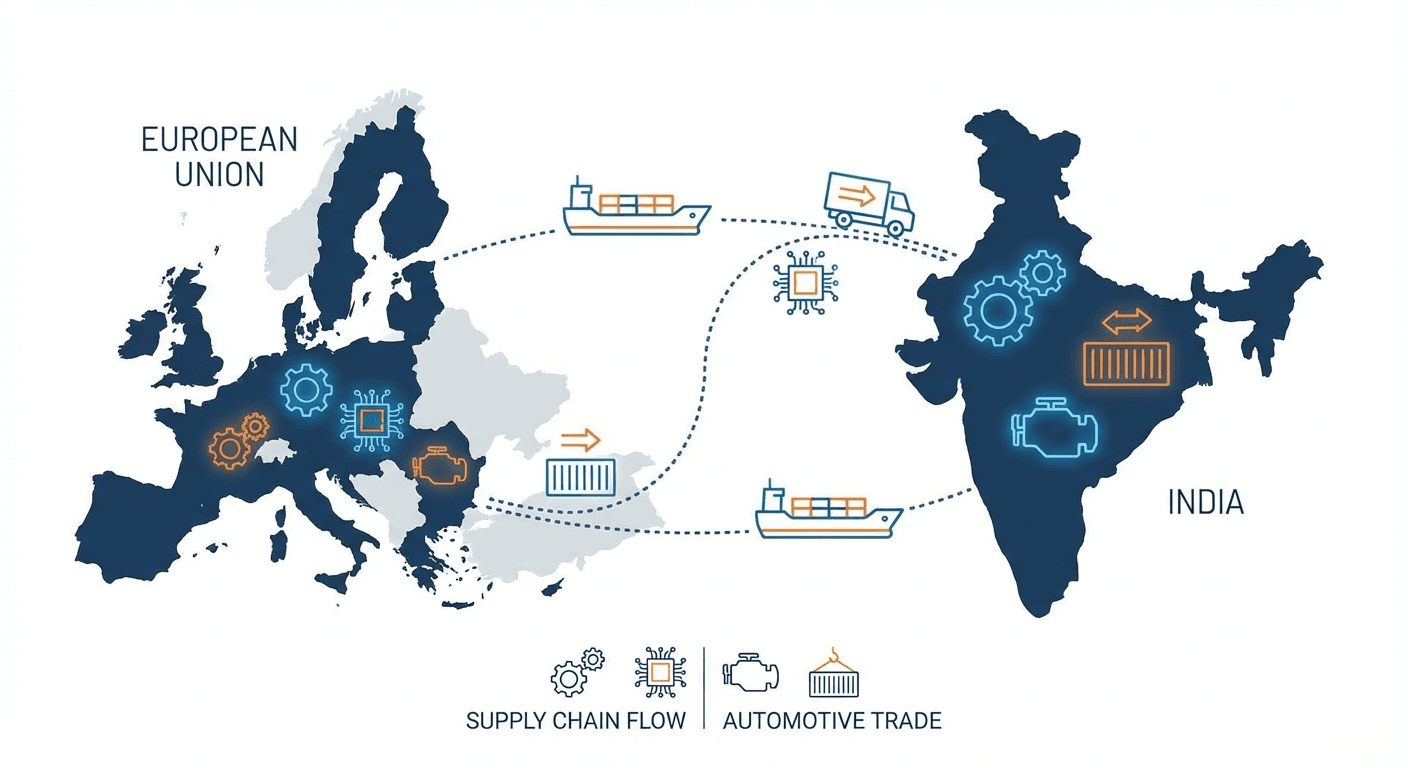
EU-India FTA: European Cars at 10% Tariff — What Tier 2 Suppliers Should Know
EU-India FTA cuts car tariffs from 110% to 10%. Zero-tariff auto components are the real prize. Tier 2 & 3 supplier action plan with timeline, BIS requirements, and first-mover advantages.