There is no single figure for “India tariffs” that a manufacturer can carry into landed cost. Separate a tariff another country applies to Indian exports from the duties and taxes India applies when goods enter India. For an India import, the working answer depends on the exact product classification, origin, customs value, date, applicable treatment or notification, and other import charges. The U.S. International Trade Administration presents India import tariffs as a market-access issue and links to the Customs Info Database, which the page says is available to estimate duties and taxes. Separately, the page's Global Business Navigator chatbot disclaimer tells users to double-check the chatbot's responses and not use them as legal or professional advice; that warning is not attached to the Customs Info Database lookup (U.S. ITA, last published April 17, 20261). Under this article's editorial rule, use aggregate profiles for context only and obtain a dated, line-level determination before making a commercial commitment (WTO, World Tariff Profiles 2026: India2).
What does “India tariffs” mean in this decision?
The first decision is direction: are the goods leaving India, or entering India? One case concerns a tariff imposed by another destination on Indian exports. The other concerns Indian import duties and taxes on goods entering India.
For a Western manufacturer entering India, write the transaction in one line. Name the product, stated origin, seller, proposed importer, direction of movement and decision date. Then state the question you need answered. A news headline about Indian exports cannot answer an Indian import question merely because both use the words “India tariffs.”
The U.S. ITA page is a starting point for U.S. businesses researching India import tariffs as a market-access issue. It links to the Customs Info Database, which the page says is available to estimate duties and taxes. A separate Global Business Navigator chatbot disclaimer tells users to double-check the chatbot's responses and not use them as legal or professional advice; it does not qualify the Customs Info Database lookup (U.S. ITA). Under this article's editorial rule, request a supported answer for the named transaction, not a general tariff summary.
Why is an average tariff not your product rate?
An average describes a selected dataset or group. It does not identify the line-level treatment of a shipment. The WTO profile presents aggregate bound and MFN-applied summaries. It also presents distributions by broad product groups, with the relevant periods or years labelled (WTO, World Tariff Profiles 2026: India). Those summaries provide context. The WTO profile does not turn a broad group into a rate for a specific item (WTO).
WITS exposes tariff data through country, partner and product filters. It also labels the scope displayed by the query (World Bank WITS, India tariff page3). Save the filter choices and retrieval date if you use WITS as a reproducible research query. Its result is aggregate or reported tariff data. It is not evidence of the reader’s product classification, customs value, origin qualification or final payable amount (World Bank WITS).
For a broader source-selection method, use the market research tools guide. Keep any average in a context field, outside the approved landed-cost input.
What line-level evidence packet should you build?
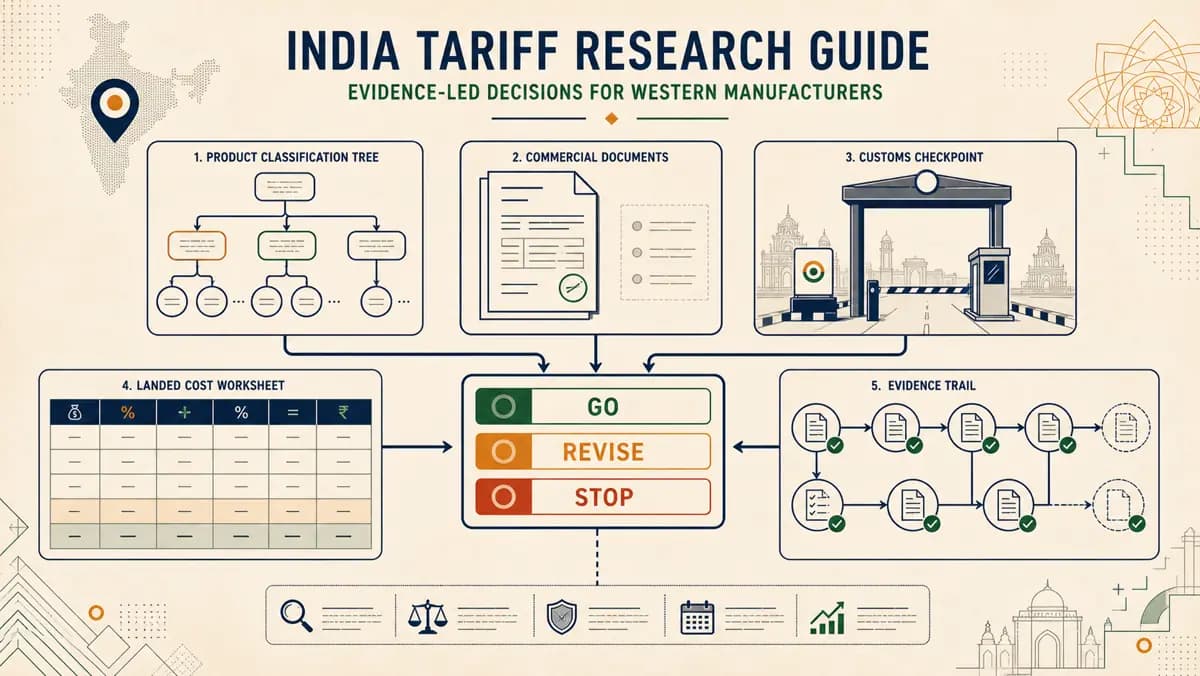
The packet should trace each proposed treatment to the exact product, transaction, date and cited instrument. Under this editorial workflow, the fields below remain unresolved. Suitable customs or legal expertise must verify them.
- Product identity: exact description, model or part reference, materials, function, intended use and technical record supplied for review.
- Working classification: proposed HS classification, the version used, who proposed it, supporting rationale and unresolved alternatives. It stays a working position until reviewed.
- Origin: stated origin, the evidence offered for it, the rule or treatment being tested and every open origin question.
- Transaction and value: seller, buyer, proposed importer, Incoterm, invoice inputs, assists or other valuation inputs identified for review, currency and exclusions.
- Decision date: intended import date or date range and the date on which each source was checked.
- Treatment evidence: title, identifier, scope, effective-date wording and link for the official notice or other instrument relied on. Do not fill this field from a headline.
- Taxes and charges: each proposed item as a separate field, with its basis, source, owner and review status. Do not insert an assumed rate.
- Control record: reviewer, review date, decision owner, open issues, next verification and document version.
The packet is narrower than a full India sourcing review, but the product identity and commercial basis should match across both files.
Source discipline: “Found in a lookup” is an observation. “Applies to this shipment” is an interpretation that still needs line-level verification.
How should observation, interpretation and verification stay separate?
Do not allow a cited source observation to become an uncited product conclusion in the next column. Use one row for each question. Preserve the line between what the source displays and what the analyst thinks it may mean. Then state what a qualified reviewer still needs to verify.
| Research item | Source observation | Analyst interpretation | Still-open verification |
|---|---|---|---|
| Direction of tariff | The ITA source addresses India import tariffs as a market-access topic (U.S. ITA) | This source may be relevant when the goods enter India | Confirm that the transaction under review is an India import |
| Aggregate context | The WTO profile reports aggregate summaries and broad product-group distributions with labelled periods or years (WTO) | The profile can frame context | Do not carry an average into the product line |
| Filtered research | WITS exposes country, partner and product filters and labels the displayed scope (World Bank WITS) | The saved query can make background research reproducible | Verify classification, origin, value and payable treatment for the shipment |
| Lookup result | ITA links to the Customs Info Database, which the page says is available to estimate duties and taxes. A separate Global Business Navigator chatbot disclaimer (not a lookup warning) says to double-check chatbot responses and not use them as legal or professional advice (U.S. ITA) | Under this article's editorial rule, the lookup result can identify a question for review | Obtain a dated answer tied to the official instrument and transaction facts |
How would a hypothetical component move through the check?
A fictional example should test the workflow without claiming a code, rate or customs outcome. Assume Northstar Motion plans to send an industrial motion-control component to a proposed importer in India. Northstar Motion is a fictional Western manufacturer. The name, company and transaction are hypothetical.
The team prepares a technical description, materials list, function, intended use and drawings. It records a working classification without publishing it. It records the stated origin and the documents proposed as support. The commercial file identifies the seller, buyer, proposed importer, Incoterm and valuation inputs, but it leaves every treatment and charge field blank.
An analyst saves a relevant WITS query as background. WITS supports country, partner and product filters and labels the displayed scope (World Bank WITS). The analyst does not turn that query into a shipment conclusion. WITS does not prove the reader’s classification, customs value, origin qualification or final payable amount (World Bank WITS). A suitable reviewer must still verify the product facts, working classification, origin, value, applicable instrument, date and charges before the commercial gate.
How can you build a landed-cost scenario without making a customs determination?
Build a variable-based scenario only after a documented rate or treatment has been supplied, and label the result non-binding. The tariff calculator can be used as a scenario tool, never as a source of legal truth.
Use separate formula fields so assumptions remain visible:
| Scenario field | Input control | Formula role |
|---|---|---|
| Supplier price basis | Record source, currency, Incoterm and date | Starting commercial value input |
| Customs value input | Enter only the value supplied for the reviewed scenario | customs value input |
| Duty treatment input | Enter only a documented, reviewed treatment | customs value input × reviewed duty input |
| Other import tax or charge input | Keep each reviewed item separate | documented basis × reviewed input |
| Freight, insurance and handling | Record source, scope and date for each input | Add the stated scenario inputs |
| Landed-cost scenario | Display assumptions and exclusions beside the result | commercial inputs + reviewed border inputs + logistics inputs |
Do not publish or approve the scenario as a customs determination. Re-check the product, origin and valuation facts. Re-check the instrument and effective date before a quote or other commitment. If a value is unresolved, keep the cell open. Use a clearly labelled range only after the relevant treatment has been documented.
Scenario label: Non-binding planning model. It does not establish classification, origin, customs value, entitlement, rate or final payable amount.
How do tariffs interact with certification and import requirements?
A tariff workstream and a certification or import-requirements workstream can share a product file. One does not prove the other. A classification proposal or tariff lookup does not establish that a product meets a certification or import requirement. A certification record does not establish a tariff treatment.
Keep two decision columns in the entry file:
- Border-cost question: What classification, origin, value, date, instrument, duties, taxes and charges have been reviewed for the transaction?
- Product-entry question: What certification or import requirement has been identified for the exact product and use, and what evidence supports that separate conclusion?
The shared product description should be consistent, while the sources, reviewers, findings and open issues remain distinct. Place both workstreams inside the wider India market entry strategy rather than allowing one checked box to stand in for the other.
What changes under a trade agreement?
A headline signature does not establish line-level entitlement. For this workflow, a proposed trade-agreement treatment stays unresolved until it is checked for the planned transaction. The check covers the exact product line, origin position, supporting proof, applicable instrument and effective-date wording.
Create a separate treatment record with:
- the agreement or instrument being tested;
- the working classification and version;
- the origin rule or treatment under review;
- the evidence offered to support origin;
- the relevant line or schedule entry;
- the effective-date evidence;
- the reviewer, review date and unresolved questions.
Do not replace this record with a press headline, signature announcement or broad product-group statement. For corridor context, the EU-India FTA guide for Western companies belongs in the background file, not in the cell that requires a verified line-level treatment.
What is the go, revise or stop gate before a quote or market entry?
Stop if product identity or classification, origin, customs value, applicable instrument or the responsible reviewer remains unresolved. A go decision means the dated evidence packet supports the exact scenario being approved. This article and the scenario model do not become legal, tax or customs advice.
| Gate | Required record | Decision |
|---|---|---|
| Go | Product and transaction facts are fixed; a suitable reviewer has documented the classification, origin, value, instrument, date and treatment used in the scenario | Permit the named quote or entry scenario to move to its next internal approval |
| Revise | The reviewer has identified a specific fact, document or assumption that must change | Update the packet and rerun the affected scenario before approval |
| Stop | Product identity or classification, origin, customs value, applicable instrument or responsible reviewer is unresolved | Do not use a tariff input in the quote or market-entry commitment |
Record who made the gate decision and what version was reviewed. State which commercial action it covers. State when the packet must be checked again. Talk to an India market specialist to structure the evidence packet and coordinate the open research questions.
Frequently Asked Questions
What is the current tariff on goods imported into India?
There is no responsible single rate to give without the exact product classification, origin, customs value, date, applicable treatment or notification, and other import charges. The ITA treats India import tariffs as a market-access research issue and links to the Customs Info Database, which the page says is available to estimate duties and taxes. Separately, its Global Business Navigator chatbot disclaimer says to double-check the chatbot's responses and not use them as legal or professional advice; that disclaimer is not a warning about the lookup (U.S. ITA). Under this article's editorial rule, obtain a dated line-level determination for the planned transaction.
Who pays India import tariffs?
The evidence packet should identify the proposed importer, seller, buyer, Incoterm, valuation inputs and each party’s stated commercial responsibility. Do not infer the final responsibility from a headline or average. Have the transaction structure and customs treatment reviewed before the quote.
Where can a manufacturer find India tariff rates?
The U.S. ITA Country Commercial Guide is a starting point and links to the Customs Info Database, which the page says is available to estimate duties and taxes. Separately, its Global Business Navigator chatbot disclaimer says to double-check chatbot responses and not use them as legal or professional advice; that disclaimer does not apply to the lookup (U.S. ITA). Under this article's editorial rule, treat any lookup result as a research input requiring line-level verification. WITS provides reproducible country, partner and product filters for aggregate or reported tariff research, but it does not prove a reader’s product classification, customs value, origin qualification or final payable amount (World Bank WITS).
Is a broad India tariff average enough for landed cost?
No. The WTO profile presents aggregate bound and MFN-applied summaries and broad product-group distributions with labelled periods or years, not a shipment-level answer (WTO, World Tariff Profiles 2026: India). Use that material for context and obtain a dated line-level determination before using a tariff input in a commercial commitment.
Written by Loïc Guyon (Tileo)4, an operator with a decade of Europe-Asia industrial trade programs.
Continue the research
Choose the next evidence step
Use this briefing as context, then choose the format that fits the question you need to answer.
Standard report
Start with a dated baseline
Use a fixed-scope report when you need a sourced answer to a defined market question.
ExploreCustom MIR
Shape the question around your case
Carry this article’s question into one target market, sector, corridor, and decision brief.
ExploreScoping call
Talk through the decision
Bring the corridor, timing, and evidence gap to a call before choosing the right format.
ExploreRelated Intelligence

Wholly Owned Subsidiary in India under the Companies Act 2013: A Source Map
A source map for the wholly owned subsidiary India Companies Act 2013 question: Companies Act relationships, FEMA and RBI source tracks, FAQs, and counsel handoff.
Branch Office India: RBI Application and Decision Guide
An operational guide to the RBI and AD Category-I bank route for a branch office in India, with decision points, tax context, and post-approval controls.
India US Trade Deal: What Manufacturers Must Verify
As of 2026-09-14, the US-India trade framework is not operative legal text. Verify tariff lines, origin and customs guidance before changing landed cost.