
India sourcing should begin with a technical and commercial requirement, supplier identity evidence, applicable product requirements, sample and inspection records, landed-cost inputs, and an explicit approval gate. A directory listing or a convincing sample can help identify a candidate, but neither establishes who will manufacture the product, which requirements apply, or whether production will match the reviewed sample. Western industrial buyers should build a traceable decision file before approval. This does not promise compliance or supplier quality. It gives owners, CFOs, and COOs a measured way to decide what is known, what remains unverified, and when the sourcing process should stop.
Our verdict: supplier discovery should open an evidence review, not decide supplier approval.
What is India sourcing?
India sourcing is the process of identifying, assessing, and commercially engaging an Indian supplier for a defined requirement. For an industrial buyer, the useful output is not a long supplier list. It is a documented decision about whether a particular supplier and product can move to the next approval stage.
That distinction matters. A supplier may present an attractive catalogue, respond quickly, and produce a promising sample. Those signals can justify further assessment, but they do not answer every question a buyer must resolve. The buyer still needs a clear product requirement, evidence tied to the legal supplier identity, a record of what was sampled or inspected, defined commercial terms, and a documented decision.
Tensor Advisory uses the following evidence pack as editorial guidance for industrial buyers. It is Tensor Advisory's method, not a legal standard, certification scheme, or universal sourcing process.
| Sourcing stage | Decision to make | Evidence to retain | Gate |
|---|---|---|---|
| Requirement | What exactly is being requested? | Drawings, specification, materials, tolerances, intended use, quantities, packaging, and acceptance points | Do not search until the requirement is clear enough to compare responses |
| Supplier identity and manufacturing responsibility | Who is offering, and who will manufacture? | Legal identity records, addresses, named contacts, manufacturing-site details, and the relationship between the seller and the manufacturer | Pause if identity or manufacturing responsibility cannot be traced |
| Applicable product requirements | Which current official instrument or QCO applies to this exact product and use? | Official source, instrument or QCO identifier, product scope, holder or entity, claimed identifier, and verification date | Record no coverage, exemption, certification, compliance, or acceptance conclusion until each relevant element is verified |
| Sample | What item was actually reviewed? | Sample identifier, revision, date, supplier, observations, photos, and disposition | Do not treat an untraceable sample as production approval |
| Inspection | What was checked, against which acceptance point? | Inspection scope, method stated by the inspecting party, results, exceptions, evidence, and sign-off | Hold approval where the record does not support the decision |
| Commercial and landed-cost inputs | What is included in the offer and the buyer's cost file? | Price basis, inclusions, exclusions, packaging, logistics inputs, payment conditions, validity, source dates, and unresolved cost items | Compare only offers built on the same requirement and stated basis; pause if a material input has no owner or source |
| Approval | Is the evidence sufficient for the buyer's decision? | Named approver, decision date, conditions, open points, and stop reasons | Approve, approve with stated conditions, pause, or reject |

Which products and requirements should be fixed first?
Start with the item the business intends to buy, not with the supplier directory. Write a technical and commercial requirement that lets different candidates respond to the same request.
The technical part can record the product description, drawing or specification revision, materials, dimensions and tolerances, performance or acceptance points, intended use, required marking or documentation, packaging, and any buyer-approved deviation process. Include only criteria that the buyer can define and assess. If a point is unknown, mark it as unresolved rather than allowing each supplier to make a different assumption.
The commercial part can record the requested quantity basis, price basis, included and excluded items, delivery basis as stated by the parties, payment proposal, tooling or development items, quotation validity, and the documents expected with the offer. These are fields for comparison, not recommended terms.
The applicable product-requirements review must be product-specific. The Bureau of Indian Standards states that its product certification scheme is "basically voluntary in nature," while the Central Government makes compliance with Indian Standards compulsory for a number of products through QCOs (Bureau of Indian Standards, Product Certification Overview). That general overview cannot establish whether a specific product is covered, exempt, certified, compliant, or acceptable. Before recording a conclusion, verify the exact current instrument or QCO, product scope, holder or entity, and identifier against official material (Bureau of Indian Standards, Product Certification Overview). This article is not legal, customs, or conformity advice.
This requirement file is also the anchor for later sample and inspection records. If the drawing revision, intended use, or acceptance points change, the buyer can see whether earlier evidence still addresses the current request.
How do you identify potential suppliers?
Use directories, search results, referrals, trade contacts, and official investment context as discovery routes, not as approval evidence. Invest India presents sector and state information and describes itself through its official investment-support context; that material can help a buyer orient an India market review, but it does not establish that a particular supplier is approved (Invest India).
Create an initial candidate record for each supplier using the same fields:
- Name used in the offer and correspondence.
- Claimed legal entity name and address.
- Named commercial contact.
- Claimed manufacturing site and manufacturing responsibility.
- Product or process fit against the buyer's requirement.
- Source through which the candidate was found.
- Documents requested, received, missing, or awaiting verification.
- Conflicts or unanswered questions.
This is where the objection “a supplier directory and sample are enough” breaks down. A directory profile is a discovery record. A sample is evidence about the item identified in its record. Neither, by itself, traces the supplier's identity, identifies applicable requirements, documents an inspection, or fixes the commercial basis. A buyer may choose a different process, but those questions still need explicit answers before the evidence can support approval.
For category context before building a candidate list, see manufacturing companies in India. Buyers deciding whether to run this supplier process in India or Mexico can use the India-versus-Mexico manufacturing decision path before opening plant-level diligence. Buyers assessing a specific category can also review the approach used for India furniture manufacturers. These pages should inform discovery, not replace product-specific evidence.
Which supplier evidence should you request?
Request documents that let the buyer connect the offer, the manufacturing responsibility, and the reviewed product to a traceable supplier record. The appropriate request depends on the transaction and the buyer's own controls. Tensor Advisory's supplier-document checklist is editorial guidance:
- Legal entity identity document supplied by the candidate.
- Registered and operating addresses stated by the candidate.
- Named signatory and contact details.
- Manufacturing-site identity and address.
- Written explanation of the relationship between seller, exporter, and manufacturer where they differ.
- Offer tied to the buyer's current requirement revision.
- Product and process information relevant to the stated acceptance points.
- Copies of any claimed certificates or licences, with identifier, holder, scope, issuer, and validity information available for independent verification.
- Declaration of any proposed subcontracting relevant to the reviewed requirement.
- Sample, inspection, and exception records linked to the same product identifier.
- Commercial terms with inclusions, exclusions, and unresolved items stated.
- Record of independent checks completed by the buyer and the source used for each check.
Receiving a document is not the same as verifying it. Record who issued it, what entity and scope it names, how it relates to the offered product, and where the buyer checked it. A certificate image should not be extended to a product, site, or entity that its stated scope does not cover. For BIS-related claims, use the relevant current official BIS material and verify the exact current instrument or QCO, product scope, holder or entity, and identifier rather than relying on a general certification page (Bureau of Indian Standards, Product Certification Overview).
Talk to an India market specialist to structure a supplier evidence review around your product and decision gate.
What product requirements may apply?
There is no responsible product-requirements answer without the exact product, intended use, specifications, and relevant official instrument. Similar names or catalogue categories can conceal different scopes. The buyer's file should therefore separate three questions:
- What requirement has the buyer specified contractually?
- What official product requirement has been identified for the exact product?
- What evidence supports the supplier's claim against that identified requirement?
For BIS product certification, preserve the official wording rather than converting a general overview into a product conclusion. BIS says its certification scheme is "basically voluntary in nature" and that the Central Government makes compliance with Indian Standards compulsory for a number of products through QCOs (Bureau of Indian Standards, Product Certification Overview). Only the exact current instrument or QCO, read against the product scope, holder or entity, and identifier, can support the buyer's recorded conclusion (Bureau of Indian Standards, Product Certification Overview).
Record the official source URL, instrument title or identifier, stated scope, date checked, and the product facts used to assess relevance. If the team cannot identify the applicable source or match the product to its scope, label the point unresolved and pause the corresponding approval. Do not ask the supplier's marketing material to serve as the legal conclusion.
Market entry questions may sit beside, but should not be confused with, product approval. Our guide to GST registration in India for a foreign company addresses a separate business issue. The broader India market entry strategy for European SMEs can help place sourcing within the company's wider India decision.
How should samples and inspections be documented?
A sample record should identify the physical item and the requirement against which it was reviewed. An inspection record should identify what was checked, the evidence observed, exceptions, and the resulting disposition. Neither record should imply more than it shows.
Tensor Advisory's sample and inspection record checklist is editorial guidance:
- Supplier identity and manufacturing site stated on the record.
- Product, part, or drawing identifier.
- Requirement revision used for the review.
- Sample identifier and date received or reviewed.
- Quantity represented in the record, where relevant.
- Photos or files linked to the same identifier.
- Acceptance points checked and results recorded separately.
- Method stated by the inspecting party, without implying an unstated standard.
- Equipment or source records included where the decision relies on them.
- Deviations, damage, rework, substitutions, and unanswered points recorded.
- Name and role of the person creating the record.
- Buyer disposition: accepted for the stated purpose, conditionally accepted, held, or rejected.
- Clear statement of what the record does not establish.
Avoid labelling a sample “approved” without saying what the approval permits. It may support design review, visual review, a stated test, or a commercial discussion. The record should make that boundary visible. If production evidence is later reviewed, give it its own identifier and decision rather than treating the earlier sample as proof of later output.
What belongs in landed-cost inputs?
A landed-cost file is useful when it shows inputs, sources, assumptions, exclusions, and ownership rather than a single unexplained total. Tensor Advisory's method records the following fields for buyer review:
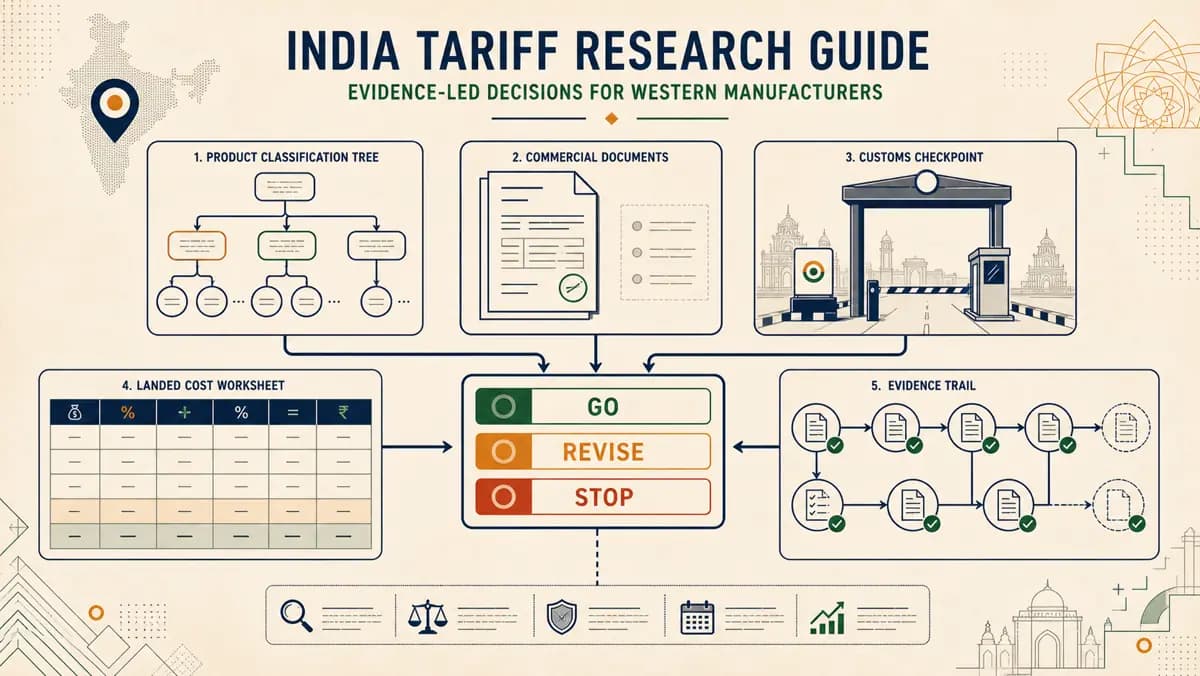
Before inserting a tariff input, use the India tariffs line-level check to separate aggregate context from the product and transaction evidence that still needs review.
- Supplier price and the exact basis stated in the offer.
- Tooling, development, testing, inspection, or documentation items stated separately.
- Product and export packaging inputs.
- Origin transport and handling inputs.
- International transport and insurance inputs.
- Destination transport and handling inputs.
- Product classification recorded for official verification.
- Any applicable customs and tax inputs, each supported by the relevant current official source before use.
- Bank, currency, or payment inputs stated by the buyer's approved provider or internal source.
- Cost treatment for samples, rejected items, rework, replacement, or returns where the parties have stated it.
- Open items, owner, source, verification date, and approval status.
This is not a tariff, tax, customs, or pricing calculation. No rate or classification should be inferred from this checklist. The buyer should identify the applicable official source for the exact product and transaction, then cite that source inside the cost file. If an input remains unknown, keep it visible as an unresolved item. Do not substitute a guessed value and present the total as settled.
Commercial offers should also be normalized to the same requirement and basis before comparison. A lower displayed unit price does not establish a lower buyer cost when inclusions, packaging, evidence, or unresolved items differ.
When should a buyer pause or reject a supplier?
The approval gate turns an accumulation of documents into a controlled decision. It should name the decision owner, the evidence reviewed, any conditions, and the open points. Tensor Advisory's approval and stop checklist is editorial guidance:
- The offered product matches the current technical and commercial requirement.
- The supplier, seller, and manufacturing responsibility are traceable.
- Claimed documents can be connected to the correct entity, site, product, and stated scope.
- Applicable product requirements have been identified from current official sources, or the point is explicitly held as unresolved.
- The sample record identifies the item and the limited purpose of its disposition.
- The inspection record supports only the checks and results it states.
- Commercial terms identify inclusions, exclusions, and open items.
- Landed-cost inputs have owners and sources, with unknowns kept visible.
- Deviations and contradictions have been resolved or accepted in writing by the named buyer decision owner.
- The final decision is recorded as approve, conditional approval, pause, or reject.
Pause when supplier identity, manufacturing responsibility, applicable product requirements, sample traceability, inspection evidence, or material commercial inputs remain unresolved. Reject when the buyer's stated stop condition is met, when requested evidence cannot support the claim made, or when a material contradiction is not resolved to the decision owner's satisfaction. These are buyer decision controls, not a claim that one outcome is legally required in every transaction.
FAQ
Is India sourcing only about finding a supplier?
No. Discovery produces candidates. A sourcing decision also needs a fixed requirement, traceable supplier identity, product-specific requirement review, sample and inspection records, commercial inputs, and a documented approval gate under Tensor Advisory's method.
Is a successful sample enough to approve production?
Not by itself. A sample record shows what was reviewed for its stated purpose. It should identify the item, revision, observations, exceptions, and disposition. Production approval requires whatever additional evidence and decision the buyer has defined for that gate.
Does a supplier's BIS claim prove that the offered product is covered?
No. A general supplier claim cannot establish product coverage (Bureau of Indian Standards, Product Certification Overview). BIS states that its certification scheme is "basically voluntary in nature," while the Central Government makes compliance with Indian Standards compulsory for a number of products through QCOs (Bureau of Indian Standards, Product Certification Overview). Before recording a conclusion, verify the exact current instrument or QCO, product scope, holder or entity, and identifier for the item against official material (Bureau of Indian Standards, Product Certification Overview).
Can a directory profile serve as supplier due diligence?
A directory can support discovery. It does not, by itself, establish the supplier's legal identity, manufacturing responsibility, applicable product requirements, inspection evidence, or agreed commercial basis. Retain it as a source record and verify decision-critical claims separately.
What should management see before approving a supplier?
Management should see the current requirement, supplier identity record, product-requirements file, sample and inspection records, commercial and landed-cost inputs, open points, and a proposed decision with a named owner. The pack should distinguish received documents from independently verified claims.
Who should own the final sourcing decision?
The buying company should name its decision owner according to its own governance. The record should show who approved, paused, conditionally approved, or rejected the supplier, what evidence supported that decision, and which conditions remain open.
India sourcing becomes more decision-ready when every important claim can be traced to a requirement, a supplier identity, a record, or an official source, and when uncertainty remains visible. The goal is not to manufacture confidence. It is to give the buyer a clear basis for the next gate.
Talk to an India market specialist to build an evidence-led India sourcing review for your product and buying team.
Written by Tileo, an operator with a decade of Europe-Asia industrial trade programs.
Read the methodology, source date and confidence level before carrying a number into a decision.
What does the FTA change for your product?
Open the Tariff Calculator →Every figure above is dated and source-attributed. Nothing arrives as an unexplained number.
- Sources are listed in the report methodology and verified against the publication date.
- Regulatory outcomes remain subject to entry-into-force dates and line-level classification.
Continue the research
Choose the next evidence step
Use this briefing as context, then choose the format that fits the question you need to answer.
Standard report
Start with a dated baseline
Use a fixed-scope report when you need a sourced answer to a defined market question.
ExploreCustom MIR
Shape the question around your case
Carry this article’s question into one target market, sector, corridor, and decision brief.
ExploreScoping call
Talk through the decision
Bring the corridor, timing, and evidence gap to a call before choosing the right format.
ExploreRelated Intelligence
Manufacturing in India vs Mexico: Which to Screen First?
Screen Mexico first for a North America-led brief and India first for an India-led brief, then test trade, product, supplier, logistics, and site evidence.
India US Trade Deal: What Manufacturers Must Verify
As of 2026-09-14, the US-India trade framework is not operative legal text. Verify tariff lines, origin and customs guidance before changing landed cost.
Manufacturing Companies in India: A Buyer Shortlist Guide
Find manufacturing companies in India, verify each candidate, compare evidence, and turn directory results into a defensible supplier shortlist.