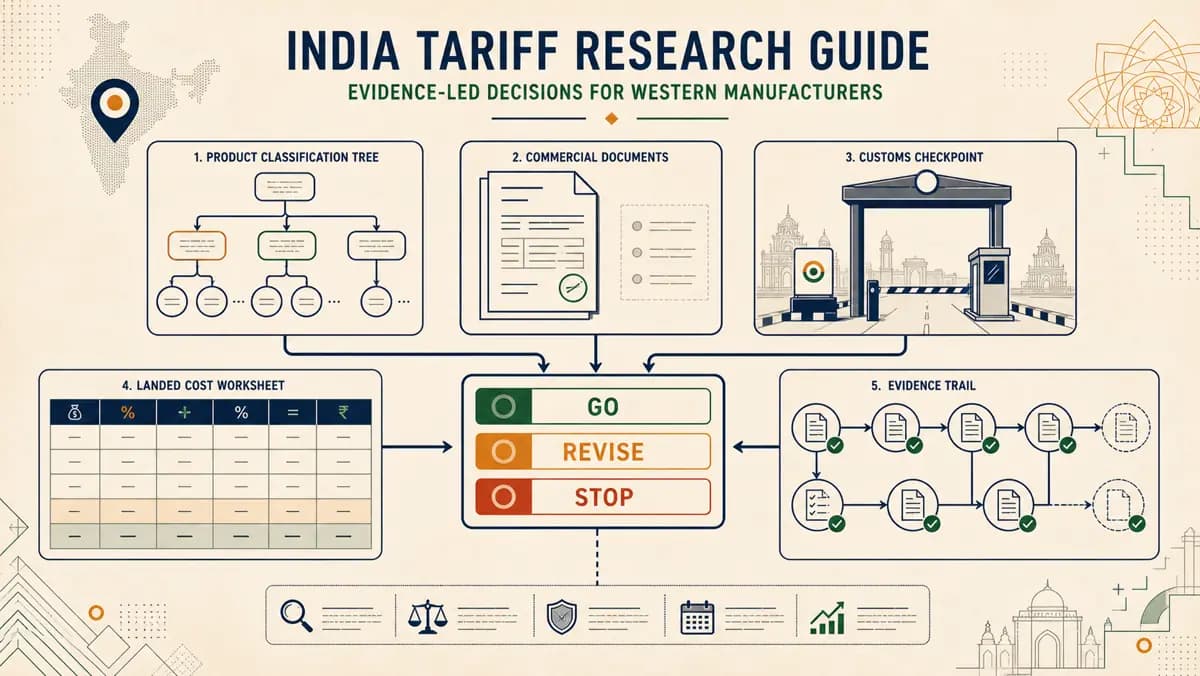
This India US trade deal brief is for manufacturers who must decide whether a February 2026 joint statement changes a landed-cost model.
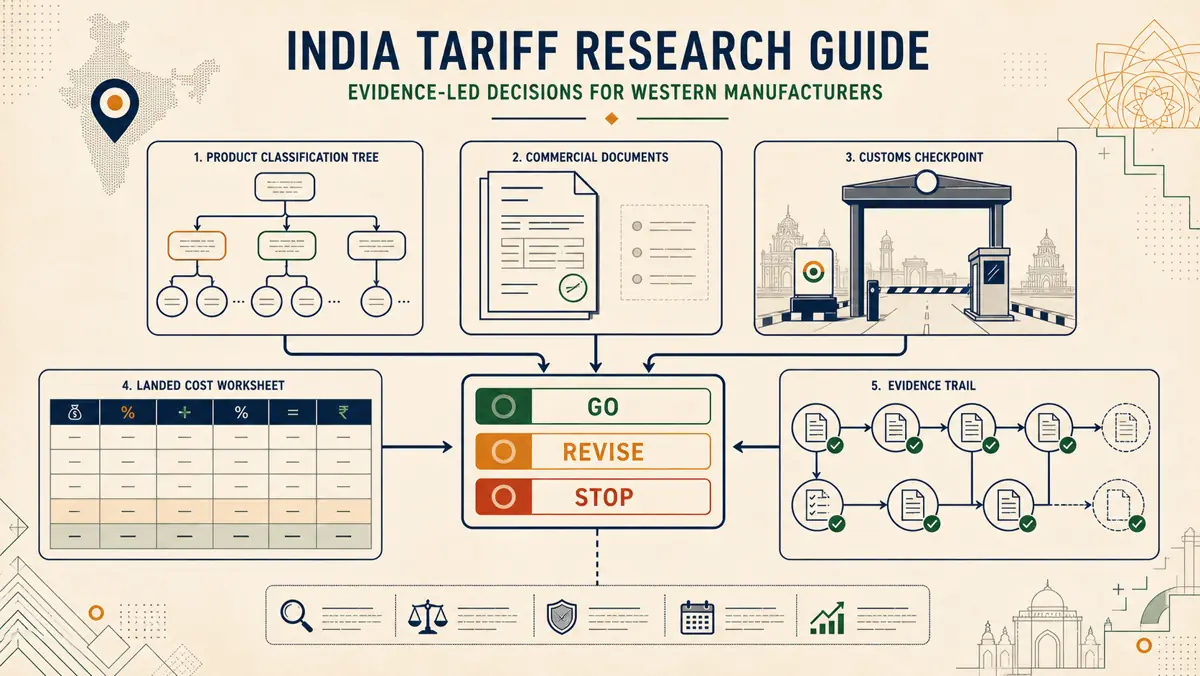
As of 2026-09-14, the White House United States-India Joint Statement of February 6, 2026 announces that the United States and India have reached a framework for an Interim Agreement regarding reciprocal and mutually beneficial trade, and states that the parties will promptly implement this framework and work towards finalizing the Interim Agreement (White House). A political or joint statement is not enough to update customs assumptions. Manufacturers should wait for the operative legal text, product-level tariff schedule, effective date, rules of origin and customs guidance that apply to their HS codes before changing a landed-cost model. USTR’s India page reports 2025 bilateral trade totals; it does not publish a product-level tariff schedule for the framework (USTR).
Decision boundary: This brief separates framework language from operative instruments. It is not legal, customs, tariff-classification or tax advice, and it does not determine treatment for any HS code, shipment or company.
What does the February 2026 joint statement actually say?
The White House published the United States-India Joint Statement on February 6, 2026 (White House). Keep the statement’s own wording.
The statement says the United States and India “are pleased to announce that they have reached a framework for an Interim Agreement regarding reciprocal and mutually beneficial trade (Interim Agreement)” (White House).
It reaffirms commitment to the broader U.S.-India Bilateral Trade Agreement (BTA) negotiations, “launched by President Donald J. Trump and Prime Minister Narendra Modi on February 13, 2025, which will include additional market access commitments and support more resilient supply chains” (White House).
It states that “Key terms of the Interim Agreement between the United States and India will include” the tariff, origin, non-tariff and related items summarised below (White House).
It closes by saying the United States and India “will promptly implement this framework and work towards finalizing the Interim Agreement with a view to concluding a mutually beneficial BTA consistent with the roadmap agreed in the Terms of Reference” (White House).
For a manufacturer, the February text is a framework announcement that describes terms the Interim Agreement will include. On its face it is not a product-level customs instrument, a complete tariff schedule or an entry-into-force notice for every line a company may ship.
| Joint-statement element | Official wording focus | What still belongs in a product file |
|---|---|---|
| Legal character | “framework for an Interim Agreement” (White House) | Operative legal text for the Interim Agreement, if and when published for the transaction under review |
| Broader track | Reaffirmation of BTA negotiations launched February 13, 2025 (White House) | Whether any BTA text, schedule or notice applies to the product and date under review |
| Tariff language | “Key terms of the Interim Agreement … will include” listed tariff actions (White House) | Product-level tariff schedule lines tied to verified HS codes |
| Timing language | Parties “will promptly implement this framework and work towards finalizing the Interim Agreement” (White House) | Effective date and customs guidance for the planned movement of goods |
| Origin language | Parties “will establish rules of origin that ensure that the benefits of the Agreement accrue predominately to the United States and India” (White House) | Origin rule text and proof standard for the shipment |
Do not convert “framework” or “will include” into a claim that a specific HS code already has a new duty rate.
How much does the US trade with India?
USTR’s India country page reports estimated 2025 bilateral totals. Use them as corridor context only. They do not identify treatment for a product line (USTR).
- U.S. goods and services trade with India (exports plus imports) totaled an estimated $239.6 billion in 2025, up 12.1 percent ($25.8 billion) from 2024 (USTR).
- U.S. goods trade with India totaled an estimated $149.1 billion in 2025 (USTR).
- U.S. goods exports to India in 2025 were $45.4 billion, up 9.1 percent ($3.8 billion) from 2024 (USTR).
- U.S. goods imports from India totaled $103.8 billion in 2025, up 18.9 percent ($16.5 billion) from 2024 (USTR).
- The U.S. goods trade deficit with India was $58.4 billion in 2025, a 27.8 percent increase ($12.7 billion) over 2024 (USTR).
- U.S. services trade with India totaled an estimated $90.4 billion in 2025; services exports were $42.9 billion and services imports were $47.6 billion; the services trade deficit was $4.7 billion (USTR).
The approved USTR snapshot does not rank India’s largest export product to the United States or name India’s largest trade partner overall. Aggregate corridor size can support market sizing inside a broader India market-entry assessment. It cannot replace line-level tariff, origin and customs evidence.
What is the current tariff on India by the US under the framework?
The joint statement lists tariff-related items among the key terms the Interim Agreement “will include” (White House). Record the categories and conditions. Do not invent rates outside this wording.
India-side tariff language:
- Industrial and agricultural market access. “India will eliminate or reduce tariffs on all U.S. industrial goods and a wide range of U.S. food and agricultural products, including dried distillers’ grains (DDGs), red sorghum for animal feed, tree nuts, fresh and processed fruit, soybean oil, wine and spirits, and additional products” (White House).
- Preferential market access. “The United States and India commit to provide each other preferential market access in sectors of respective interest on a sustained basis” (White House).
- Reciprocal adjustment. “In the event of any changes to the agreed upon tariffs of either country, the United States and India agree that the other country may modify its commitments” (White House).
United States-side tariff language:
- 18 percent reciprocal tariff on originating goods of India. “The United States will apply a reciprocal tariff rate of 18 percent under Executive Order 14257 of April 2, 2025 (Regulating Imports With a Reciprocal Tariff to Rectify Trade Practices That Contribute to Large and Persistent Annual United States Goods Trade Deficits), as amended, on originating goods of India, including textile and apparel, leather and footwear, plastic and rubber, organic chemicals, home décor, artisanal products, and certain machinery” (White House).
- Conditional annex removals. The same sentence states that the United States, “subject to the successful conclusion of the Interim Agreement, will remove the reciprocal tariff on a wide range of goods identified in the Potential Tariff Adjustments for Aligned Partners Annex to Executive Order 14346 of September 5, 2025 (Modifying the Scope of Reciprocal Tariffs and Establishing Procedures for Implementing Trade and Security Agreements), as amended, including generic pharmaceuticals, gems and diamonds, and aircraft parts” (White House).
- Certain aircraft and aircraft parts. “The United States will also remove tariffs on certain aircraft and aircraft parts of India imposed to eliminate threats to national security found in Proclamation 9704 of March 8, 2018 (Adjusting Imports of Aluminum Into the United States), as amended; Proclamation 9705 of March 8, 2018 (Adjusting Imports of Steel Into the United States), as amended; and Proclamation 10962 of July 30, 2025 (Adjusting Imports of Copper Into the United States)” (White House).
- Automotive parts tariff-rate quota. “Similarly, consistent with U.S. national security requirements, India will receive a preferential tariff rate quota for automotive parts subject to the tariff imposed to eliminate threats to national security found in Proclamation 9888 of May 17, 2019 (Adjusting Imports of Automobiles and Automobile Parts Into the United States), as amended” (White House).
- Pharmaceuticals contingent on Section 232 findings. “Contingent on the findings of the U.S. Section 232 investigation of pharmaceuticals and pharmaceutical ingredients, India will receive negotiated outcomes with respect to generic pharmaceuticals and ingredients” (White House). The joint statement does not publish a full product-by-product duty table for every HS code, does not state an entry-into-force date for the Interim Agreement as a completed instrument, and does not replace customs guidance for a named shipment. The 18 percent figure is the reciprocal tariff rate the United States “will apply … on originating goods of India” under Executive Order 14257, as amended, with the listed product groups given as inclusions, not as a complete catalogue of every line a manufacturer ships (White House).
For line-level India import workflow separate from this corridor, use the India tariffs manufacturer check. For a different bilateral with a published entry-into-force record in an earlier Tensor Advisory brief, see the India-UK trade deal checklist. Neither page substitutes for U.S.-India operative text on the transaction under review.
What non-tariff and origin terms sit beside the tariff headlines?
The joint statement also records origin and non-tariff commitments that can affect whether a preference is usable after a rate is known (White House).
- Rules of origin. “The United States and India will establish rules of origin that ensure that the benefits of the Agreement accrue predominately to the United States and India” (White House).
- Non-tariff barriers. “The United States and India will address non-tariff barriers that affect bilateral trade” (White House).
- Medical devices. “India agrees to address long-standing barriers to the trade in U.S. medical devices” (White House).
- ICT goods licensing. India agrees to “eliminate restrictive import licensing procedures that delay market access for, or impose quantitative restrictions on, U.S. Information and Communication Technology (ICT) goods” (White House).
- Standards review window. India agrees to “determine, with a view towards a positive outcome, within six months of entry into force of the Agreement whether U.S.-developed or international standards, including testing requirements, are acceptable for the purposes of U.S. exports entering the Indian market in identified sectors” (White House).
- Food and agriculture non-tariff barriers. “India also agrees to address long-standing non-tariff barriers to the trade in U.S. food and agricultural products” (White House).
- Digital trade pathway. The parties “commit to address discriminatory or burdensome practices and other barriers to digital trade and to set a clear pathway to achieve … mutually beneficial digital trade rules as part of the BTA” (White House).
The standards item is timed to “within six months of entry into force of the Agreement” (White House). That clock presupposes entry into force. A joint-statement framework date is not, by itself, that trigger.
Purchase language in the same statement is not a customs rate. India “intends to purchase $500 billion of U.S. energy products, aircraft and aircraft parts, precious metals, technology products, and coking coal over the next 5 years” (White House). Keep that figure outside the duty cell.
If your team needs the framework language mapped to a product dossier and open verification list: Talk to an India market specialist.
What must an importer or exporter verify before changing landed cost?
Treat the February joint statement as an index of claims to test, not as the test result. Before any landed-cost, quote, sourcing or market-entry model is updated, the product file should show the instruments that govern the shipment.
Build the file around these verification fields:
- Operative legal text. Identify the instrument that applies: Interim Agreement text if concluded and in force for the relevant scope, implementing proclamation or order text, or other customs instrument. The February statement describes a framework and work toward finalizing the Interim Agreement (White House).
- Product identity and HS classification. Record the exact product description and the working classification under review. This brief does not classify products.
- Product-level tariff schedule line. Locate the schedule or annex line for the verified classification. Do not substitute category lists such as “certain machinery” or “additional products” for a line-level rate (White House).
- Effective date. Record the effective-date wording in the operative instrument and the intended ship or entry date. The joint statement’s “will promptly implement this framework and work towards finalizing the Interim Agreement” language is not a product-level effective date (White House).
- Rules of origin. Capture the origin rule text required for any claimed benefit. The framework says the parties will establish rules of origin so benefits “accrue predominately to the United States and India” (White House).
- Conditionality. Flag conditions that still require a later instrument, including “subject to the successful conclusion of the Interim Agreement” for aligned-partner annex removals and “Contingent on the findings of the U.S. Section 232 investigation of pharmaceuticals and pharmaceutical ingredients” for negotiated pharmaceutical outcomes (White House).
- Customs guidance. Attach the customs notice, ruling pathway or qualified adviser memorandum that applies the operative text to the planned movement of goods.
- Direction of trade. State whether the model covers U.S. goods entering India, Indian originating goods entering the United States, or both, and keep evidence packs separate. The statement’s India-side and U.S.-side tariff paragraphs are not interchangeable (White House).
Landed-cost input Acceptable evidence Not acceptable alone Duty or reciprocal tariff assumption Operative legal text + product-level schedule line + effective date for the HS code February 6, 2026 joint-statement framework language (White House) Preference eligibility Rules of origin text + origin proof standard + any quota or annex condition Category mentions such as “certain machinery” without a schedule line (White House) Implementation timing Customs guidance and effective-date wording on the controlling instrument “Will promptly implement this framework” wording without an operative effective date (White House) Corridor volume context USTR 2025 bilateral totals kept outside the duty cell (USTR) Using $239.6 billion goods-and-services trade as if it were a product rate (USTR)
Compliance checkpoint: A political or joint statement is not enough to update customs assumptions. Wait for the operative legal text, product-level tariff schedule, effective date, rules of origin and customs guidance that apply to the HS codes under review.
When is a landed-cost model ready to update?
Use a go / revise / stop gate that tracks evidence, not headlines.
| Gate | Required record | Decision |
|---|---|---|
| Go | Operative legal text, verified HS classification, product-level tariff schedule line, effective date, origin rule position and customs guidance are documented for the named transaction and date | Permit the named landed-cost scenario to move to internal approval |
| Revise | A reviewer has identified a missing instrument, unresolved condition (for example Interim Agreement conclusion or Section 232 findings language in the framework), or a classification, origin or date mismatch (White House) | Update the packet and recalculate only after the gap is closed |
| Stop | The file still relies on the February framework announcement, aggregate USTR trade totals, or negotiation headlines without operative line-level instruments (White House; USTR) | Do not change the landed-cost model’s duty or preference inputs |
Record the reviewer, review date, instrument versions checked and the commercial action covered.
Frequently Asked Questions
Is the India-US trade deal in force as of 2026-09-14?
The White House joint statement of February 6, 2026 announces a framework for an Interim Agreement and states that the parties will promptly implement this framework and work towards finalizing the Interim Agreement (White House). The approved snapshots in this brief do not provide a separate entry-into-force notice for a completed Interim Agreement text that a manufacturer can apply to a product line. Treat force and applicability as open until operative legal text, effective date and customs guidance are verified for the HS codes under review.
What is the current tariff on India by the US under the joint statement?
The joint statement says the United States will apply a reciprocal tariff rate of 18 percent under Executive Order 14257 of April 2, 2025, as amended, on originating goods of India, including textile and apparel, leather and footwear, plastic and rubber, organic chemicals, home décor, artisanal products, and certain machinery (White House). It also describes conditional removals and other measures, including measures tied to successful conclusion of the Interim Agreement and Section 232 findings for pharmaceuticals (White House). That framework language is not a complete tariff schedule for every product. Verify the operative instrument and schedule line for each HS code.
How much goods and services trade is there between the US and India?
USTR reports that U.S. goods and services trade with India totaled an estimated $239.6 billion in 2025, up 12.1 percent ($25.8 billion) from 2024, with goods trade at an estimated $149.1 billion and services trade at an estimated $90.4 billion (USTR). Those totals do not set a duty rate.
Does the framework already set rules of origin for my product?
The joint statement says the United States and India will establish rules of origin that ensure that the benefits of the Agreement accrue predominately to the United States and India (White House). It does not publish the product-specific origin rule text in the approved snapshot. Origin remains a verification field until the operative rule and proof standard are in the product file.
Can manufacturers change pricing after the joint statement alone?
No. A political or joint statement is not enough to update customs assumptions. Wait for the operative legal text, product-level tariff schedule, effective date, rules of origin and customs guidance that apply to the relevant HS codes (White House).
Final implementation note
Hold the landed-cost model until the product file contains operative instruments, not only the February 2026 framework announcement. The United States-India Joint Statement is a dated official source for what the parties say the Interim Agreement framework will include and how they describe next steps toward finalizing it (White House). USTR’s 2025 trade totals provide corridor scale only (USTR).
Readers must verify tariff classification, origin, schedules, effective dates and implementation with the operative legal text, customs authorities and qualified advisers. This article is general information only and is not legal, customs, tariff-classification or tax advice. It does not state that any specific company or product qualifies for any rate, removal, quota or preference.
If you need a specialist to structure the verification packet against your HS list: Talk to an India market specialist.
Written by Tileo, an operator with ten years moving critical technologies and operations between countries.
Read the methodology, source date and confidence level before carrying a number into a decision.
What does the FTA change for your product?
Open the Tariff Calculator →Every figure above is dated and source-attributed. Nothing arrives as an unexplained number.
- Sources are listed in the report methodology and verified against the publication date.
- Regulatory outcomes remain subject to entry-into-force dates and line-level classification.
Continue the research
Choose the next evidence step
Use this briefing as context, then choose the format that fits the question you need to answer.
Standard report
Start with a dated baseline
Use a fixed-scope report when you need a sourced answer to a defined market question.
ExploreCustom MIR
Shape the question around your case
Carry this article’s question into one target market, sector, corridor, and decision brief.
ExploreScoping call
Talk through the decision
Bring the corridor, timing, and evidence gap to a call before choosing the right format.
ExploreRelated Intelligence
India UK Trade Deal: Manufacturer Action Checklist
India–UK trade deal checklist for manufacturers: verify classification, origin, schedules and implementation before changing price, sourcing or market-entry plans.

India EU Trade Deal: What Is Binding in September 2026?
A dated implementation-status guide to the India-EU trade deal, the published draft texts, and the checks Western companies should complete before changing a quote.
India Tariffs: A Manufacturer's Line-Level Check
Separate India tariff headlines from the line-level import evidence needed before quoting, sourcing or entering the market.