
The UK Government states that the India–UK FTA came into force on 15 July 2026, with 99% of Indian goods entering the UK and 90% of UK goods entering India duty free or subject to reduced tariffs (UK Government). For a manufacturer, those headline percentages are a starting point, not a product-level conclusion.
Before changing a price, sourcing plan or India market-entry decision, verify the product’s tariff classification, origin, applicable schedule and current implementation through the official agreement and customs authorities, supported by qualified advisers. This checklist structures that review without asserting that any specific company or product qualifies.
What entered into force and when?
The UK Government describes the arrangement as the UK–India Free Trade Agreement and says it came into force on 15 July 2026 (UK Government). India’s Press Information Bureau announced the entry into effect of CETA on the same date (India PIB).
The sequence is also recorded by the House of Commons Library: negotiations launched in 2022, the agreement was signed in 2025, and it entered into force on 15 July 2026 (House of Commons Library).
The entry-into-force date does not, by itself, establish the treatment of an individual product. The operational question for a manufacturer is narrower: what treatment applies to the exact product, origin position and schedule entry under review?
Compliance checkpoint 1: Entry into force is not proof of eligibility for a specific product. Verify tariff classification, origin, schedules and implementation with the official agreement, customs authorities and qualified advisers.
For businesses still deciding how India fits into their commercial footprint, the agreement review should sit inside a broader India market-entry assessment. The trade deal may change an input to that assessment, but it does not replace decisions about whether, what and how to sell or source.
What do the headline tariff commitments mean?
The central public figures are broad measures of liberalisation. The UK Government says that 99% of Indian goods entering the UK and 90% of UK goods entering India are duty free or have reduced tariffs (UK Government). Business.gov.uk expresses the commitments as 99% of UK tariffs and 90% of Indian tariffs being liberalised (Business.gov.uk).
Those formulations should be preserved. They do not mean that all products are duty free, and they do not identify the treatment of a particular manufactured item. A company therefore needs to separate what the announcement establishes from what remains to be verified.
| Headline | What a manufacturer must verify |
|---|---|
| The FTA came into force on 15 July 2026 (UK Government). | Whether the relevant implementation position applies to the product and transaction under review. |
| 99% of Indian goods entering the UK are duty free or have reduced tariffs (UK Government). | The product’s tariff classification, origin and applicable schedule entry. |
| 90% of UK goods entering India are duty free or have reduced tariffs (UK Government). | The product’s tariff classification, origin and applicable schedule entry. |
| Business.gov.uk says 99% of UK tariffs and 90% of Indian tariffs will be liberalised (Business.gov.uk). | The official wording, schedule and implementation relevant to the planned movement of goods. |
| The deal includes cooperation on green technologies (Business.gov.uk). | Whether that cooperation has any documented relevance to the manufacturer’s specific decision. |
The distinction matters because a country-level announcement does not provide a documented product-level answer. Do not turn a liberalisation percentage into a product-level claim.
Compliance checkpoint 2: Preserve the official distinction between goods that are “duty free or have reduced tariffs” and the separate description of tariffs that “will be liberalised.” Do not convert either statement into “all products are duty free.”
What must a manufacturer verify at product level?
A product-level review should remain bounded by the four elements named in this article’s required disclaimer: tariff classification, origin, schedules and implementation. Each answers a different verification question, but the final position should be read together rather than inferred from one element alone.
Use this checklist for every product under consideration:
Tariff classification. Record the classification being assessed and have it verified through the appropriate official customs channel and qualified advisers. This article does not provide tariff-classification advice.
Origin. Establish and verify the origin position against the official agreement, customs authorities and qualified advisers.
Schedule. Locate the official schedule entry associated with the verified classification. Record the wording that applies instead of relying on the national headline percentage.
Implementation. Confirm the implementation position relevant to the contemplated movement of goods through official sources. The agreement entered into force on 15 July 2026, but that fact alone does not establish product eligibility (UK Government).
Decision. State what commercial decision is supported by the verified material, and what remains unresolved. Avoid stating that the business or product qualifies unless that conclusion has been established through the official agreement, customs authorities and qualified advisers.
The output should be a traceable record, not a broad assertion that the deal applies. If a manufacturer is assessing both India sales and India sourcing, keep the product-level records tied to the direction of trade under review. The UK Government’s published figures distinguish Indian goods entering the UK from UK goods entering India (UK Government).
For wider commercial context, see our guides to India sourcing and the EU–India FTA for Western companies. They address different trade relationships and should not be used as substitutes for the India–UK agreement’s official text and schedules.
Compliance checkpoint 3: This checklist is not legal, customs or tariff-classification advice. It does not state that a specific company, component or finished product qualifies for preferential treatment.
Which sourcing and market-entry decisions change?
For manufacturers, the relevant business review concerns sourcing and market-entry decisions. The agreement does not predetermine the result. A decision-led review asks whether verified product-level treatment changes the evidence supporting a particular commercial choice.
Review these decision areas without assuming an outcome:
UK-to-India market entry: state whether the verified classification, origin, schedule and implementation position changes the market-entry decision.
India-to-UK sourcing: state whether the verified classification, origin, schedule and implementation position changes the sourcing decision.
Product scope: distinguish products supported by a verification file from products mapped only to the headline announcement.
Decision record: connect the sourcing or market-entry decision to the verified product-level position, without turning the national percentages into a product claim.
Green-technology discussions: Business.gov.uk mentions cooperation on green technologies, but a manufacturer should connect that statement to a decision only where documented, product-relevant material supports it (Business.gov.uk).
This approach keeps the trade agreement in its proper role. It can alter a verified input to a sourcing or market-entry decision. It does not answer whether India is the right market, which operating approach fits the business, or whether a particular product will succeed.
The useful question is not “Is the deal good?” It is “Which verified product-level fact changes which decision?” That wording avoids a universal verdict and directs attention to evidence that management can review.
If your team needs to connect the agreement review to a market-entry choice: Talk to an India market specialist.
What evidence belongs in an implementation file?
An implementation file should make the path from official statement to business decision visible. Keep the file specific to the product and direction of trade being assessed. Its purpose is to show what was checked, which source controlled the conclusion, and what the business decided on that basis.
Include:
The official entry-into-force record. The UK Government says the FTA came into force on 15 July 2026 (UK Government). India’s PIB announced CETA’s entry into effect on 15 July 2026 (India PIB).
The product identification and classification under review. Record what was assessed and the official or qualified verification supporting it. Do not treat this article as classification advice.
The origin record under review. Connect the documented origin position to the relevant official agreement material and qualified verification.
The applicable official schedule material. Retain the wording used for the product-level assessment; the published figures of 99% and 90% remain country-level headlines (UK Government).
The implementation evidence. Record the official implementation material consulted for the product and transaction under review.
The decision note. Identify the sourcing, market-entry or commercial decision considered, the evidence used, and any question still requiring official or qualified review.
The review basis. Identify the official agreement or customs authority and qualified advisers used to verify classification, origin, schedules and implementation.
The file should also distinguish source language from internal interpretation. For example, retain the UK Government’s wording that goods are “duty free or have reduced tariffs” rather than compressing it into an unsupported universal claim (UK Government). Our methodology explains the broader approach to source-led market intelligence.
Frequently Asked Questions
What is the India–UK trade agreement?
It is the trade agreement that the UK Government calls the UK–India Free Trade Agreement; India’s PIB announced CETA’s entry into effect (UK Government; India PIB). The House of Commons Library records that negotiations launched in 2022, the agreement was signed in 2025, and it entered into force on 15 July 2026 (House of Commons Library).
What changed under the India–UK trade deal?
The UK Government says that, following entry into force, 99% of Indian goods entering the UK and 90% of UK goods entering India are duty free or have reduced tariffs (UK Government). Business.gov.uk says 99% of UK tariffs and 90% of Indian tariffs will be liberalised and also mentions cooperation on green technologies (Business.gov.uk). These statements do not establish treatment for a specific product.
What gets cheaper under the India–UK trade deal?
The packet’s official sources provide broad liberalisation figures, not a product-by-product answer. The UK Government states that 99% of Indian goods entering the UK and 90% of UK goods entering India are duty free or have reduced tariffs (UK Government). Whether a particular product receives a particular treatment must be verified through its tariff classification, origin, applicable schedules and implementation, using the official agreement, customs authorities and qualified advisers.
Who benefits from the India–UK trade deal?
The official headline covers trade in both directions: Indian goods entering the UK and UK goods entering India (UK Government). A manufacturer should not infer a company-specific benefit from that headline. Any benefit depends on the verified product-level position and the business decision being considered.
Final implementation note
Treat the India–UK trade deal as a documented product-level workstream, not a blanket commercial assumption. A sourcing or market-entry decision should be supported by the entry-into-force record and verified classification, origin, schedules and implementation.
Readers must verify tariff classification, origin, schedules and implementation with the official agreement, customs authorities and qualified advisers. This article is general information only and is not legal, customs, tariff-classification or tax advice. It does not state that any specific company or product qualifies.
Written by Tileo, an operator with a decade of Europe-Asia industrial trade programs.
Read the methodology, source date and confidence level before carrying a number into a decision.
What does the FTA change for your product?
Open the Tariff Calculator →Every figure above is dated and source-attributed. Nothing arrives as an unexplained number.
- Sources are listed in the report methodology and verified against the publication date.
- Regulatory outcomes remain subject to entry-into-force dates and line-level classification.
Continue the research
Choose the next evidence step
Use this briefing as context, then choose the format that fits the question you need to answer.
Standard report
Start with a dated baseline
Use a fixed-scope report when you need a sourced answer to a defined market question.
ExploreCustom MIR
Shape the question around your case
Carry this article’s question into one target market, sector, corridor, and decision brief.
ExploreScoping call
Talk through the decision
Bring the corridor, timing, and evidence gap to a call before choosing the right format.
ExploreRelated Intelligence
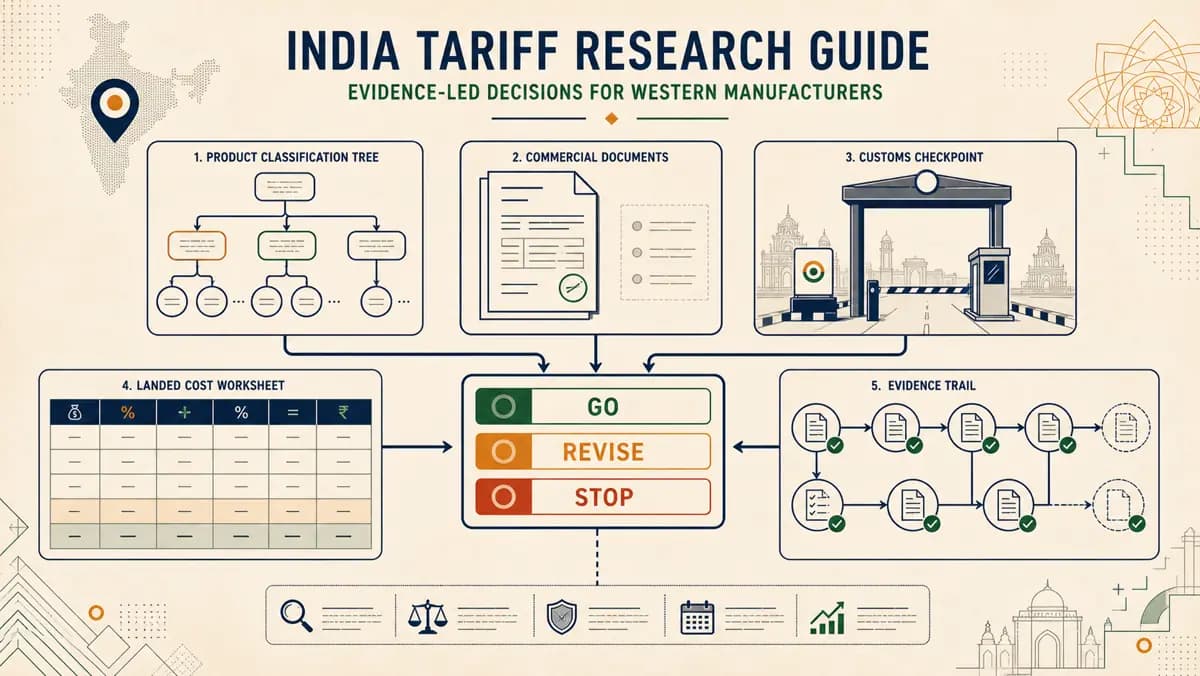
India US Trade Deal: What Manufacturers Must Verify
As of 2026-09-14, the US-India trade framework is not operative legal text. Verify tariff lines, origin and customs guidance before changing landed cost.

India EU Trade Deal: What Is Binding in September 2026?
A dated implementation-status guide to the India-EU trade deal, the published draft texts, and the checks Western companies should complete before changing a quote.
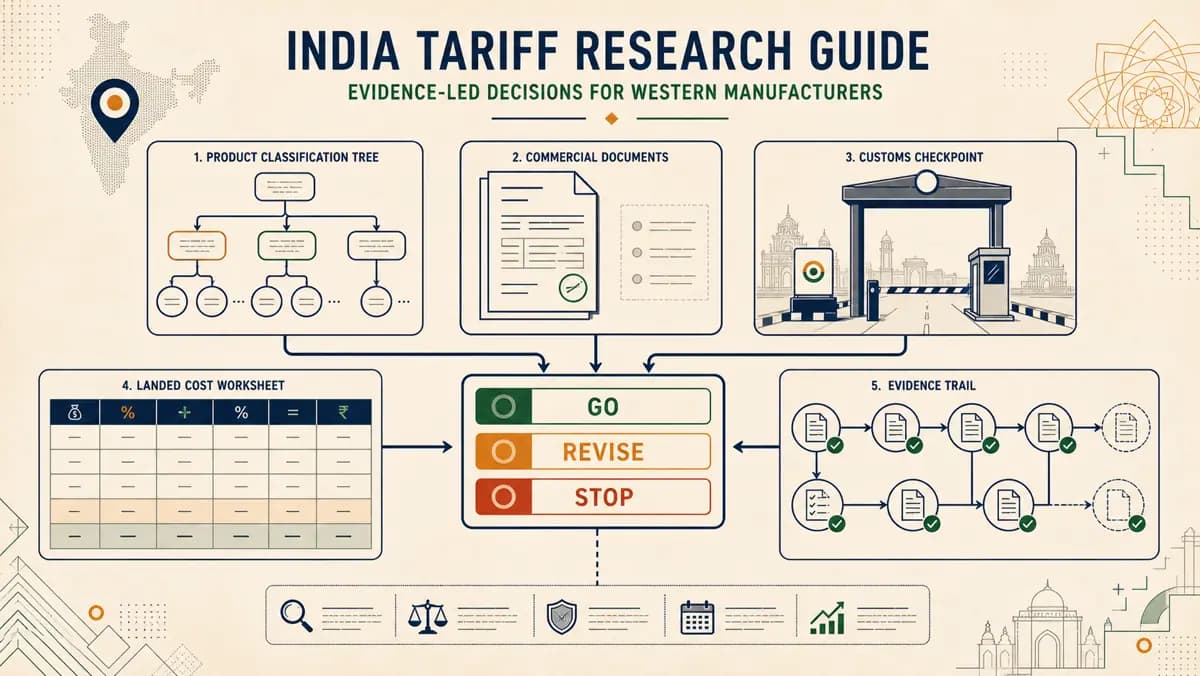
India Tariffs: A Manufacturer's Line-Level Check
Separate India tariff headlines from the line-level import evidence needed before quoting, sourcing or entering the market.