Operator definitions used in this guide: a market research study is a bounded project using primary or secondary research to answer a defined question. An intelligence rhythm is continuing monitoring connected to decision support, based on the ongoing process described by Cision and Mintel (Cision; Mintel). These labels are practical buying categories, not universal industry definitions.
Verdict: Buy a study for a defined question, establish an intelligence rhythm for a decision exposed to market change, and combine them when both needs are present.
Is market intelligence the same as market research?
No. Cision says the terms are often confused but are not the same: market research addresses specific customer and product questions, while market intelligence helps guide overall strategy (Cision). Mintel also treats them as separate forms of insight that serve different purposes (Mintel).
The boundary is not a contest between two substitutes. Cision recommends using both where possible, and Mintel says they complement each other (Cision; Mintel). For an industrial market-entry buyer, the useful question is which decision each one must support.
What are the key differences between market intelligence and market research?
| Decision dimension | Market research study | Market intelligence rhythm |
|---|---|---|
| Core question | A specific question about customers or products (Cision) | A view of the industry, competitors, customers, and market environment that can guide strategy (Cision; Mintel) |
| Operating shape | Operator definition: a bounded, project-based study | An ongoing process of collecting, analysing, and disseminating external-market information (Mintel) |
| Scope | A focused or “zoom lens” view of a particular market section (Mintel) | A “wide-angle lens” view of the overall market environment through continuous data collection (Mintel) |
| Inputs named by the sources | Surveys, interviews, focus groups, sales data, and study of the competitive landscape (Cision) | Information relevant to products, competitors, consumers, and markets (Mintel) |
| Decision use | Test a product idea or understand a target market's needs, wants, behaviours, preferences, or attitudes (Cision) | Spot trends, observe competitors, and support informed business decisions (Cision) |
| Industrial market-entry fit | Operator application: answer one defined entry question | Operator application: keep an entry decision connected to changes in the external market environment |
The last row is Tensor Advisory's application of the source definitions to industrial market entry. It is not a claim made by Cision or Mintel.
When do you need a market research study?
Choose a study when the buying brief can state the question that the research must answer. Cision's examples and methods support these study briefs:
Test whether a product idea may appeal to a particular customer group (Cision).
Learn about a target market's needs, wants, and behaviours (Cision).
Use surveys, interviews, or focus groups to collect information directly from customers (Cision).
Analyse sales data or study the competitive landscape for the defined question (Cision).
For procurement, write the decision question before requesting methods. The study can then be assessed against that question rather than against the volume of material delivered.
When do you need an ongoing market intelligence rhythm?
Choose an intelligence rhythm when the decision depends on the external market environment and needs continuing collection, analysis, and dissemination. That wording follows Mintel's explicit definition of market intelligence (Mintel).
The monitored scope can include:
Products, competitors, consumers, and markets (Mintel).
Industry trends and competitor activity (Cision).
Information used to identify opportunities and potential threats (Cision).
Insights intended to support informed decisions and help anticipate what comes next (Cision; Mintel).
For an industrial buyer, define the decision that receives the intelligence. “Monitor the market” is not yet a buying brief. “Maintain the external evidence used for this entry decision” gives the work a decision boundary.
Can market research be part of market intelligence?
Yes. Cision describes market intelligence as aggregating data from market research, customer interactions, and competitive analysis to derive actionable insights (Cision). Mintel likewise presents market research and analysis as part of market intelligence, while still distinguishing the focused view of research from the continuous, wide-angle view of intelligence (Mintel).
That relationship supports a simple sequence for a market-entry brief:
- State the defined question that requires a study.
- Use the study findings in the market-entry decision.
- If that decision depends on changes in the external environment, place the relevant evidence into an ongoing intelligence rhythm. The ongoing character follows the definitions used by both sources (Cision; Mintel).
The sequence does not make every study an intelligence programme. It connects the two only when the buying decision requires both.
How do you write the buying brief?
Start with the decision rather than the name of the deliverable. The operator framework below turns the distinction in this guide into a procurement brief. It is Tensor Advisory's application, not a method prescribed by Cision or Mintel.
Write the decision in one sentence
Name the choice that the work must support. A brief such as “understand this market” leaves the analyst to guess what the buyer will do with the answer. A decision sentence identifies the choice, the subject of that choice, and the point at which the buyer will use the result.
Keep background questions separate from the decision. Background may still be needed, but it should earn its place by helping the buyer answer the stated question. This gives the final review a simple test: can the decision-maker use the delivered work to address the sentence written at the start?
Set the boundary of the question
Record the product or service, customer group, geography, and period relevant to the decision. Also record exclusions. A boundary prevents a focused study from expanding into an undefined description of an industry. It also tells an intelligence rhythm which parts of the external environment belong in the monitoring scope.
Do not use a wider boundary simply because more information is available. The useful boundary is the one attached to the decision. If an excluded subject later changes the choice, revise the brief openly instead of allowing the scope to drift without a recorded reason.
Separate the one-time question from the changing evidence
Ask which part of the decision needs a defined answer now and which part depends on changes in the external environment. Put the defined question in the study brief. Put the evidence that must remain current in the intelligence brief.
This separation may show that only one buying shape is needed. It may also show that the two should be combined. The point is not to commission both by default. It is to make each part of the work answer a named need.
Define what the buyer will accept
For a study, write an acceptance question that tests whether the stated question was answered. For an intelligence rhythm, name the external information to be collected, how it will be analysed, who receives it, and which decision it supports. The collection, analysis, and dissemination language follows Mintel's definition of market intelligence (Mintel).
Add a treatment for uncertainty. The brief can require the deliverable to distinguish sourced information, operator interpretation, and an item that still needs verification. That distinction lets the buyer review the work without treating every sentence as the same kind of evidence.
Check the handoff between the two
When both shapes are required, state which study findings enter the intelligence rhythm and why they remain relevant to the decision. Do not transfer every page merely because it exists. Transfer the evidence whose change could affect the choice, then retain the original study boundary so readers can see what the finding did and did not answer.
Finish the brief with five written fields:
- The decision to support.
- The defined question that needs an answer.
- The external evidence that may change over time.
- The acceptance test for each deliverable.
- The owner who will use the result in the decision.
Those fields do not replace a research method or an intelligence process. They give each one a visible job and give the buyer a consistent basis for reviewing what was delivered.
How should an industrial market-entry buyer choose?
Start with the decision, then select the buying shape.
| If your brief says... | Buy... | Acceptance question |
|---|---|---|
| “Answer this defined customer, product, or market question.” | A market research study | Does the deliverable answer the stated question? |
| “Keep this entry decision connected to the external market environment.” | A market intelligence rhythm | Does the work collect, analyse, and disseminate the relevant external information on an ongoing basis? That operating shape follows Mintel's definition (Mintel). |
| “Answer the defined question, then keep the decision connected to market change.” | Both | Is the study question explicit, and is its relevant evidence carried into the intelligence rhythm? Cision and Mintel both say the two approaches can complement each other (Cision; Mintel). |
If the immediate need is a market-entry decision file, inspect Tensor Advisory's market intelligence report example and the buyer checklist for a market intelligence report sample. The India market-entry strategy guide provides the related entry context. Wider engagement paths are listed on the services page.
Frequently Asked Questions
What is an example of market intelligence?
Cision gives competitor activity and industry trends as examples of the wider view supported by market intelligence (Cision). In this guide's industrial market-entry application, an intelligence rhythm keeps the external evidence used for an entry decision connected to that wider environment.
What is an example of market research?
Cision gives testing a new product idea with a particular customer group as an example. It also names surveys, interviews, focus groups, sales-data analysis, and study of the competitive landscape as research methods (Cision).
Is market intelligence primary or secondary research?
The sources describe market intelligence as a process that can bring together information from market research, customer interactions, competitive analysis, and the external market environment (Cision; Mintel). It is therefore not labelled as only one research type in this guide.
Which comes first, market research or market intelligence?
There is no universal order stated by the cited sources. They say the approaches are distinct and complementary (Cision; Mintel). For the operator sequence used here, commission the defined study when a specific question must be answered, then carry relevant evidence into an ongoing intelligence rhythm only if the decision requires it (Cision; Mintel).
Is a market intelligence report a market research report?
Not under the operator definitions used here. A market research report closes a bounded study, while a market intelligence report connects external-market evidence to decision support. For the Tensor Advisory house format, review the annotated report example and get the sample report.
Written by Loïc Guyon (Tileo)3, an operator with a decade of Europe-Asia industrial trade programs.
Read the methodology, source date and confidence level before carrying a number into a decision.
What does the FTA change for your product?
Open the Tariff Calculator →Every figure above is dated and source-attributed. Nothing arrives as an unexplained number.
- Sources are listed in the report methodology and verified against the publication date.
- Regulatory outcomes remain subject to entry-into-force dates and line-level classification.
Continue the research
Choose the next evidence step
Use this briefing as context, then choose the format that fits the question you need to answer.
Standard report
Start with a dated baseline
Use a fixed-scope report when you need a sourced answer to a defined market question.
ExploreCustom MIR
Shape the question around your case
Carry this article’s question into one target market, sector, corridor, and decision brief.
ExploreScoping call
Talk through the decision
Bring the corridor, timing, and evidence gap to a call before choosing the right format.
ExploreRelated Intelligence

Best Market Research Tools for India Market Entry
Choose market research tools by evidence layer and use a practical worksheet for an industrial company evaluating India.

Quarterly Market Intelligence Report: A Decision Record
Build a quarterly market intelligence report that records dated evidence, changed assumptions, decisions, triggers, and an auditable archive.
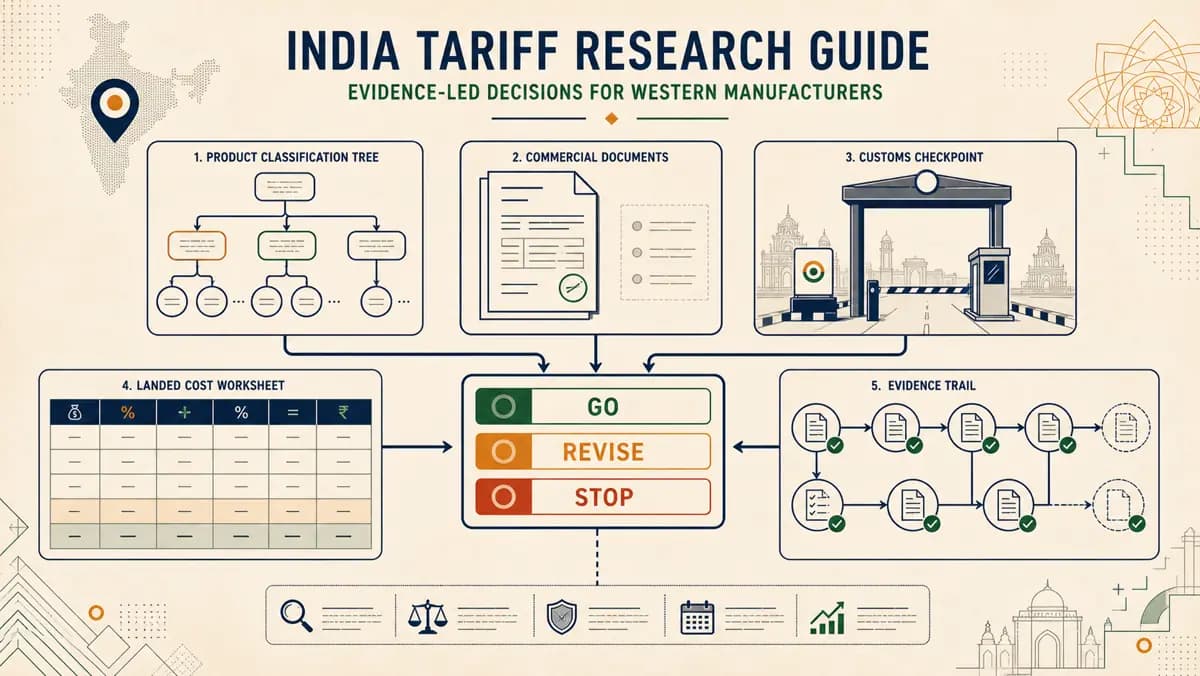
India US Trade Deal: What Manufacturers Must Verify
As of 2026-09-14, the US-India trade framework is not operative legal text. Verify tariff lines, origin and customs guidance before changing landed cost.