European manufacturers evaluating expansion beyond China face three primary alternatives: India, Vietnam, and Mexico. Each market offers distinct advantages depending on your sector, scale, timeline, and risk tolerance.
This analysis compares all three across 15 dimensions using current data, not projections from 2019 reports. The goal is not to declare a winner but to provide a framework for matching your specific situation to the right market.
What are the key differences at a glance?
- India offers the largest market (1.4 billion people, $4 trillion GDP) with the most complex regulatory environment
- Vietnam offers the fastest setup and lowest initial costs, with an established EU free trade agreement
- Mexico offers proximity to the US market and USMCA access, but lacks a comprehensive EU FTA
Why are European manufacturers looking beyond China?
Four drivers are accelerating the China+1 strategy:
Geopolitical risk. Supply chain concentration in a single market creates unacceptable exposure for companies serving EU and US customers with compliance requirements.
Tariff uncertainty. US-China tariff policy continues to shift unpredictably. Companies that diversified manufacturing before 2024 are better positioned than those that waited.
Rising costs. Chinese manufacturing wages have tripled in the past decade. The cost advantage over Central European manufacturing has narrowed significantly.
ESG and compliance pressure. The EU Corporate Sustainability Due Diligence Directive (CSDDD) and Carbon Border Adjustment Mechanism (CBAM) are making supply chain origin a compliance issue, not just a cost issue.
Manufacturing in India vs Mexico and Vietnam: how costs compare
| Dimension | India | Vietnam | Mexico |
|---|---|---|---|
| GDP (2025) | $4.0 trillion | $490 billion | $1.8 trillion |
| Population | 1.4 billion | 100 million | 130 million |
| GDP Growth Rate | 6.5–7% | 6–6.5% | 2–3% |
| Manufacturing % of GDP | 17% | 25% | 20% |
| Average Manufacturing Wage (monthly) | €250–€400 | €300–€450 | €500–€800 |
| Entity Setup Time | 8–16 weeks | 4–8 weeks | 6–10 weeks |
| Entity Setup Cost | €15K–€30K | €8K–€15K | €10K–€20K |
| Year 1 Total Operating Cost | €200K–€400K | €150K–€300K | €250K–€500K |
| Corporate Tax Rate | 25.17% (new mfg) | 20% | 30% |
| EU FTA Status | Concluded Jan 2026 | In force (EVFTA, Aug 2020) | No comprehensive EU FTA |
| Regulatory Complexity (1–10) | 8 | 5 | 6 |
| Infrastructure Quality (1–10) | 6 | 5 | 7 |
| English Proficiency | High | Low-moderate | Low-moderate |
| Corruption Perception Index | 91/182 | 88/182 | 141/182 |
| Ease of Profit Repatriation | Moderate (FEMA rules) | Easy | Easy |
How does regulatory complexity compare?
India (8/10 complexity): Multiple overlapping jurisdictions — central, state, and municipal. BIS certification for industrial products takes 9–14 months (not the 3 months often quoted). FEMA regulations govern all foreign investment. GST compliance is monthly. Labour laws vary by state.
Vietnam (5/10 complexity): Single-tier regulatory system. Investment registration at provincial level is straightforward. Labour code is unified. Environmental compliance is tightening but still simpler than India. The main challenge is navigating in Vietnamese — English is not the business language.
Mexico (6/10 complexity): Federal and state jurisdictions, but more predictable than India. Labour reform (2019) increased unionisation rights. Tax compliance is digital (SAT system). Environmental regulations vary by state. The main regulatory risk is policy unpredictability.
What is the FTA advantage for each market?
India — EU-India FTA (concluded January 2026): The most significant trade development for European manufacturers in a decade. 96.6% of tariff lines covered. Key reductions include industrial machinery (current 7.5–10% → 0%), medical devices (current 10–15% → 0–5%), and food processing equipment (current 7.5% → 0%). Full implementation over 7 years, with most industrial goods reaching zero tariff by year 3.
Vietnam — EVFTA (in force since August 2020): Already delivering results. 99% of tariff lines eliminated or being phased out. European manufacturers have had 5+ years to establish operations under preferential terms. The first-mover advantage is real — companies that entered in 2020–2022 are now well-established.
Mexico — USMCA (no comprehensive EU FTA): Mexico's trade advantage is US access, not EU access. USMCA provides preferential terms for goods manufactured in Mexico and sold in the US. For European companies targeting the US market, this is significant. For EU-focused companies, Mexico's FTA landscape is less relevant.
Where does India win?
Market size. India is not just a manufacturing base — it is a market. 1.4 billion consumers, a rapidly growing middle class, and domestic demand that can sustain manufacturing operations even if export markets fluctuate.
FTA momentum. The EU-India FTA is the newest and most comprehensive trade agreement. Companies entering now benefit from tariff reductions that will continue for 7 years.
English proficiency. Business can be conducted in English at every level — from factory floor supervisors to C-suite executives. This reduces operational friction significantly compared to Vietnam or Mexico.
Services sector depth. India's strength in IT, engineering services, and professional services means you can hire locally for functions that would require expatriate staff in Vietnam.
Demographic dividend. Median age of 28. A growing workforce for the next two decades, while China, Vietnam, and most EU countries face demographic decline.
Where does India lose?
Bureaucratic complexity. India's regulatory environment is the most complex of the three. Setup timelines are the longest. Compliance costs are higher. State-level variations add an additional layer of complexity.
Infrastructure gaps. Despite massive investment in highways, ports, and industrial corridors, India's infrastructure outside tier-1 cities remains inconsistent. Power reliability, water supply, and last-mile logistics are genuine challenges.
Longer setup timelines. Entity registration plus all necessary certifications can take 6–18 months. Vietnam and Mexico are consistently faster.
Profit repatriation. FEMA regulations require RBI approval for certain categories of outward remittance. The process is manageable but adds administrative overhead.
How should you decide?
Choose India if your primary goal is accessing a large domestic market, you have a 3–5 year horizon, your products benefit from the EU-India FTA, and you can invest the time to navigate regulatory complexity.
Choose Vietnam if you need the fastest, cheapest market entry with proven EU FTA benefits, your primary model is export manufacturing, and you have supply chain partners who can operate in Vietnamese.
Choose Mexico if your primary market is the United States, you need geographic proximity to North American customers, and USMCA access is more valuable than EU trade preferences.
Consider all three if you are building a global manufacturing footprint, need to de-risk supply chain concentration, and have the resources to operate across multiple regulatory environments.
Related Intelligence
Download the Free 2026 India Market Entry Playbook — The complete framework for entering India, from entity structure to compliance.
India Market Entry Strategy for European and American SMEs: The 2026 Playbook — The full framework if India is your choice.
India Market Entry Costs: A Realistic Budget for Western Companies — Detailed Year 1 cost breakdown for India specifically.
The EU-India FTA: What Western Exporters Need to Do Before Ratification — How the new FTA changes India's competitive positioning.
Manufacturing in India vs Mexico: Buyer Guide — A product-level decision path covering customer market, qualifying trade treatment, regulation, suppliers, logistics, and site diligence.
Frequently Asked Questions
Which country is cheapest for a European manufacturer to enter?
Vietnam has the lowest Year 1 costs (€150K–€300K) and fastest setup (4–8 weeks). However, cost alone should not drive the decision — market access, regulatory environment, and long-term growth trajectory matter more.
Can I use India as a manufacturing base for EU exports?
Yes, and the EU-India FTA makes this increasingly attractive. With tariff reductions on both sides, manufacturing in India for EU export becomes cost-competitive, especially for sectors like machinery and equipment where India has an emerging industrial base.
How long does it take to set up a company in India?
Entity registration (private limited company or LLP) takes 4–8 weeks. However, the total timeline including sector-specific certifications (BIS, FSSAI, CDSCO), bank account opening, GST registration, and import-export code can extend to 4–6 months. Plan for 6 months before first operations.
Is Vietnam better than India for manufacturing?
For labour-intensive, export-oriented manufacturing with low regulatory complexity, Vietnam is often the better choice. For high-value manufacturing targeting a large domestic market with strong IP protection needs, India has structural advantages. The answer depends entirely on your business model.
What about Bangladesh or Indonesia as alternatives?
Both are valid alternatives for specific sectors. Bangladesh for textiles and garments (the EU's Everything But Arms preference). Indonesia for natural resources and food processing. Neither offers the combination of market size, English proficiency, and FTA momentum that India provides for industrial equipment manufacturers.
Deciding Between India, Vietnam, and Mexico?
The right market depends on your product, business model, and growth strategy. We can model all three scenarios and help you make a data-driven decision.
Book a Free Assessment → | Download the India Market Entry Playbook →
Read the methodology, source date and confidence level before carrying a number into a decision.
What does the FTA change for your product?
Open the Tariff Calculator →Every figure above is dated and source-attributed. Nothing arrives as an unexplained number.
- Sources are listed in the report methodology and verified against the publication date.
- Regulatory outcomes remain subject to entry-into-force dates and line-level classification.
Continue the research
Carry the market-entry question forward
Use the sources in this briefing to decide whether you need a defined baseline, a corridor-specific brief, or a scoping conversation.
Standard report
Start with a dated baseline
Use a fixed-scope report when you need a sourced answer to a defined market question.
ExploreCustom MIR
Shape the question around your case
Carry this article’s question into one target market, sector, corridor, and decision brief.
ExploreScoping call
Talk through the decision
Bring the corridor, timing, and evidence gap to a call before choosing the right format.
ExploreRelated Intelligence
Manufacturing in India vs Mexico: Buyer Guide
A sourced India-versus-Mexico manufacturing sequence for Western buyers: market, trade treatment, regulation, suppliers, logistics, and site diligence.
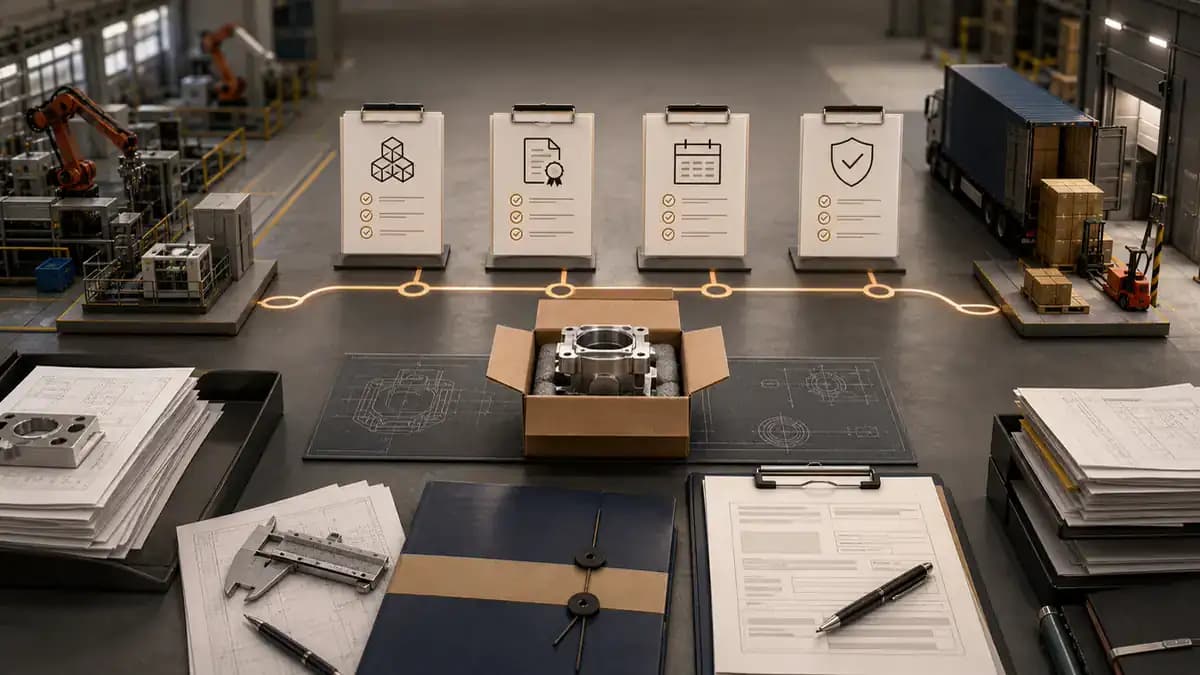
India UK Trade Deal: Manufacturer Action Checklist
India–UK trade deal checklist for manufacturers: verify classification, origin, schedules and implementation before changing price, sourcing or market-entry plans.
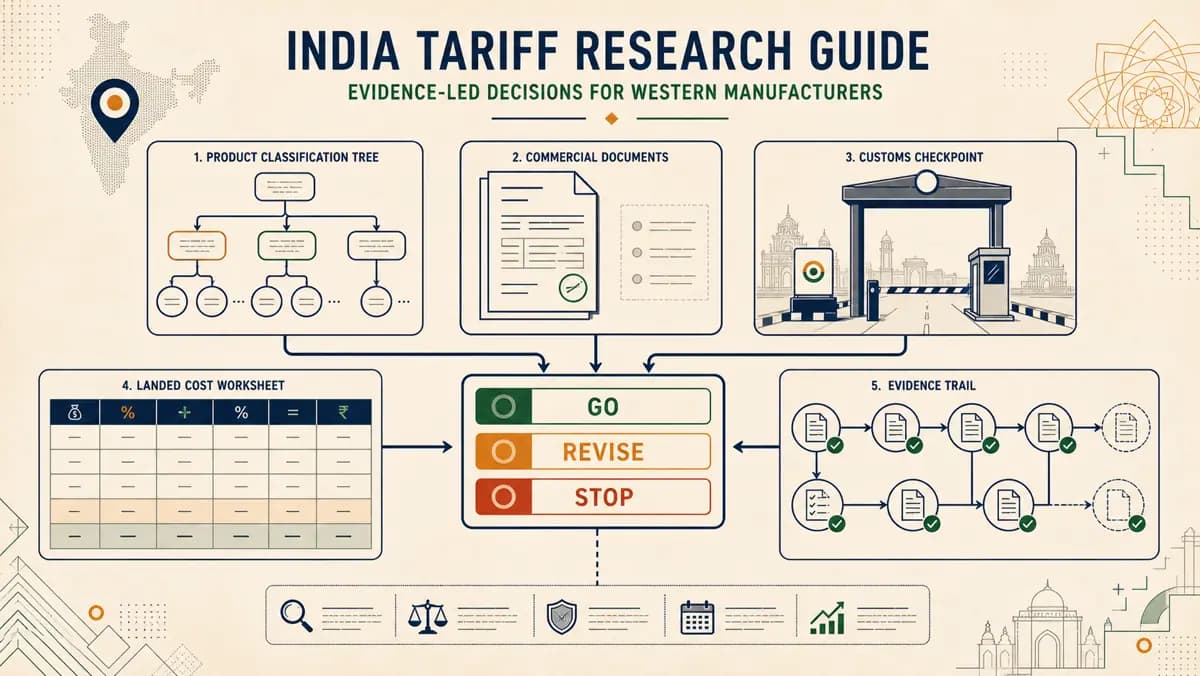
India Tariffs: A Manufacturer's Line-Level Check
Separate India tariff headlines from the line-level import evidence needed before quoting, sourcing or entering the market.