Start with a bounded pilot and verifiable evidence, not a national growth headline. Country-level sources such as the World Bank India overview1 provide context, while the World Bank's manufacturing value-added series2 lets teams inspect the underlying indicator. Neither determines whether a specific product, supplier, or operating model will work.
Our view: choose the operating model and product evidence first; choose the state, partner and entity structure second.
What does “manufacturing in India” mean for your company?
The phrase can hide several different objectives. A procurement team may want a second source for a defined drawing. A commercial team may need local assembly to serve Indian buyers. Management may want an owned factory, even though customer demand and process capability have not yet been proved.
Turn the broad ambition into a decision statement:
- Define the product, configuration, annual demand range and target customer.
- State whether the primary goal is supply resilience, customer access, lead-time control, localization, engineering access, or ownership of production.
- Separate what must happen in India from what can remain at the current site.
- Set measurable conditions for expansion, redesign, supplier replacement, or exit.
This prevents a common sequencing error: selecting a location or creating an entity before the company knows which activities the project must perform. A promotional overview such as IBEF's manufacturing sector page3 may help frame sectors and policy themes, but its claims should be treated as IBEF's sector promotion, not as proof of project viability. The official Make in India page4 is useful program context for the same reason.
Key takeaways
- Define a product and operating problem, not a country thesis.
- Test the lightest route that can produce decision-grade evidence.
- Keep location, partner, entity and investment decisions reversible until the evidence supports commitment.
Which entry route should you test first?
No route is a universal winner. Choose the model that can test your most important assumption with an acceptable level of control and exit burden.
| Entry route | Best-fit use case | Evidence needed before commitment | Exit burden |
|---|---|---|---|
| Sourcing | Buying a defined component or finished item from an existing supplier | Drawing and specification match, sample and process results, quality history, capacity proof, traceability, compliance scope and landed-cost model | Usually lower, but tooling ownership, inventory and supplier dependency can complicate exit |
| Contract manufacturing | Producing to your specification without owning the plant | Process capability, change control, approved subcontractors, inspection plan, IP controls, capacity allocation and corrective-action discipline | Medium; transfer depends on tooling, validated processes, data access and alternate capacity |
| Local assembly | Importing selected inputs and completing defined operations in India | Customer demand, bill-of-material split, customs and tax treatment, assembly work instructions, test capability, warranty flow and local content assumptions | Medium; leases, people, inventory and approvals may remain even with outsourced assembly |
| Owned operation | Building long-term control over a strategic process or sustained market position | Validated demand, site and utility evidence, management capacity, permits, labor plan, capital case, governance and a staged ramp plan | High; assets, employment, contracts, permits and closure obligations reduce reversibility |
For many SMEs, the first test should be a supplier or contract-manufacturing pilot because it can reveal product, quality, communication and logistics risks before fixed investment. That is not a rule. A regulated product, sensitive process, customer localization requirement, or hard-to-transfer technology may point to a different model.
If the immediate need is supplier discovery, see India sourcing. If the objective is sales coverage rather than production, assess whether a reliable distributor in India solves the actual problem more directly.
How do you choose a state or manufacturing cluster?
Do not begin with a generic ranking of “best states.” Begin with the product flow. A suitable cluster is one where the required process base, supplier depth, workforce, utilities, testing access, logistics and customer proximity support that flow.
Build a shortlist against a common evidence sheet:
- Industrial fit: relevant processes, materials, toolmakers, maintenance support and qualified subcontractors.
- Customer and logistics fit: distance to customers, ports, airports, consolidation points and service locations.
- Operating fit: utilities, industrial space, workforce availability, training needs and local management access.
- Compliance fit: product-specific approvals, environmental and operating permits, and state-level obligations.
- Resilience fit: alternate suppliers, route options, seasonal constraints and recovery plans.
Use the same assumptions for every location. A cluster with a higher quoted conversion cost may still offer better total economics if it reduces rejects, expedites, supplier travel or inventory. Conversely, proximity to a large city is not evidence of process capability.
Visit the finalists with a process-specific agenda. Ask to see the equipment, records, operators, warehouses, testing resources and subcontractors that would serve your product. Record gaps and owners. Avoid treating a polished presentation or industrial-park brochure as verification.
What supplier evidence belongs in due diligence?
Due diligence should connect claims to records and records to the proposed product. A certificate, machine list or major-customer logo is only a starting point.
| Evidence area | What to request and verify |
|---|---|
| Corporate identity | Legal name, registration details, ownership, operating addresses, authorized signatories and material disputes or restrictions disclosed through appropriate checks |
| Capability | Product-specific process map, equipment available, tolerances, materials handled, testing methods, maintenance status and operator competence |
| Quality records | Relevant certifications, recent audit findings, nonconformance trends, calibration records, traceability examples and change-control records |
| Product compliance scope | Exact products, models, sites and processes covered by reports, certificates, registrations or approvals, including validity and issuing body |
| Subcontracting | Every outsourced process, named subcontractor, approval method, incoming controls, traceability and change-notification rules |
| Capacity proof | Current loading, demonstrated output, bottleneck operation, shift pattern, maintenance downtime, surge assumptions and capacity reserved for the project |
| Tooling and IP | Ownership, marking, storage, access, maintenance, data controls, permitted use, return rights and treatment at termination |
| Commercial terms | Quote assumptions, currency, payment, minimum orders, indexation, scrap, warranty, liability, forecast flexibility and termination rights |
| Logistics | Packaging, handover point, export records where relevant, lead-time evidence, freight assumptions, insurance, documents and disruption plan |
| Corrective action | Named escalation route, containment timing, root-cause method, effectiveness checks and examples of closed actions |
Triangulate documents, interviews and observation. For example, compare the claimed output with cycle time, shifts, yield and current loading. Trace one batch from material receipt to dispatch. Review a recent corrective action and confirm that the fix reached work instructions and operator practice.
Contract language cannot replace process evidence. It can, however, preserve audit rights, define change notification, allocate tooling and IP rights, and make exit practical. Use qualified counsel for the final contract.
Need an evidence-led shortlist and pilot plan? Talk to an India market specialist.
Which regulatory and tax questions come before a quote?
Regulatory and tax decisions are specific to the product, activity, state, contract and entity structure. A supplier's quotation does not settle who may import, whether a product falls within a mandatory standard, what registrations apply, or how taxes and duties affect the transaction.
Before comparing quotes, establish questions such as:
- What is the exact product, component, intended use and transaction flow?
- Who owns the goods at each step, and who acts as importer, manufacturer, seller and warranty provider?
- Which product standards, labeling, testing, registration or certification requirements may apply?
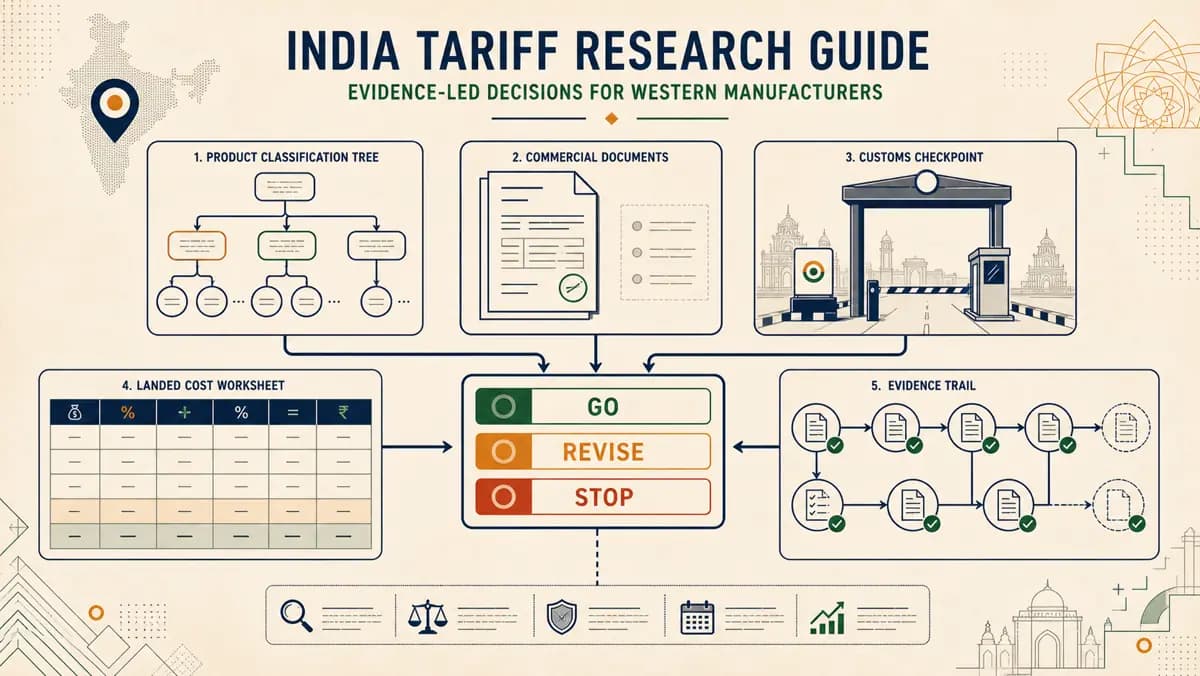
- What customs classification, valuation, origin and documentation assumptions underpin the landed-cost model?
- What GST registrations, invoicing flows, credits or permanent-establishment questions require advice?
- Does the proposed activity, sector or ownership structure raise foreign-investment conditions or approvals?
- Which central, state, local, environmental, factory or labor permissions may apply to the chosen activity and site?
Do not let a generic market-entry article classify your product. Verify BIS, customs, GST, foreign-investment and sector requirements against current official sources and qualified legal, tax and technical advisers. The DPIIT foreign direct investment policy page5 is the official place to check current FDI policy documents, but route and sector conditions must not be simplified.
For issue-specific preparation, review the guides to BIS certification for European companies and GST registration for a foreign company. They support scoping, not a formal opinion.
How do you compare landed economics without false precision?
A low unit quote can become an expensive supply route. Compare scenarios through a range-based model with named assumptions, owners and sensitivity cases.
Include at least:
- ex-works product price, tooling, samples and engineering changes;
- packaging, inland movement, freight, insurance and handling;
- customs duties, taxes and recoverability assumptions validated by advisers;
- inspection, testing, audits, travel and supplier-development effort;
- rejects, rework, warranty, scrap and yield assumptions;
- inventory in production and transit, minimum orders and working capital;
- expedites, disruption buffers, currency exposure and payment terms;
- local staff, entity, compliance, systems and closure costs where relevant.
Use base, adverse and threshold cases rather than a single precise total. Show which variables can change the decision. If freight, yield, duty treatment or minimum order is not verified, mark it as an assumption rather than burying it in the total.
The decision should also account for value that does not appear in the supplier quote: customer response time, access to engineering changes, resilience, management attention and the option to scale. These factors still need evidence. They should not become convenient labels used to rescue a weak financial case.
What should a 90-day manufacturing pilot prove?
A pilot should reduce specific uncertainties. It is not a ceremonial sample order or a compressed factory launch. Scope one product family, one process flow, a defined supplier or site, and explicit acceptance gates.
90-day pilot checklist
- Freeze the drawing, revision, material, test method and acceptance criteria.
- Confirm the commercial flow, responsibilities, Incoterm and documented regulatory assumptions.
- Verify the supplier's legal identity, proposed site, process map and subcontractors.
- Complete a product-specific process review and close critical findings.
- Agree tooling ownership, IP use, access, maintenance and return provisions.
- Produce samples through the intended production route, not a separate prototype route.
- Record first-pass yield, defects, rework, cycle time and measurement results.
- Test traceability from incoming material through packing and dispatch.
- Run packaging, documentation and logistics through the proposed handover point.
- Exercise one nonconformance and corrective-action workflow.
- Update landed economics with actual pilot evidence and sensitivity ranges.
- Hold a gate review: scale, repeat, redesign, change partner, change route, or stop.
By day 90, management should know whether the proposed route can repeatedly make the defined product, whether controls work when something goes wrong, and which assumptions remain open. Set the scale gate before the pilot begins. Examples include a defined quality threshold, closure of critical findings, verified compliance path, acceptable landed-cost range and confirmed capacity evidence. The exact gates depend on the product and risk.
For the broader sequence around customers, route, compliance and investment, see the India market-entry strategy for European SMEs.
What else do Western manufacturers ask about India manufacturing?
Is India a good manufacturing base for a Western SME?
It can be for a defined product and operating model when supplier capability, compliance, quality control, logistics and landed economics are supported by evidence. It is not automatically suitable for every SME or product. Start with a bounded pilot that tests the assumptions most likely to change the decision.
Which Indian state is best for manufacturing?
There is no universally best state. The answer depends on the required processes, supplier network, customers, logistics, utilities, skills, compliance needs and resilience plan. Compare a short list of relevant clusters using the same product-specific criteria, then verify the finalists on site.
Do foreign manufacturers need an Indian company?
Not in every entry model. A foreign company may initially buy from an Indian supplier, use a contract manufacturer, work through a distributor, or consider another structure. The correct setup depends on the activities, contracts, tax position, sector and investment plan. Verify the current position with qualified legal and tax advisers and official sources before acting.
How should a company verify an Indian supplier?
Check legal identity, ownership, the actual production site, product-specific capability, quality records, compliance scope, subcontractors, capacity, tooling and IP controls, commercial terms, logistics and corrective-action performance. Triangulate documents with interviews, site observation and a production-route pilot. Do not rely on certificates or customer logos alone.
What should be included in landed cost?
Include the product price plus tooling, packaging, inland and international logistics, insurance, customs and tax assumptions, inspections, testing, rejects, rework, warranty, inventory, working capital, supplier management, compliance, currency exposure and disruption scenarios. For local operations, add people, premises, systems, permits, professional advice and exit costs. Present ranges and sensitivities where inputs remain uncertain.
India manufacturing becomes a manageable decision when the company narrows the product, route and evidence required. Keep early commitments reversible, verify regulatory and tax assumptions, and make the scale decision from pilot results rather than broad market narratives.
Talk to an India market specialist to structure the route comparison, partner evidence and 90-day pilot.
Written by Loïc Guyon (Tileo)6, an operator with a decade of Europe-Asia industrial trade programs.
Read the methodology, source date and confidence level before carrying a number into a decision.
What does the FTA change for your product?
Open the Tariff Calculator →Every figure above is dated and source-attributed. Nothing arrives as an unexplained number.
- Sources are listed in the report methodology and verified against the publication date.
- Regulatory outcomes remain subject to entry-into-force dates and line-level classification.
Continue the research
Choose the next evidence step
Use this briefing as context, then choose the format that fits the question you need to answer.
Standard report
Start with a dated baseline
Use a fixed-scope report when you need a sourced answer to a defined market question.
ExploreCustom MIR
Shape the question around your case
Carry this article’s question into one target market, sector, corridor, and decision brief.
ExploreScoping call
Talk through the decision
Bring the corridor, timing, and evidence gap to a call before choosing the right format.
ExploreRelated Intelligence
India US Trade Deal: What Manufacturers Must Verify
As of 2026-09-14, the US-India trade framework is not operative legal text. Verify tariff lines, origin and customs guidance before changing landed cost.
India UK Trade Deal: Status and Manufacturer Checklist
India UK trade deal status for manufacturers: what is in force, what the tariff headlines mean, and what to verify for each product.

Quarterly Market Intelligence Report: A Decision Record
Build a quarterly market intelligence report that records dated evidence, changed assumptions, decisions, triggers, and an auditable archive.