To find manufacturing companies in India, start with a sector reference and current company product or facility pages. Then verify each candidate's legal identity, product evidence, and factory details. A company name is only a lead. It does not prove that the company makes your product, controls the named facility, meets a required standard, can export, or suits your order. Move candidates through discovery, qualification, and due diligence. Keep the source and date for each material fact. Record gaps as unknown. Seek an independent or on-site check when documents cannot prove a key claim.
This is a supplier-research method, not a ranking of the “top” manufacturing companies in India. It does not provide legal, tax, or investment advice.
Where can a buyer find manufacturing companies in India?
Use several source types because each answers a different question. The India Brand Equity Foundation manufacturing sector page is a sector-reference page. It can help a buyer identify relevant industries and frame a search. It is not a product-level supplier register.
Search results, trade directories, marketplace profiles, university lists, and downloadable company lists can add names to a longlist. Treat them as discovery surfaces only. Their value is coverage, not proof. Do not copy their labels, claims, or contact details into a shortlist without checking the source behind each field.
For every promising name, open the company's own current website. Look for a product page that matches the required process or product, a legal name, a physical facility address, and contact details tied to the same entity. Preserve the URL and access date. A polished home page is weaker evidence than a precise product page, a dated technical document, or a record from the relevant authority.
Source-quality table
| Source | Best use | What it can support | What it cannot support by itself |
|---|---|---|---|
| IBEF manufacturing sector page | Sector orientation | Sector context and relevant industry paths | A buyer-specific supplier shortlist or validation of a named factory |
| Official company product and facility pages | Qualification | What the company currently states about its products, processes, and locations | Independent confirmation of those statements |
| Relevant regulator or issuing body's live database | Claim verification | The status and scope shown by the authority for the exact entity or product | Commercial fit outside the displayed scope |
| Marketplace, list, or search-result page | Lead generation | A name, category, or claimed product worth checking | Any material supplier claim without a primary source |
The table is a hierarchy of use, not a blanket trust score. A source may be strong for legal identity and silent on production. Another may show a product but say nothing about the entity named on a purchase order.
Why is a directory not a supplier shortlist?
A directory is built to help users find records. A supplier shortlist is built to support a buying decision. Those are different jobs.
Directory categories can be broad. Records can also reflect a corporate group, sales office, distributor, service provider, or entity whose current activity is unclear. Even when the category is correct, it may not reveal the manufacturing process, material grade, tolerance, batch size, tooling ownership, or location that matters to the buyer.
A credible shortlist connects four things:
- The exact legal entity that would quote and contract.
- The product or process required by the buyer.
- The facility said to perform the work.
- Evidence that is current, specific, and traceable to its source.
If one of these links is missing, mark it as unknown. Do not replace the gap with a group-level brochure, an old directory entry, or a sales representative's statement.
This distinction also prevents a common category error. Discovery asks, “Who might do this work?” Qualification asks, “Does the available evidence match our requirement?” Due diligence asks, “Can we rely on the material claims before we commit?” A company can pass discovery and still fail qualification. Passing qualification does not remove the need for risk-based due diligence.
For the evidence pack that turns supplier discovery into a controlled approval decision, read the India sourcing evidence-led buyer's guide.
For a sector-specific example of this process, see the India furniture manufacturers sourcing and verification guide.
For a product-category shortlist, read the India manufacturing products buyer frame. For a wider market-entry frame, read the India market-entry strategy for European SMEs. If the product may fall under an Indian standard or Quality Control Order, use the BIS certification guide for European companies as a starting point, then confirm the current position through the BIS compulsory-certification pages.
Get the sample report to see how source-backed market research can be structured for a buying team.
Examples by sector: which manufacturers can start a longlist?
The examples below are non-ranked discovery leads, not recommended suppliers. Each statement is limited to what the linked company page said when checked. The links do not establish certification, capacity, export eligibility, financial health, ownership, sanctions status, or suitability for an order.
| Sector | Company | Company-stated manufacturing, product, or facility evidence | Check date |
|---|---|---|---|
| Automotive | Maruti Suzuki India | Its green-manufacturing page refers to cars the company manufactures and identifies its Gurugram facility. | Verified 2026-09-03 |
| Forgings and engineered components | Bharat Forge | Its company page identifies manufacturing sites in Pune, Baramati, Satara, and Nellore and describes forged, machined, and aluminium-cast components made at those sites. | Verified 2026-09-03 |
| Cement and concrete | UltraTech Cement | Its company overview states that it manufactures ready-mix concrete and white cement and that its business operations include India. | Verified 2026-09-03 |
| Steel | JSW Steel | Its facilities page identifies integrated and downstream facilities across India, including works at Vijayanagar, Dolvi, Salem, Tarapur, Kalmeshwar, and Vasind. | Verified 2026-09-03 |
| Aerospace components | Godrej Enterprises Group | Its aerospace page states that the business manufactures space engines and aviation components at its facilities. | Verified 2026-09-03 |
These names answer list intent only. A buyer still needs to test the exact legal entity, product, proposed site, and evidence against the requirement.
Which evidence should be verified first?
Start with facts that can disqualify a candidate before the team spends time on calls, samples, or visits. Verify the evidence in this order of dependency, but adjust it to the product and risk.
Qualification checklist
- Identity: Match the legal name on the website, quotation, invoice details, and available official records. Note any mismatch instead of assuming that two similar names are the same entity.
- Product fit: Find a current official page or technical document that names the required product, process, or material. A generic “engineering solutions” label is not enough.
- Facility link: Ask which site will perform the work. Match its address across the quotation, company material, and available records.
- Drawing and specification fit: Send a controlled requirement pack. Record which revision the candidate reviewed and which points remain open.
- Certification scope: If a certificate is material, obtain the certificate and verify the exact legal entity, site, standard, scope, issuer, and current status with the issuing body. For BIS questions, check the official BIS product-certification resources, not a supplier badge alone.
- Regulatory path: Identify which product rules may apply before asking whether the supplier “is compliant.” The answer must relate to the exact product, standard, market, and entity.
- Commercial terms: Separate quoted facts from assumptions. State the product, currency, tax treatment, delivery term, tooling, packaging, testing, and validity shown in the quote. Seek qualified advice where tax or contract interpretation is needed.
- Evidence log: Save the source URL, document title, named entity, scope, issue date where shown, access date, reviewer, and open questions.
Do not infer ownership, capacity, export rights, or financial strength from a brand name or plant photograph. Each of those claims needs its own suitable primary evidence. A buyer should also run any required sanctions or restricted-party checks through the relevant official systems and professional process. This article does not determine sanctions status.
How should a Western buyer compare candidates?
Build a comparison matrix from the requirement, not from the fields a directory happens to provide. Every row should represent a decision factor. Every cell should contain one of three states: verified, contradicted, or unknown. An empty cell should never receive a favorable score.
| Comparison field | Evidence to record | Decision treatment |
|---|---|---|
| Legal counterparty | Official record, quotation, and company contact details | Stop if the contracting entity cannot be resolved |
| Product and process match | Current official product page, controlled response, and technical submission | Advance only the scope supported by evidence |
| Proposed manufacturing site | Address and facility-specific material | Keep site-level claims unknown until matched |
| Specification response | Clause-by-clause response to the buyer's revision | Separate accepted, exception, and unanswered items |
| Quality controls | Procedure or records tied to the proposed work | Do not treat a logo as evidence of execution |
| Certification, if required | Issuer record and certificate scope for the exact entity and site | Verify with the issuing authority before reliance |
| Quote basis | Written commercial offer with assumptions and exclusions | Compare only offers based on the same requirement |
| Delivery plan | Written plan tied to the requested quantity and site | Treat an unsupported promise as unverified |
| Open risks | Named gap, owner, and next evidence needed | Keep visible until closed or accepted |
Use gates instead of a single total score. A high mark for communication should not offset an unresolved legal identity. A low price should not cancel a product mismatch. A certificate outside the relevant scope should not earn partial credit.
Ask candidates the same core questions and issue the same controlled files. This makes differences easier to explain. It also exposes candidates who answer a different requirement from the one sent. Keep sales responsiveness separate from technical evidence.
Red flags that require clarification
- The legal name changes between the website, quotation, bank details, and certificate.
- The proposed factory is not named in the technical or commercial submission.
- Product images appear without a matching specification or process description.
- A certificate is cropped, expired, untraceable, or issued to another entity or site.
- The candidate claims unlimited capacity or guaranteed delivery without evidence tied to the request.
- The quote omits major assumptions, test scope, tooling, packaging, delivery terms, or exclusions.
- A marketplace profile is presented as proof of manufacturing activity.
- The candidate resists a reasonable request to identify subcontracted work.
- Technical answers conflict across email, quotation, and meeting notes.
- Pressure to pay arrives before identity, scope, and payment instructions are verified.
A red flag is not always proof of misconduct. It is a reason to pause, seek evidence, and decide whether the gap can be closed.
When is an on-site or independent check needed?
Use an on-site or independent check when the decision depends on facts that documents cannot establish with enough confidence. Examples include whether the proposed line exists at the named address, whether the stated process is performed there, whether inspection equipment is available, and whether a sample was made under the same conditions proposed for production.
The depth of the check should reflect the consequence of failure. Consider a facility visit, independent inspection, specialist technical review, or qualified legal and financial review when:
- The product is safety-critical, regulated, custom-tooled, or hard to replace.
- Upfront payment, tooling exposure, or supply disruption would be material to the buyer.
- Key work will be subcontracted and the subcontractor is not disclosed or verified.
- Documents contain identity, address, scope, or date conflicts.
- A certificate or test report is central to approval but cannot be validated at source.
- The team must confirm process control, traceability, testing, storage, or segregation in practice.
- The candidate is being considered for an ongoing or sole-source role.
Define the check before commissioning it. State the exact facility, product, process, documents, and claims to test. Request evidence that can be tied back to the buyer's requirement. A generic factory tour can produce photographs without answering the decision question.
An independent check is also not a guarantee. It is one layer in a documented decision. The buyer still needs suitable contracts, product acceptance criteria, payment controls, logistics planning, and professional advice for legal, tax, regulatory, or financial questions.
Frequently Asked Questions
What are the top 10 manufacturing companies in India?
This article's method does not establish a universal top ten. Any ranking depends on the sector and criterion a buyer selects. The five examples above are non-ranked discovery leads. Define the required product, process, and site, then verify each candidate against those requirements.
What is the best directory of manufacturing companies in India?
There is no single directory that proves supplier suitability. Use the IBEF page for sector orientation and directories or search results to discover names. Then verify the legal entity, product, and facility through current primary evidence.
Can a buyer rely on a supplier's website?
Use the website as first-party evidence of what the company states. It is useful for product, process, and location claims, but it is not independent confirmation. Verify material claims with the relevant official record, issuer, customer-controlled test, or independent check.
Does a certification prove that a company is a good supplier?
No. A certificate can support only the entity, site, standard, scope, and status it covers. Check those fields with the issuer. It does not prove fit for a particular drawing, order, delivery plan, or commercial relationship.
Should a shortlist include price before technical qualification?
Record price only with its scope, assumptions, exclusions, currency, tax treatment, delivery term, and validity as stated in the written quote. Compare prices after the offers refer to the same requirement. Obtain professional advice for tax, customs, and contract questions.
Turn a company list into a decision record
The useful output is not a long spreadsheet of names. It is a short, traceable set of candidates with evidence for identity, product fit, facility, specification response, and unresolved risk. Keep discovery broad, qualification evidence-led, and due diligence proportional to the decision.
Talk to an India market specialist to build a source-backed supplier map and qualification plan for your product.
Written by Tileo, an operator with a decade of Europe-Asia industrial trade programs.
Read the methodology, source date and confidence level before carrying a number into a decision.
What does the FTA change for your product?
Open the Tariff Calculator →Every figure above is dated and source-attributed. Nothing arrives as an unexplained number.
- Sources are listed in the report methodology and verified against the publication date.
- Regulatory outcomes remain subject to entry-into-force dates and line-level classification.
Continue the research
Choose the next evidence step
Use this briefing as context, then choose the format that fits the question you need to answer.
Standard report
Start with a dated baseline
Use a fixed-scope report when you need a sourced answer to a defined market question.
ExploreCustom MIR
Shape the question around your case
Carry this article’s question into one target market, sector, corridor, and decision brief.
ExploreScoping call
Talk through the decision
Bring the corridor, timing, and evidence gap to a call before choosing the right format.
ExploreRelated Intelligence
India Manufacturing Products: A Buyer Shortlist Frame
A decision frame for Western SMEs shortlisting India manufacturing products using sector signals, export evidence and product-level compliance gates.
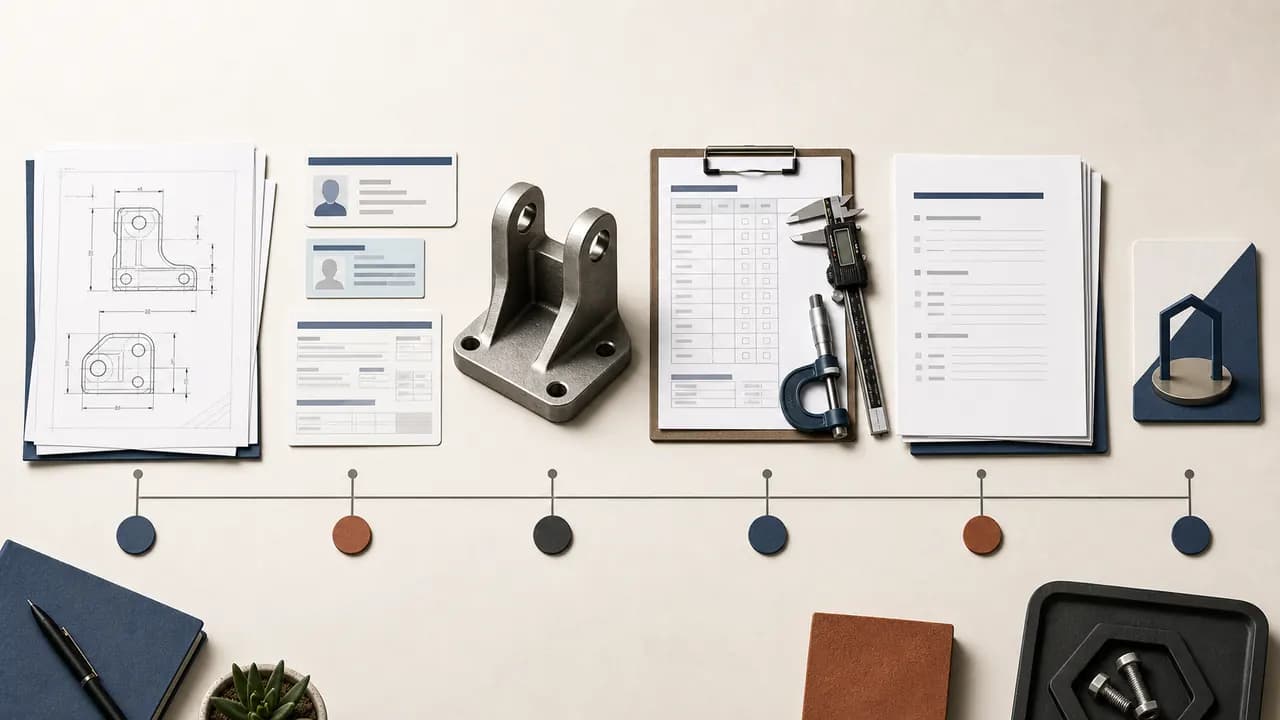
India Sourcing: An Evidence-Led Buyer's Guide
Build an India sourcing evidence pack covering requirements, supplier identity, product rules, samples, inspections and approval gates.
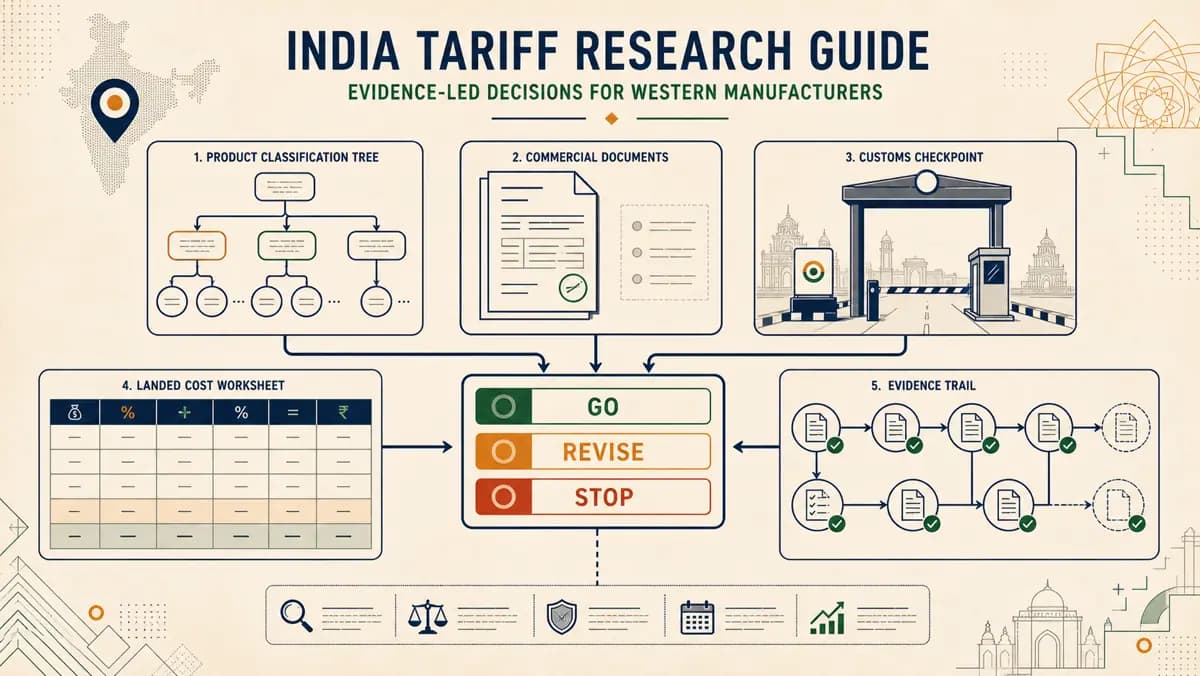
India Tariffs: A Manufacturer's Line-Level Check
Separate India tariff headlines from the line-level import evidence needed before quoting, sourcing or entering the market.