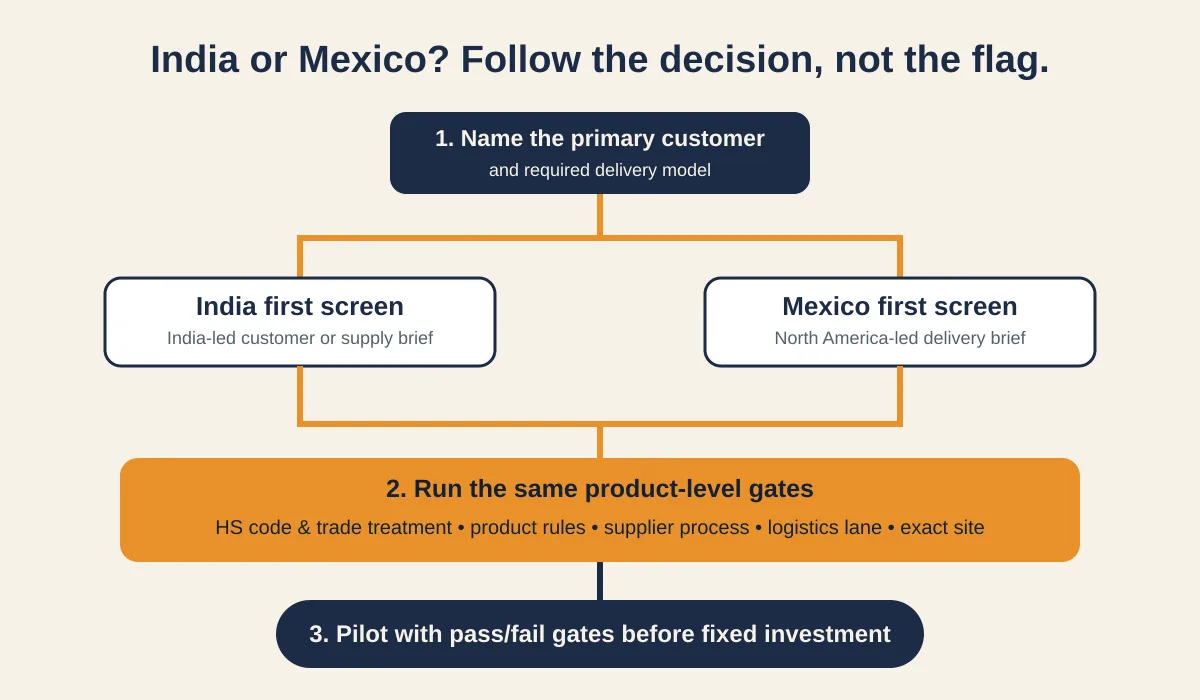
When comparing manufacturing in india vs mexico, screen Mexico first when the primary customer market is North America and USMCA qualification matters. Mexico is close to the United States, and USTR says that USMCA covers the United States, Mexico, and Canada and highlights improved rules of origin for automobiles, trucks, and other products (Trade.gov1; USTR2). Screen India first when the customer or supply-base brief is India-led. The World Bank describes India as a large economy with regional disparities, so national scale does not prove demand or site suitability (World Bank3). In either country, confirm the HS classification, applicable origin and product rules, supplier process, logistics lane, and exact site before committing capital. Screen one country first, but fund only a product-and-site case.
Which country should a Western manufacturer screen first?
Use the primary customer market as the first filter. Mexico is geographically close to the United States, and its manufacturing base is integrated into global value chains; USTR also confirms that Mexico is part of USMCA (Trade.gov; World Bank4; USTR). That combination makes Mexico a logical first screen for a North America-led brief. It does not guarantee preferential duty treatment for the finished product (USTR).
| Buyer question | Screen India first when... | Screen Mexico first when... | Evidence needed before selection |
|---|---|---|---|
| Where is the primary customer? | The commercial brief is India-led; national scale alone is not proof of demand (World Bank). | North American delivery is central; Mexico's proximity is relevant to the lane (Trade.gov). | Named customers, delivery terms, service needs, and lane quotes |
| Does trade treatment matter? | USMCA preference is not part of the India case (USTR). | The product may qualify under USMCA, subject to its applicable origin rules (USTR). | HS classification, origin analysis, and customs advice |
| Is the product regulated? | The product appears on the official BIS compulsory-certification material (BIS5). | Record product-specific Mexico compliance advice from counsel. | Current product scope, standards, labeling, importer, and test evidence |
| Does the supplier ecosystem fit? | A process-capable India supplier is found and verified. | The requirement matches Mexico's documented automotive, aerospace, medical-equipment, electronics, or regional capabilities (Trade.gov). | Process audit, capacity evidence, references, tooling, and sub-tier map |
| Can the move stay reversible? | A sample, pilot, or supplier audit can test the India case before a plant commitment. | A lane quote, supplier audit, or contract-manufacturing pilot can test the Mexico case before a plant commitment. | Written pass/fail gates and an exit condition |
Decision rule: a country screen ranks where to investigate. It does not replace HS-code, legal, customs, supplier, logistics, environmental, labor, tax, or site diligence.
How should USMCA affect the Mexico case?
Treat USMCA as a qualification question, not a blanket promise of duty-free access. USTR says the agreement covers the United States, Mexico, and Canada and highlights improved rules of origin for automobiles, trucks, and other products (USTR). A Mexico address alone therefore does not establish that a product receives preferential treatment (USTR).
Tensor's proposed risk-control method is:
- Classify the finished good and relevant inputs under the applicable HS system before testing USMCA treatment.
- Identify the USMCA origin rule for that finished good in the agreement text (USTR).
- Map where each material, component, and transformation originates for that origin analysis.
- Test the bill of materials and production steps against the applicable rule of origin.
- Obtain customs and legal review before using USMCA preference in the financial case.
This sequence is Tensor's risk-control guidance, not a workflow prescribed by USTR. The USTR page supports the existence of the agreement and product-specific rules of origin (USTR). Do not infer a duty rate from the country of assembly or current product treatment from a general trade page.
What product regulation should be checked in India?
Start with the exact product, standard, and current compulsory scope. BIS states that its certification scheme is generally voluntary, while the central government makes compliance with Indian Standards compulsory for specified products under stated public-interest considerations (BIS). Its live page links the compulsory-product material and certification routes (BIS). That supports a product screen, not a universal claim that every manufactured good needs BIS approval (BIS).
Tensor's proposed diligence method for an India candidate is:
- the product name, model range, intended use, and HS classification;
- whether the product appears in current BIS compulsory material, with the exact standard and order linked (BIS);
- the proposed manufacturer, importer, label owner, testing party, and approval holder;
- which state and site permissions counsel says apply to the proposed activity; and
- which tax registrations and filing actions apply to the chosen transaction model, using the official GST portal for the current workflow (GST portal6).
These bullets are a diligence file, not a claim that every item applies to every project. The GST home page offers registration and taxpayer services (GST portal). It does not support a universal filing frequency, cost, or setup duration (GST portal). No incorporation instruction or timing is asserted here.
Regulatory callout: if the standard, order, applicant, factory, or importer is still unclear, the India compliance line is not ready for a budget.
How should supplier ecosystems change the shortlist?
Sector presence is a lead source, not supplier proof. Trade.gov identifies aerospace, automotive, medical equipment, and electronics among Mexico's main advanced-manufacturing sectors. It also maps different strengths across Bajío, northern Mexico, Guadalajara, and central Mexico (Trade.gov). That evidence can focus a supplier search by process and region. It cannot validate a particular vendor's capacity, quality system, ownership, or delivery record.
India's national scale should be handled with the same discipline. The World Bank calls for stronger manufacturing, infrastructure, and value-chain integration and notes regional disparities (World Bank). That is a warning against treating India as one supplier market. A procurement team should define the process, tolerance, material, annual volume, tooling, quality evidence, and sub-tier dependencies before comparing vendors.
Tensor's proposed plant-level diligence method for both countries is:
- verify the legal entity and beneficial ownership through current local records;
- walk the actual production flow, warehouse, utilities, quality lab, and dispatch area;
- reconcile claimed capacity with machines, shifts, maintenance records, and booked demand;
- inspect sample traceability, nonconformance handling, change control, and sub-tier approvals;
- contact product-relevant customer references with consent; and
- make commercial release conditional on a documented pilot result.
An older NBER summary is useful as a caution, not a current plant score. It reports research finding different plant life-cycle and productivity patterns across India, Mexico, and the United States, then discusses several possible frictions behind them (NBER7). Because the study is historical and aggregate, it should strengthen plant-level diligence rather than rank today's candidate factories.
How should logistics be designed before comparing cost?
Compare complete lanes, not pins on a map. Trade.gov explicitly links Mexico's US proximity with its supply-chain role and describes region-specific manufacturing strengths (Trade.gov). That supports testing a Mexico-to-US lane early. It does not prove a shorter or cheaper delivery for every origin, border crossing, mode, or customer.
Tensor's proposed lane-quotation method is to ask forwarders and customs advisers to quote the same operating scenario for each finalist:
- supplier or factory gate to export node;
- export clearance and handling;
- main transport and insurance;
- border or port process;
- import clearance under the tested tariff treatment;
- delivery to the named customer; and
- the inventory policy required by the quoted service design.
Keep assumptions separate from evidence. A map can suggest which lane to quote; only current route, mode, Incoterm, shipment profile, customs, and service data can support the model. The World Bank describes Mexico as integrated into global value chains and India as seeking deeper value-chain integration, but those country observations do not price a shipment (World Bank Mexico; World Bank India).
Get the sample report to see how a market decision can separate supported findings, assumptions, open questions, and next actions.
What is a reversible next step?
Buy evidence before buying irreversibility. Tensor's proposed risk-control options test an assumption that could reverse the country screen:
- If North American preference drives Mexico, commission the HS-code and origin analysis first (USTR).
- If India market access drives India, verify named customer demand and the applicable BIS product scope first (BIS).
- If supplier depth drives either case, audit one process-matched supplier in the target region before discussing a new plant.
- If delivery drives the case, quote an end-to-end lane using the same shipment and service assumptions for both finalists.
- If no single assumption dominates, run a bounded contract-manufacturing or sourcing pilot with written pass/fail gates.
These are reversible investigation choices, not statements that one structure fits every company. For product screening, see the BIS certification guide. For the report structure behind this sequence, review the market intelligence report example.
Stop/go gate: do not convert a country preference into a plant commitment until the product, trade, supplier, logistics, and site files agree.
Frequently Asked Questions: what do buyers miss?
What are the main exports of India to Mexico?
The live allowed sources do not provide a current bilateral product ranking. A defensible answer needs dated customs data, a defined period, and a clear product classification. For an actual manufacturing decision, identify the relevant HS codes and current Mexico treatment instead of relying on a generic export list.
Does making a product in Mexico guarantee USMCA preference?
No. USTR identifies rules of origin as an agreement feature, including improved rules for automobiles, trucks, and other products (USTR). Check qualification for the specific good and supply chain against the agreement text (USTR).
Does every product made or sold in India require BIS certification?
No. BIS says its certification scheme is generally voluntary, but specified products are made compulsory by the central government under identified considerations (BIS). Check the current product and standard scope.
Where should the final decision land?
Screen Mexico first for a North America-led brief; screen India first for an India-led brief. Advance neither country until one named product-and-site case passes the same five files: trade treatment, product regulation, supplier process, logistics lane, and exact-site diligence. If one file remains open, keep the decision at the screen or pilot stage rather than treating it as a plant selection.
Written by Loïc Guyon (Tileo)8, an operator with ten years moving critical technologies and operations between countries.
Read the methodology, source date and confidence level before carrying a number into a decision.
What does the FTA change for your product?
Open the Tariff Calculator →Every figure above is dated and source-attributed. Nothing arrives as an unexplained number.
- Sources are listed in the report methodology and verified against the publication date.
- Regulatory outcomes remain subject to entry-into-force dates and line-level classification.
Continue the research
Choose the next evidence step
Use this briefing as context, then choose the format that fits the question you need to answer.
Standard report
Start with a dated baseline
Use a fixed-scope report when you need a sourced answer to a defined market question.
ExploreCustom MIR
Shape the question around your case
Carry this article’s question into one target market, sector, corridor, and decision brief.
ExploreScoping call
Talk through the decision
Bring the corridor, timing, and evidence gap to a call before choosing the right format.
ExploreRelated Intelligence
India vs. Vietnam vs. Mexico: Market Entry Cost Comparison for European Manufacturers (2026)
15-dimension comparison: setup costs ($12K-$85K), labour rates, regulations, FTA tariffs, and market size. Real data to pick the right China+1 market for your expansion.
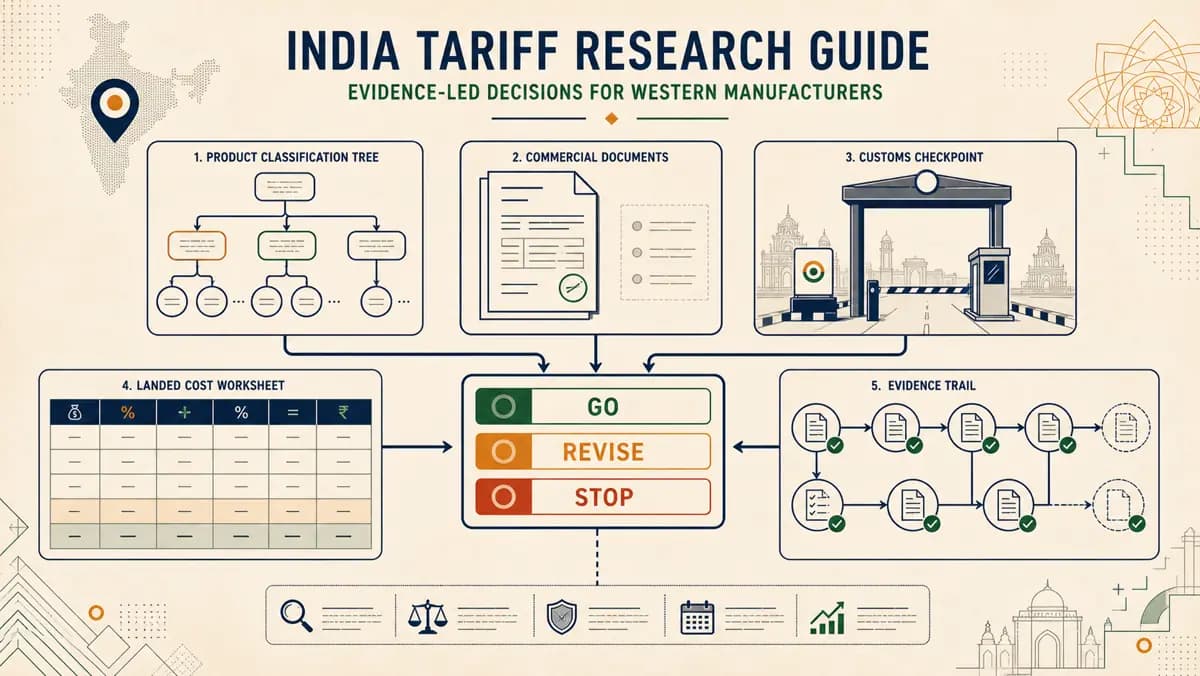
India US Trade Deal: What Manufacturers Must Verify
As of 2026-09-14, the US-India trade framework is not operative legal text. Verify tariff lines, origin and customs guidance before changing landed cost.
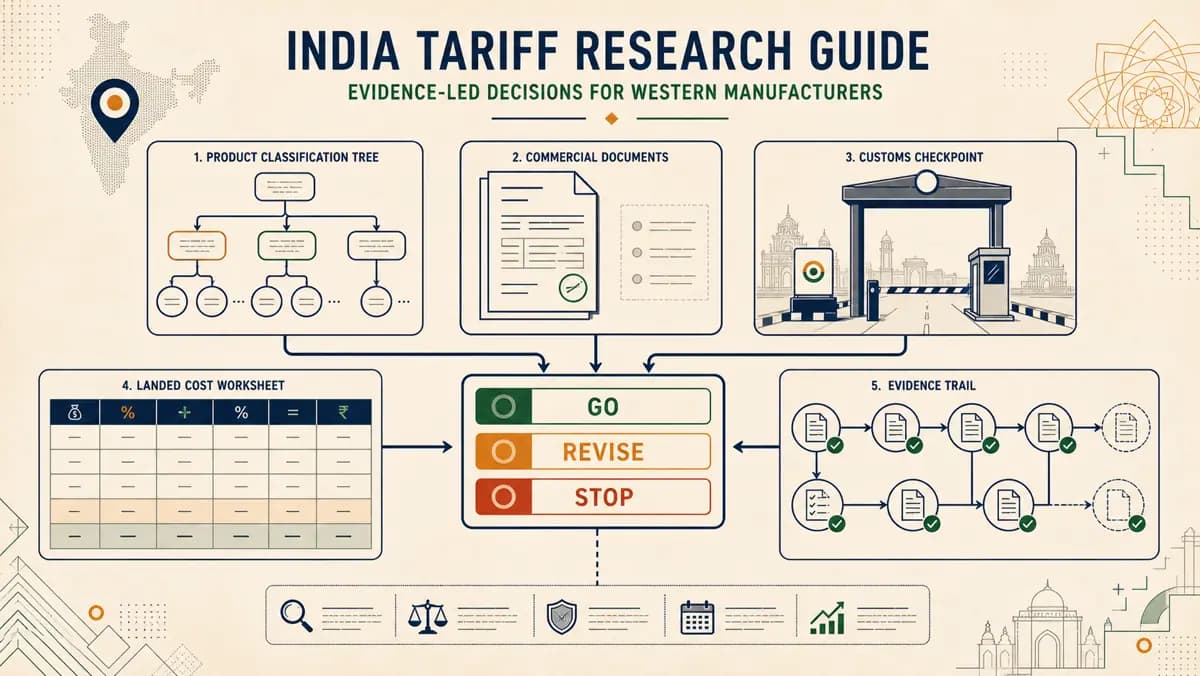
India Tariffs: A Manufacturer's Line-Level Check
Separate India tariff headlines from the line-level import evidence needed before quoting, sourcing or entering the market.