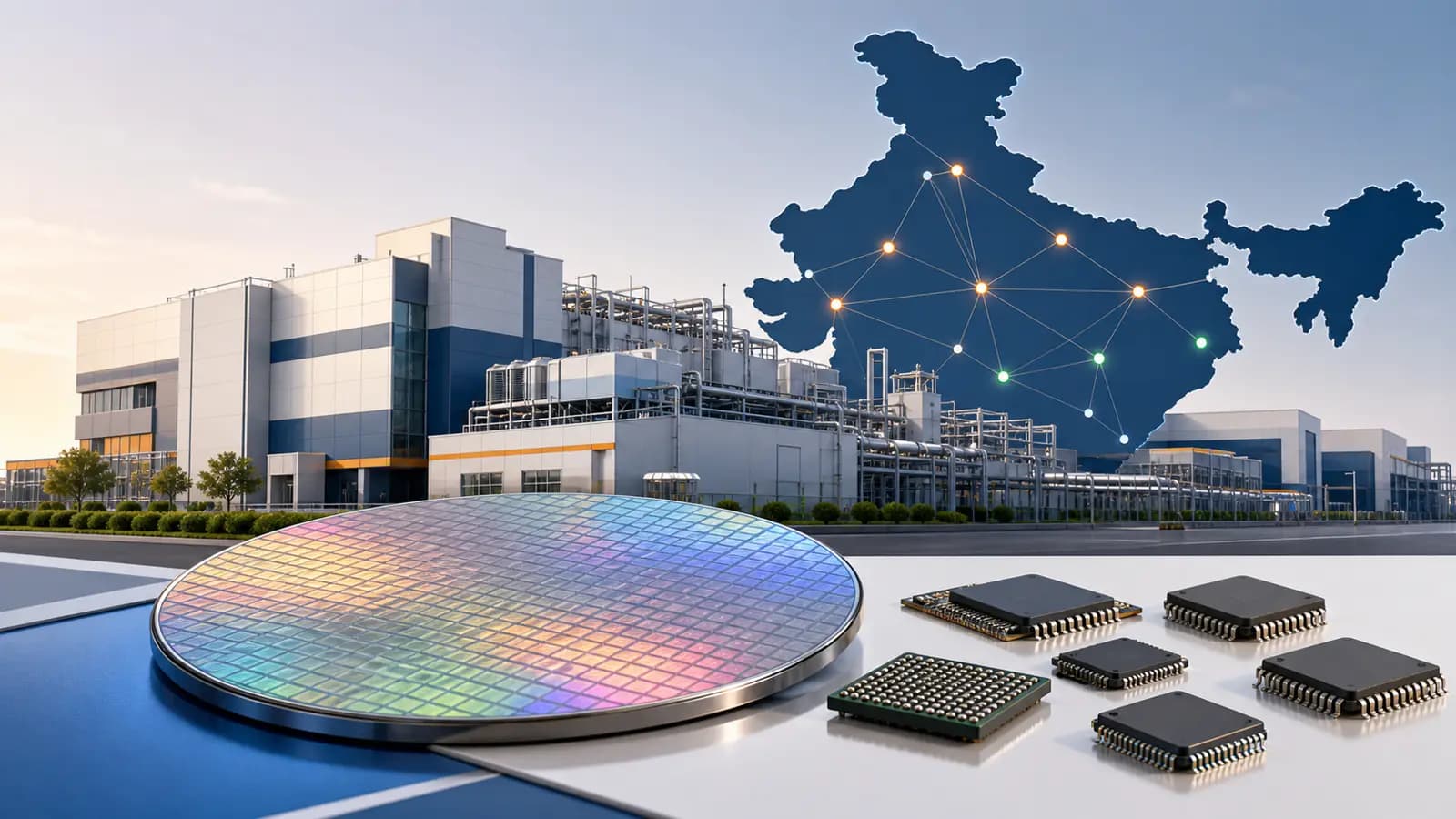
Verified 28 August 2026: India semiconductor manufacturing under the India Semiconductor Mission comprises 12 approved projects across Gujarat, Uttar Pradesh, Punjab, Assam, Odisha, and Andhra Pradesh, according to the government portfolio update dated 15 July 2026. (PIB, 15 July 2026) The same release identifies three facilities in commercial production: Micron ATMP, Kaynes Semicon, and CG Power OSAT. (PIB, 15 July 2026) The portfolio also includes a silicon fab, compound-semiconductor and display projects, and assembly, testing, marking, and packaging facilities. (PIB, 15 July 2026) Approval records a government decision. It does not prove that a plant is operating. Suppliers should keep approved, being established, expanding, and commercial production separate, then qualify each project by site, process, status evidence, and buying entity. (PIB, 15 July 2026)
Who manufactures semiconductors in India?
Within the ISM portfolio, the government identified three facilities in commercial production by 15 July 2026. They were Micron ATMP, Kaynes Semicon, and CG Power OSAT. (PIB, 15 July 2026) The same release lists one silicon fab and one compound-semiconductor fab with packaging. It also lists one micro-LED display GaN fab with packaging and nine ATMP or OSAT facilities. (PIB, 15 July 2026)
These categories should not be merged:
A fab forms devices on wafers. The approved Tata Electronics Private Limited (TEPL) project in Gujarat is the silicon fab in the ISM portfolio. The government says TEPL is establishing it with PSMC, Taiwan as technology partner. (PIB, 1 April 2026)
ATMP and OSAT facilities assemble, package, mark, and test semiconductor devices. The government identifies Micron, Kaynes Semicon, and CG Power OSAT as commercially producing within this part of the value chain. (PIB, 15 July 2026)
Compound-semiconductor and display facilities address specific materials or devices. The approved SiCSem project in Odisha covers silicon-carbide fabrication and packaging. (PIB, 1 April 2026) The approved Crystal Matrix project in Dholera covers GaN-based mini/micro-LED displays and foundry services. (PIB, 5 May 2026)
India also has a semiconductor design base. A design centre is not proof of local wafer fabrication or commercial packaging. The government reports design support apart from its manufacturing project count. (PIB, 15 July 2026)
For a broader location decision beyond semiconductors, compare the operating context in manufacturing in India versus Mexico. The right comparison depends on the actual facility and supply-chain role, not a country label alone.
Which projects are approved, being built, or operating?
The table uses the latest official portfolio statement as its status anchor. “Commercial production” appears only where the 15 July 2026 PIB release uses that term. For other projects, the wording stays close to the cited record. It uses “approved,” “establishing,” “expanding,” or “will establish.”
| Project and location | Activity | Status evidence | Primary source | Verified |
|---|---|---|---|---|
| Micron, Gujarat | DRAM/NAND assembly and test | Commercial production commenced | PIB, 1 April 2026; PIB, 15 July 2026 | 28 August 2026 |
| Kaynes Semicon, Gujarat | Wire-bond/substrate-based packages | Commercial production commenced | PIB, 1 April 2026; PIB, 15 July 2026 | 28 August 2026 |
| CG Power, Gujarat | OSAT | Commercial production commenced | PIB, 1 April 2026; PIB, 15 July 2026 | 28 August 2026 |
| Tata Electronics Private Limited (TEPL), Gujarat; PSMC, Taiwan as technology partner | Silicon fab | Approved; official annexure says “is establishing” | PIB, 1 April 2026 | 28 August 2026 |
| Tata Electronics, Assam | Semiconductor packaging | Approved; official annexure says “is establishing” | PIB, 1 April 2026 | 28 August 2026 |
| Vama Sundari Investments (Delhi) Private Limited (VSIPL), Uttar Pradesh; Foxconn India as joint-venture partner; Hon Hai, Taiwan as technology provider | Display-driver IC packaging and related services | Approved; official annexure says “is establishing” | PIB, 1 April 2026 | 28 August 2026 |
| 3D Glass Solutions, Odisha | Advanced packaging and glass-substrate products | Approved; official annexure says “is establishing” | PIB, 1 April 2026 | 28 August 2026 |
| SiCSem, Odisha | Silicon-carbide fab and packaging | Approved; official annexure says “is establishing” | PIB, 1 April 2026 | 28 August 2026 |
| Continental Device India, Punjab | Discrete semiconductors | Approved expansion of an existing manufacturing facility | PIB, 1 April 2026 | 28 August 2026 |
| Advanced System in Package Technologies, Andhra Pradesh | Semiconductor manufacturing facility | Approved; official annexure says “is establishing” | PIB, 1 April 2026 | 28 August 2026 |
| Crystal Matrix, Dholera, Gujarat | GaN mini/micro-LED display fab and ATMP | Approved; Cabinet release says “will establish” | PIB, 5 May 2026 | 28 August 2026 |
| Suchi Semicon, Surat, Gujarat | OSAT for discrete semiconductors | Approved; Cabinet release says “will be setting up” | PIB, 5 May 2026 | 28 August 2026 |
This is an evidence map, not a forecast. The table does not treat proposed production capacity as installed capacity. It also does not infer commissioning from construction, equipment delivery, a pilot line, or a target date.
The status changed during 2026. A 1 April release identified Micron and Kaynes as commercially producing. (PIB, 1 April 2026) The 15 July release added CG Power OSAT to the facilities in commercial production. (PIB, 15 July 2026) This change shows why the source date matters.
Get the sample report for the structure used to turn project evidence into a market-intelligence brief.
Where are the clusters?
The approved project locations form several state-level groupings. They are not interchangeable, because the activity and status differ by site.
Gujarat: Gujarat hosts the Micron DRAM/NAND assembly and test, Kaynes Semicon wire-bond/substrate-based package, and CG Power OSAT facilities identified in commercial production. (PIB, 1 April 2026; PIB, 15 July 2026) Gujarat hosts the approved Tata Electronics Private Limited (TEPL) silicon fab, with PSMC, Taiwan as technology partner. (PIB, 1 April 2026) Dholera hosts the approved Crystal Matrix project. Surat hosts the approved Suchi Semicon OSAT project. (PIB, 5 May 2026)
Odisha: The approved 3D Glass Solutions project covers advanced packaging. The approved SiCSem project covers silicon-carbide fabrication and packaging. (PIB, 1 April 2026)
Assam: Tata Electronics is establishing a semiconductor packaging facility in Assam. (PIB, 1 April 2026)
Uttar Pradesh: Vama Sundari Investments (Delhi) Private Limited (VSIPL) is establishing the approved Uttar Pradesh project, with Foxconn India as joint-venture partner and Hon Hai, Taiwan as technology provider. It covers display-driver IC packaging and related services. (PIB, 1 April 2026)
Punjab: Continental Device India has an approved expansion of its semiconductor manufacturing facility. (PIB, 1 April 2026)
Andhra Pradesh: Advanced System in Package Technologies has an approved semiconductor manufacturing facility. (PIB, 1 April 2026)
Location screening should sit inside a full India market-entry strategy for European SMEs. A project address identifies where the facility is planned or operating. It does not, by itself, prove that a specific supplier has an addressable contract there.
What incentives can a foreign supplier verify?
The central framework names the supported project types. A MeitY release states that silicon CMOS fabs get fiscal support of 50% of project cost on a pari-passu basis. It states the same support basis for display fabs. (PIB and MeitY, 2 April 2025) The release uses a different cost base for compound semiconductors, silicon photonics, sensors, discrete fabs, ATMP, and OSAT. It states fiscal support of 50% of capital expenditure on a pari-passu basis. (PIB and MeitY, 2 April 2025)
The same release describes the Design Linked Incentive in separate terms. It states a product-design incentive of up to 50% of eligible expenditure, subject to the scheme ceiling. (PIB and MeitY, 2 April 2025) It also states a deployment-linked incentive based on net sales turnover and the period set by the scheme. (PIB and MeitY, 2 April 2025) A supplier should not treat a design incentive as a manufacturing grant.
The government announced India Semiconductor Mission 2.0 in the Union Budget for 2026-27. The official description names equipment and materials as a focus. It also names full-stack Indian intellectual property and supply chains. (PIB, 7 February 2026) This policy direction does not prove that a supplier, product, invoice, or entity is eligible.
Before relying on an incentive, verify the current scheme text and obtain written answers to these questions:
Which legal entity is the approved applicant under the relevant scheme? (PIB and MeitY, 2 April 2025)
Does the cited support apply to project cost, capital expenditure, eligible design expenditure, or net sales turnover? Those bases are stated differently in the official framework. (PIB and MeitY, 2 April 2025)
Is the purchase inside the approved project scope and the current scheme guidelines?
Is a state incentive being discussed apart from central ISM support? The government says multiple states have announced semiconductor policies with added incentives. It does not state the terms of each state package in that release. (PIB, 15 July 2026)
Does the product face a separate Indian conformity rule? Product scope must be checked against the relevant official order. The BIS certification guide for European companies explains that check without assuming every industrial product is covered.
For help defining the market question and source set, see Tensor Advisory's services.
Which diligence questions matter before entry?
Use a project-level checklist. Each answer should carry a document, issuing entity, and date.
Status and counterparty
- What is the latest status word used by the project owner or government: announced, approved, establishing, commissioned, or in commercial production?
- Which company signs the purchase order, and is it the approved project entity, a joint venture, an engineering contractor, or another affiliate?
- Does current evidence refer to a pilot line, one phase, or the full approved project?
- Has the status been confirmed after the source date used in this article?
Technical fit
- Is the site a silicon fab, compound-semiconductor fab, display facility, ATMP, or OSAT operation?
- Which process, package, material, or test step appears in the primary-source project scope?
- Is the requested specification issued by the facility owner or an authorised procurement party?
- Does the qualification request identify the production site and the line it covers?
Commercial and regulatory evidence
- Is the buyer asking for local supply, imported supply, installation, service, or technology transfer?
- Which written scheme provision supports any incentive statement made during negotiations?
- Which party is responsible for customs, product conformity, tax registration, and after-sales obligations under the proposed contract?
- Are payment, warranty, acceptance, and governing-law terms present in the actual contract draft?
Site and execution evidence
- Is there dated evidence of land, construction, tool installation, pilot output, or commercial shipments?
- Does the evidence come from the project company, a government authority, or an unnamed intermediary?
- Which milestone must occur before the supplier's scope is ordered or accepted?
- What evidence will close that milestone?
The aim is not to predict which project will succeed. It is to stop one status from being substituted for another. A project approval can support an opportunity thesis. Only operating evidence supports a claim that a plant is operating.
FAQ about India semiconductor manufacturing
How many semiconductor projects has India approved?
The government reported 12 approved semiconductor projects across six states on 15 July 2026. (PIB, 15 July 2026) It listed one silicon fab and one compound-semiconductor fab with packaging. It also listed one micro-LED display GaN fab with packaging and nine ATMP or OSAT facilities. (PIB, 15 July 2026)
Which semiconductor plants are operating in India?
For the ISM portfolio, the 15 July release names three facilities in commercial production. They are Micron ATMP, Kaynes Semicon, and CG Power OSAT. (PIB, 15 July 2026) This statement is limited to that portfolio and date.
Is the Tata semiconductor fab in Gujarat operating?
The official annexure dated 1 April 2026 says Tata Electronics Private Limited (TEPL) “is establishing” the Gujarat fab with PSMC, Taiwan as technology partner. The 15 July 2026 portfolio update names only Micron, Kaynes Semicon, and CG Power OSAT as facilities in commercial production. (PIB, 1 April 2026; PIB, 15 July 2026) This article therefore does not classify the Tata Gujarat fab as operating.
Does project approval mean capacity is available?
No. The official records use different wording for approval, establishment, expansion, and commercial production. Proposed production capacity is not the same fact as installed or operating capacity. (PIB, 1 April 2026; PIB, 5 May 2026)
What should a Western industrial supplier verify first?
Verify the named project entity, exact site, manufacturing layer, latest status, and primary source date. Then verify whether the requested product or service sits inside the project's documented scope. This sequence prevents an announcement or approval from being treated as current procurement or operating demand.
For a sector brief built around dated primary evidence, Get the sample report.
Written by Tileo, an operator with a decade of Europe-Asia industrial trade programs.
Read the methodology, source date and confidence level before carrying a number into a decision.
What does the FTA change for your product?
Open the Tariff Calculator →Every figure above is dated and source-attributed. Nothing arrives as an unexplained number.
- Sources are listed in the report methodology and verified against the publication date.
- Regulatory outcomes remain subject to entry-into-force dates and line-level classification.
Continue the research
Carry the market-entry question forward
Use the sources in this briefing to decide whether you need a defined baseline, a corridor-specific brief, or a scoping conversation.
Standard report
Start with a dated baseline
Use a fixed-scope report when you need a sourced answer to a defined market question.
ExploreCustom MIR
Shape the question around your case
Carry this article’s question into one target market, sector, corridor, and decision brief.
ExploreScoping call
Talk through the decision
Bring the corridor, timing, and evidence gap to a call before choosing the right format.
ExploreRelated Intelligence
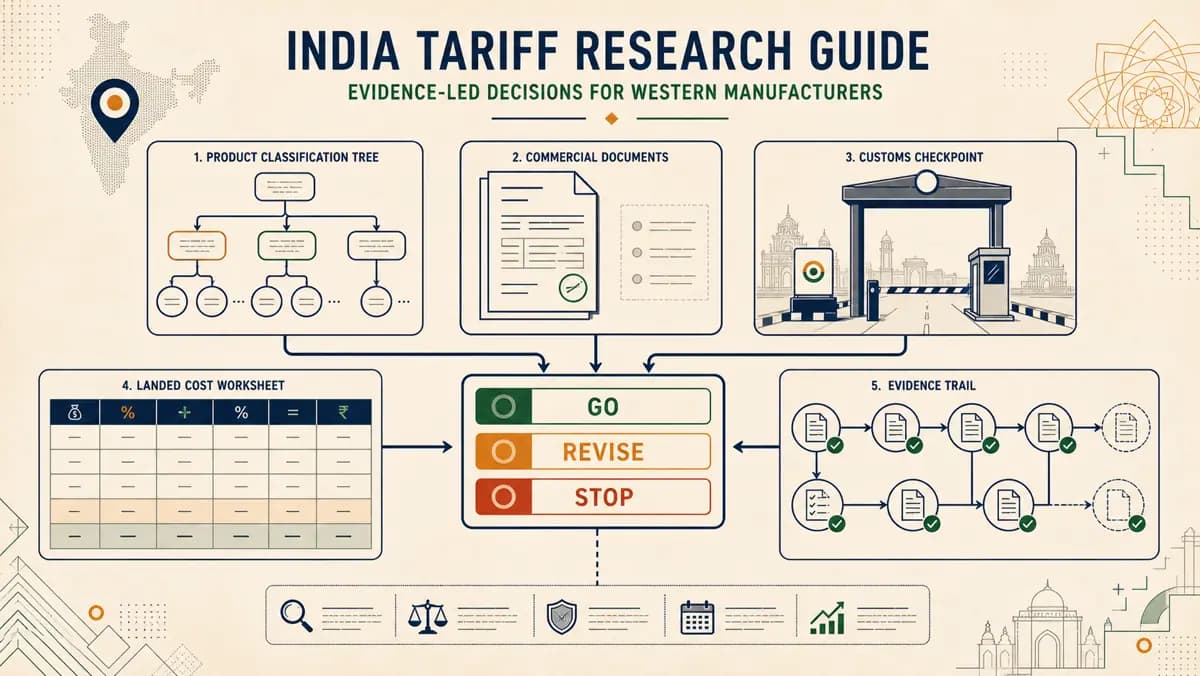
India Tariffs: A Manufacturer's Line-Level Check
Separate India tariff headlines from the line-level import evidence needed before quoting, sourcing or entering the market.
Manufacturing in India vs Mexico: Buyer Guide
A sourced India-versus-Mexico manufacturing sequence for Western buyers: market, trade treatment, regulation, suppliers, logistics, and site diligence.

India Manufacturing Products: A Buyer Shortlist Frame
A decision frame for Western SMEs shortlisting India manufacturing products using sector signals, export evidence and product-level compliance gates.